Cultivating a Future-fit Organization amid Rising Complexity
With so much change in the air, what’s the best way to cultivate organizations that succeed amid rising complexity?
This IS the question of the moment. As when we cultivate future-fit organizations, we allow our places of work to come alive and our people to thrive. We attract and retain high quality talent. We nurture cultures of trust and authenticity. We enable authenticity in our brand and value propositions. We bake-in agility and resilience across all aspects of the organization and its business ecosystem. We enable flourishing and learning amid adversity. We turn challenge into opportunity, and breakdowns into breakthroughs. We surf the edge of chaos with entrepreneurialism, creativity, ingenuity and novelty – the altogether human qualities that often get sidelines amid fear of change and a grasping for control and ego-power.
This is the question I asked myself as L&OD coach some fifteen years ago, and the inquiry is more pertinent now than ever – how to cultivate organizations that are life-affirming rather than life denying, and that unlock human potential, deepen authenticity, and stimulate the soul.
The short response/’answer’ to my on-going inquiry is: Future-fitness is predicated upon the authenticity and coherence of the organization’s inner-outer nature. As for the leader’s future-fitness, so too for the organization’s future-fitness. This necessitates the leader to see and treat the organization as a living-system, and working with its living dynamics, to cultivate future-fitness.
In this article I unpack what I mean by treating the organization as a living-system and how this ensures future-fitness, allowing the organization and its people to thrive amid rising complexity.

The Nature of The Living Organization
Many leaders now realize that there’s something desperately wrong about running their organizations like machines. With increasing levels of volatility, widespread employee disenfranchisement, customers’ trust in businesses at an all-time low, and civil society largely blaming business for the mess the world is in, to top it all off leaders themselves feel exhausted. The enormity of what lies ahead simply can’t be embraced with this exhausting machine-mentality and its incessant need for power, control, certainty and security.
More and more leaders are waking up to the need to up-stretch into a new way. A new way that cultivates cultural conditions that no longer dehumanize, drain and devitalize our working environments. Instead, enlivens the life-force of our organizations so that the working day actually enhances our humanity by challenging us to become more authentic, purposeful and fulfilled.
Across all ages and seniority in the workplace, there’s an exponential rise in the demand for meaning and purpose through work. Work that stretches and enriches us, while benefiting others and the wider world.
The developmental process of realizing our potential and becoming who we truly are involves pain, challenge, tension, struggle and journeying deep into our own fears.
The ego seeks strategies that keep us in the comfort-blanket of the status quo. It seeks ways to avoid hardship. In doing so, the ego’s fear of challenge stunts our growth.
The Fours Zones model illustrates the importance of overcoming our ego-fears and protection rackets in order to learn and grow. The four zones are: Comfort Zone, Fear Zone, Learning Zone, Growth Zone.
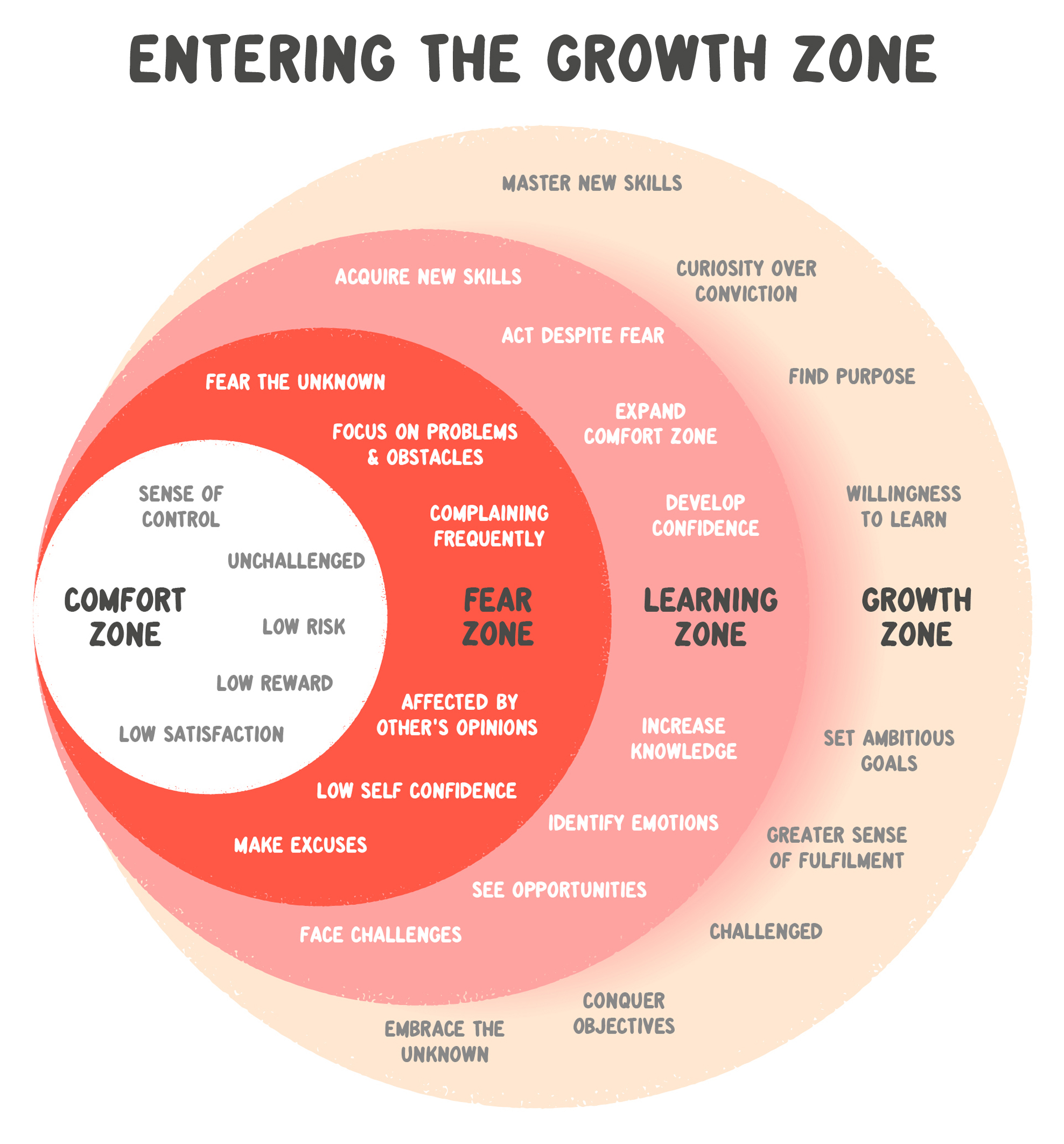
Each day is an opportunity to go through our own mini threshold-crossings of departing the safety of the Comfort Zone, enduring the anxiety of the Fear Zone and entering into the Learning and Growth Zones as we work through tensions and explore new experiences. Each time we go through these mini threshold-crossings, we can learn to become conscious of our own inner workings—what holds us back (our shadow aspects) and what impels us forth (our ambition, courage and soul-will). We can also learn to become conscious of others going through their own mini threshold-crossings and hold-space for them. Every day is the learning live-lab for realizing our potential and cultivating future-fitness.
A learning live-lab organizational culture that seeks future-fitness is one that creates conditions for everyone to be witnessing, experiencing and supporting their own and others’ navigation of the four zones. This is more developmental than what normal wellbeing-at-work or talent-management initiatives tend to support, and invites us to appreciate the psychodynamic intricacies of unlocking human potential right in the heart of the improvisational milieu of everyday interactions.
‘In organizations, real power and energy is generated through relationships. The patterns of relationships and the capacities to form them are more important than tasks, functions, roles, and positions.’ Margaret Wheatley, organization specialist
More and more leaders are waking up to the importance of cultivating the right value proposition not just for customers, but for employees. A value proposition that brings out the best in people, so people leave the work-day better for it, not exploited and burnt-out but challenged, empowered and enriched. Then, people don’t see the job as ‘just a job’ that only benefits their CV, bank account, status or lifestyle, like a trade-off for the enslavement the job brings. Instead, they realize that the job is an important part of their life-learning in helping them realize their potential, aiding them on their journey of becoming. This is what being a Regenerative Business means, creating better life-experiences, interactions, stakeholder relations, partnerships, products, services and value propositions that continuously cajole us through the four zones, and dare us to grow into what it really means to be human in this more-than-human world of ours by co-creating life-affirming futures. This involves seeing the living-organization as a learning (developmental) changing (emergent) and growing (evolutionary) system made up of complex responsive human relationships, with an inner-nature (culture) and outer-nature (stakeholder ecosystem, value propositions & brand).
This new way of working calls upon Living Systems Awareness—where leaders learn to work with (and thrive on) change, and where the organizational culture has adaptiveness baked-in. Rather than trying to control-manage tasks and teams, the Future-fit Leader senses the organization as an emergent energy system in a constant state of flux, with relational patterns, rhythms and flows that can be surfed with to encourage learning and enrichment for the individuals, teams and organization. Essentially, the living-organization is an exquisite live-lab of learning, and with Living Systems Awareness we simply start to see it for what it is, and so can better enable the live-lab’s future-fitness.
‘Get the beat…listen to the wisdom of systems.’ Donella Meadows, systems scientist
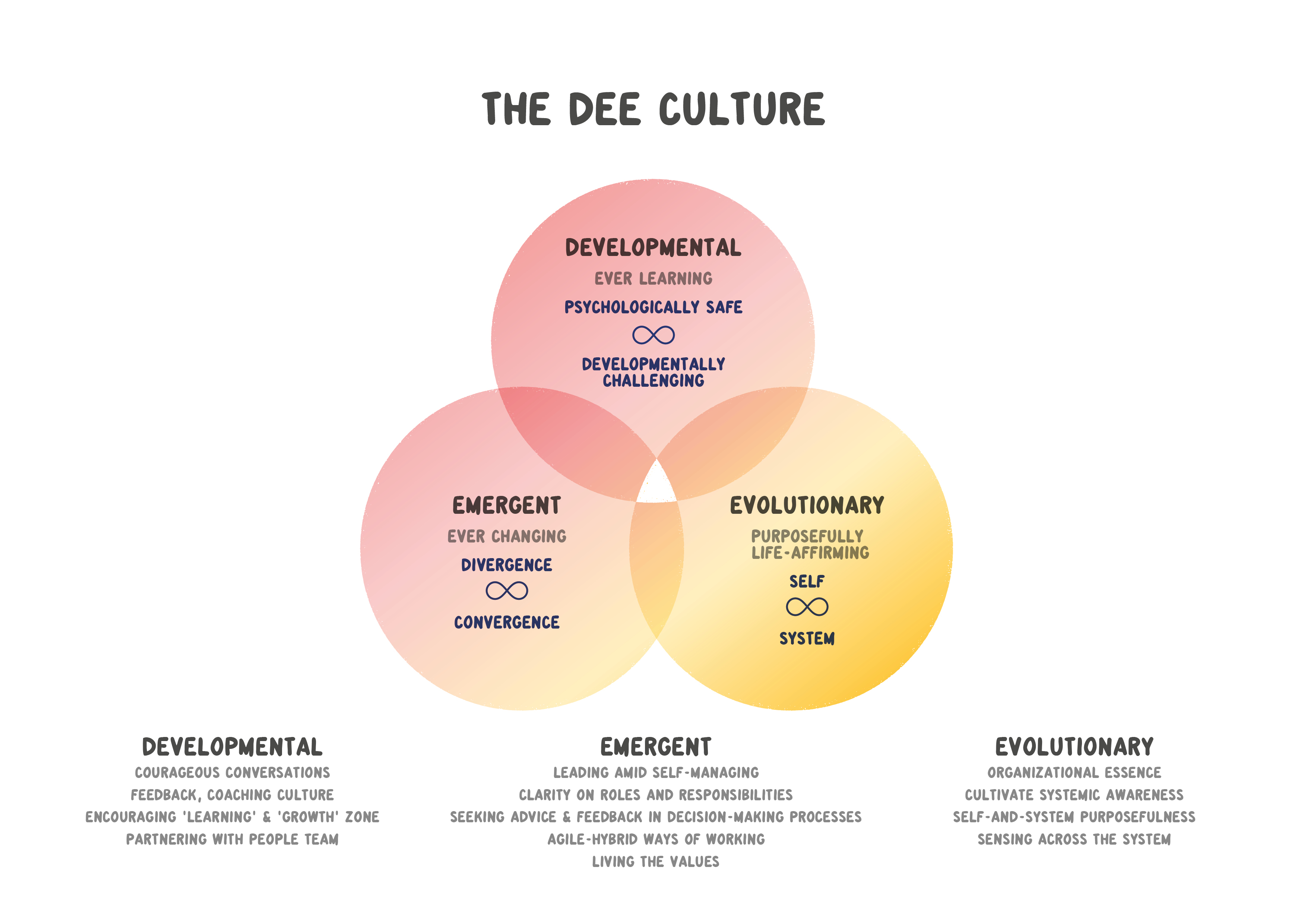
With this living-systems perspective, we can begin to see how the future-fitness of the living-organization depends on a culture that’s developmental, emergent and evolutionary—a DEE Culture: Developmental (ever-learning), Emergent (ever-changing), Evolutionary (purposefully life-affirming).
DEE Culture
Developmental (ever learning)
The living-organization is constantly creating, prototyping, adjusting, learning, growing, harvesting, releasing, renewing. And it’s important to emphasize that by ‘growth’ I don’t mean the maximization of scale, production, and profit. I mean psychological ‘inner-growth’ by becoming more integrated and authentic in our relationships—inter-personal, inter-team, inter-organization, inter-stakeholder—which contributes to the ‘outer-growth’ of the organization’s life-affirming value propositions, i.e. increased regenerative impact which enriches life’s flourishing. This calls for a greater understanding of authenticity and purposefulness for ourselves as leaders and throughout the culture. It’s what the organizational specialist Frederic Laloux refers to as ‘the journey toward wholeness’, and what Harvard professors Bob Kegan and Lisa Lahey call ‘deliberately developmental organizations’.
Developmental organizations encourage our becoming more authentic and purposeful. Everyone in the organization has the opportunity to thrive. The culture celebrates learning. This requires an L&OD approach that nurtures a psychologically safe and developmentally challenging environment for everyone to learn and grow in ways true to themselves. This creates a tension that as leaders we learn to hold: on the one-hand creating psychological safety (where people feel safe enough to open up and work through fears, and honestly reflect, share and learn) yet on the other hand stimulating developmental challenge (where people are stimulated to move through the comfort and fear zone into the learning and growth zone). If we overly focus on psychological safety, we may unwittingly encourage people to stay in the comfort zone and not take responsibility for working through their own stuff in order to grow. Alternatively, if we overly focus on challenging people to grow, we may unwittingly encourage people to become inauthentic, manage others’ impressions of themselves, no longer sharing what’s really going on for them in order to look good. With the right holding of the tension, we cultivate a learning environment that allows for plenty of space to reflect, discuss, and share constructive feedback in ways that encourage high-performing teams with a growth mindset. There are many tools and techniques to help this cultivation of a developmental culture. Leaders can lean on deep listening, dialogue, coaching conversations, sharing circles, and group sessions away from the normal working environment, such as nature immersions where people can openly reflect and share, in order to hone-in on what to learn and how best to grow.
Developmental characteristics: reflection-in-action, coaching conversations, feedback
Developmental tension: psychological safety AND developmentally challenging
Emergent (ever changing)
Emergence is propelled by tensions. Tensions create the energy that stimulates and cajoles us out of the status quo. These tensions arise between the space of divergence (diverse perspectives, self-management, distributed leadership) and convergence (alignment around purpose and values, clear roles, responsibilities), and in the sweet spot between divergence and convergence, emergence is created. Too much divergence, and chaos ensues. Too much convergence, and rigidity forms.
The living-organization’s developmental culture is indispensable because it’s a psychologically safe yet demanding environment that permits everyone to embrace complexity and grow through tensions. The culture creates the right space for tensions to be held, observed, and allowed to unfold in ways that provide the right learning environment for diverse people with different stress and anxiety tolerances, thus becoming emergent. However, reduce anxiety all together and you take out tensions, and the organization loses the ability to adapt and evolve. One might recall the importance of going through the Fear Zone in order to learn and grow.
Our everyday conversations provide creative crucibles for noticing and reflecting inward (self-awareness-in-action) and outward across the system (systemic-awareness-in-action). By practicing listening inwardly (within our own selves) and outwardly (with others) we presence. The more we invite this different attitude into conversations at work, the more emergence flows. Gaining awareness of how we deal with our own and others’ anxiety in working through tensions (psychologically safe yet demanding environments) is a continuous work-in-practice each day, in every moment, where mistakes are opportunities to reflect, learn, and grow.
Emergence characteristics: tension-transmutation, self-management, dialogue
Developmental tension: divergence (chaos) AND convergence (order)
Evolutionary (purposefully life-affirming)
A living-systems perspective helps us notice that the living-organization is adjusting and adapting both within itself and with its external environment through myriad diverse relationships on an ongoing basis. Everything is in unceasing participation with everything else. We can ease out of feeling the need to compete, assert, control, and survive. We let-go of the personal will’s ego-orientated, achiever drive and awaken a deeper purposefulness within ourselves and with life itself, whereupon we find ourselves on our own inner journey.
But what’s relevant here is that this individual purposefulness provides a less acquisitive and ego needy ‘What’s in it for me?’ and a more vulnerable, sensitive, and open way to work with the purposefulness of the living-organization. As our dharma (our inner truth) starts to resonate with the purpose of the living-organization, we ask new questions.
How can I best help the organization become a truer version of itself?
Psychological energy that was consumed by the need to relentlessly achieve to better one’s career, status, salary, and personal ambition is now flowing into sensing-responding to what genuinely serves the organization and its purpose beyond hitting the numbers.
What is the organization here to do and be?
The more we become attuned with the systemic dynamics within the organization, the more we sense what best serves the evolutionary potential of the organization and the more we acknowledge what is holding it back from serving its life-affirming purpose. We increase the capacity to listen to what wants to emerge across the inner-outer system and what might be holding it back or arresting its development. The whole organization may be readying itself to go through a Fear Zone in order to find a new way of becoming, a next-stage of flourishing. We listen to a diverse range of stakeholders—investors, customers, suppliers, ambassadors, thought-leaders, advocates, social media networkers, regulators, partners, even competitors—for insights on how the market is emerging from their perspective, providing useful insight on evolutionary pathways ahead.
Evolutionary characteristics: Sensing across the ecosystem, listening to the living-organization’s evolutionary purpose
Developmental tension: individual purposefulness AND organizational purposefulness
In Summary:
The Future-fit Leader senses the organization as an emergent energy system in a constant state of flux, with relational patterns, rhythms and flows.
The living-organization can be seen as an exquisite live-lab of learning. Where each day makes up the learning journey toward future-fitness.
Continual change demands that we regularly move through our own Comfort and Fear Zones.
Each of us is at the front-line of the organizational milieu, and our life stance contributes to systemic ripples and repercussions. (For an article on Life Stance – Dancing with Change – see https://thenatureofbusiness.org/2025/05/20/dancing-with-change-from-coping-to-thriving-amid-rising-complexity/
By embracing a living-systems approach to L&OD we create developmental, emergent, evolutionary (DEE) cultures that can thrive amid rising complexity.
We begin to engage with life and the living-organization in a subtly (yet profoundly) different way; one that seeks to work with and serve life rather than control and exploit it.
As discussed on this recent podcast with Founder & CEO of Strengths Unleashed, Andrew Dyckoff, the critical success factor facing and leaders and organizations these days is the capacity to lean-in to and embrace change, and cultivate cultures that thrive amid rising complexity.
This is what is unpacked in detail in my latest book Keys for Future Fit Leadership.
HOT OFF THE PRESS – latest book just out: Keys for Future-fit Leadership
‘Keys for Future-fit Leadership is nothing short of revolutionary—a compass for our times, providing the formula humanity urgently needs to navigate the seismic shifts we face.’ Marc Buckley, Founder ALOHAS Regenerative Foundation

‘Giles doesn’t just share his wisdom with the invigorating charm of a natural breeze—he embodies nature itself. He reminds us of our deep connection to the natural world, a bond we’ve neglected to our own detriment. Knowing Giles is like rediscovering the path back to nature.’ Lucy Cleland, Editorial Director, Country & Town House

Next Deep-dive Immersion on Future Fit leadership is 8th/9th September – see more details here: https://thenatureofbusiness.org/2025/04/15/keys-for-future-fit-leadership-8th-9th-sept-immersion/
‘The nature immersion with Giles exceeded all expectations. This is real space to develop strategies fit for the 21st century.’ – Stephen Passmore, CEO, Resilience Alliance
This two-day overnight deep-dive is for leaders and practitioners who wish to gain an embodied experience of Future-fit Leadership and also apply tools for activating Regenerative Leadership Consciousness in their own work and lives. The immersion will provide advanced techniques and frameworks for your own work as a leader and for practitioners/coaches working with clients/leaders and Future-fit L&OD (leadership & organizational development).
‘Feel I’ve been with a real master. What beautiful profound lessons’. – Simon Milton, CEO of Pulse Brands
For more details see: https://thenatureofbusiness.org/2025/04/15/keys-for-future-fit-leadership-8th-9th-sept-immersion/
‘Giles is a visionary and guide for anyone exploring the journey toward Future-fit/Regenerative Business. He’s been called a wise medicine man for our time and a magician of consciousness. When you are with Giles you get why these words are apt.’ Jannine Barron, Founder of The Growth Experience
To book for 8th/9th September Immersion or explore 121 Coaching with Giles contact him via his website https://gileshutchins.com/
To sign-up for free content, newsletters & whitepapers go to https://gileshutchins.com/newsletter-subscribe/
Video on Future-fit Leadership
Keys for Future-fit Leadership can be purchased directly (and shipped globally) from the ethical/sustainable publisher: https://www.wordzworth.com/sales/authorbooks?ISBN=9781783243532
 The Nature of Business