Future-fit L&OD: Vertical Development for Greater Agility, Authenticity and Adulthood
What a fascinating time to be a leader. The air is abundant with change, alive with so much potential for challenge, danger, tension, and opportunity, all amid a rising complexity of epic proportions.
‘A door like this has cracked open five or six times since we got up on our hind legs. It’s the best possible time to be alive, when almost everything you thought you knew is wrong.’ Valentine, Arcadia
Business, economic, social and ecological systems are experiencing unprecedented upheaval with wide ranging and far-reaching effects on the underpinning of our socioeconomic system. Interlocking crises are feeding-off each other. Institutions are eroding. Social trust is collapsing. More and more people are feeling disenfranchised, lacking the very creativity and purposefulness that might aid their ability to adapt, learn and grow amid such challenging times. Meanwhile, the knowledge economy is being radically disrupted by rapid technological advancements – AI and Quantum Computing just two notable advancements.
These pressures affect the demands placed on organizational culture, hybrid working, human capital and the labor market. The ‘new world of work’ just two-to-three years’ from now will be substantively different from today. Sure, we can spend time on foresight with various scenario models, but the future just a handful of years from now is wide open and utterly unpredictable.
What does this mean for Leadership & Organizational Development?
Organizations that learn to adapt to unceasing transformation will be tomorrow’s success stories, those that fail will be yesterday’s news.
‘Any organization designed for success in the 20th Century will be doomed to failure in the 21st Century.’ David Rose, Serial Entrepreneur
This is a pivotal moment for our organizations, let alone our civilization as a whole. It’s a time of immense breakdown-breakthrough, a metamorphic metacrisis where we either retrench and devolve or up-stretch and evolve. Adapt or die is the harsh reality.
To future-proof our organizational cultures amid such seismic systemic change, involves baking-in agility, creativity, curiosity, entrepreneurialism and ‘future-fitness’ across all levels of the organization, and its wider stakeholder ecosystem. This involves a root-and-branch change to how we embrace Leadership and Organizational Development (L&OD). Out with the old mechanistic ways of top-down change management pervaded by parent-child control-manage tendencies and fetishes for certainty, predictability and repetition. In with the new quantum-complexity sense-responding of adult-adult organization-as-living-system systemic approaches that embrace an always learning, always adapting, always evolving new-norm of unceasing transformation.
One thing is certain, this L&OD shift is predicated on a shift in leadership consciousness no less – a seeing with new eyes that affects our self-other-world relationality, our ways of being-and-knowing and our meaning-making.
As the well-regarded futurist John Naisbett put it, ‘The greatest breakthroughs of the 21st Century will not occur because of technology. They will occur because of an expanding concept of what it means to be human.’
There’s no viable way out of our present predicament other than to shift our worldview and associated leadership consciousness. Period.
Even if we limit our horizons to merely coping amid the exponentially rising complexity, a shift in leadership consciousness is necessary to survive the massiveness of what’s unfolding. Only then, if we dare shift our consciousness, will we realize that we no longer need limit ourselves to coping amid rising complexity, when thriving is well within reach.
This shift in leadership consciousness – Naisbett’s ‘expanding concept of what it means to be human’ – has a twofold effect 1) expanding the meaning-making of the organization’s leaders 2) cultivating the developmental conditions that stimulate horizontal and vertical development across the workforce and wider business ecosystem for increased agility, purpose, creativity and continual renewal. This is what ‘future-fitness’ entails – the capacity to not just cope and survive amid the rapidly evolving landscape ahead, but the inbuilt learning capacity to adapt, evolve and thrive by becoming more agile, authentic and adult.
Future-Fit Leadership & Organizational Development (L&OD)
When embodied into our daily consciousness, a future-fit way of living and leading curtails the rampant waste of human energy that is increasingly devoted to distraction, escapism, titillation, commercialization, dopamine hits, techno fixes, control fetishes, and an insidious colonization and corporatization of the self. All of which are portrayed as helping humanity while busily corrupting the harmonies of life on Earth and selling our souls downstream toward more anti-life carnage.
In place of cultivating the inner potentiality of our humanity, our dominant worldview conditions us to manufacture superficial outer appearances to fulfil material advancements that are achieved by climbing the slippery ladder of ‘success’. Lacking any real sense of connection to our true nature, our individual identity becomes little more than an ego-projection we validate externally by what people think of us. It doesn’t matter whether our in-crowd is obsessed with mainstream consumer fashion and celebrity culture or a trending counter-culture meme, too much attention is drawn into managing others’ impressions of ourselves. Pretense and artifice abound. Our Western (and now near-global) worldview of Mechanistic Materialism (MM) is destroying life ‘out there’ at the same time it’s destroying life ‘in here’.
Yet, these challenging times offer the opportunity for us to move beyond the current limitations of this MM worldview into a deeper one that encompasses a more connected way of viewing ourselves, our organizations, and the wider world we live and work in. This emerging worldview is based on contemporary findings in psychology, sociology, ecology, systems change, organizational development, consciousness studies, neurobiology, anthropology, as well as drawing from ancient wisdom traditions found the world over. This worldview of Quantum Complexity (QC) perceives the self-as-participatory and organization-as-living-system. It reorientates our self-other-world relationality from separateness to interconnectedness, and so starts to perceive the organization as immersed within the wider interconnectedness of life on Earth. This shifts our way of being-and-knowing, our psychological development, our meaning-making and our capacity to embrace change.

Future-fit Leadership depends on a shift:
From
Machine-mentality – a reductive, linear, cause-effect, control-orientated, rational-analytic awareness that seeks to manage and control change.
To
Living Systems Awareness – a relational, emergent, flowing, intuitive, empathic, embodied awareness that learns to flow with change. This awareness helps unlock our creative potential, deepen our psychology, enhance our physiology, expand our meaning-making, and allow us to work the way nature works.
This shift in awareness goes hand-in-hand with a shift in worldview from Mechanistic Materialism (MM) to Quantum Complexity (QC).
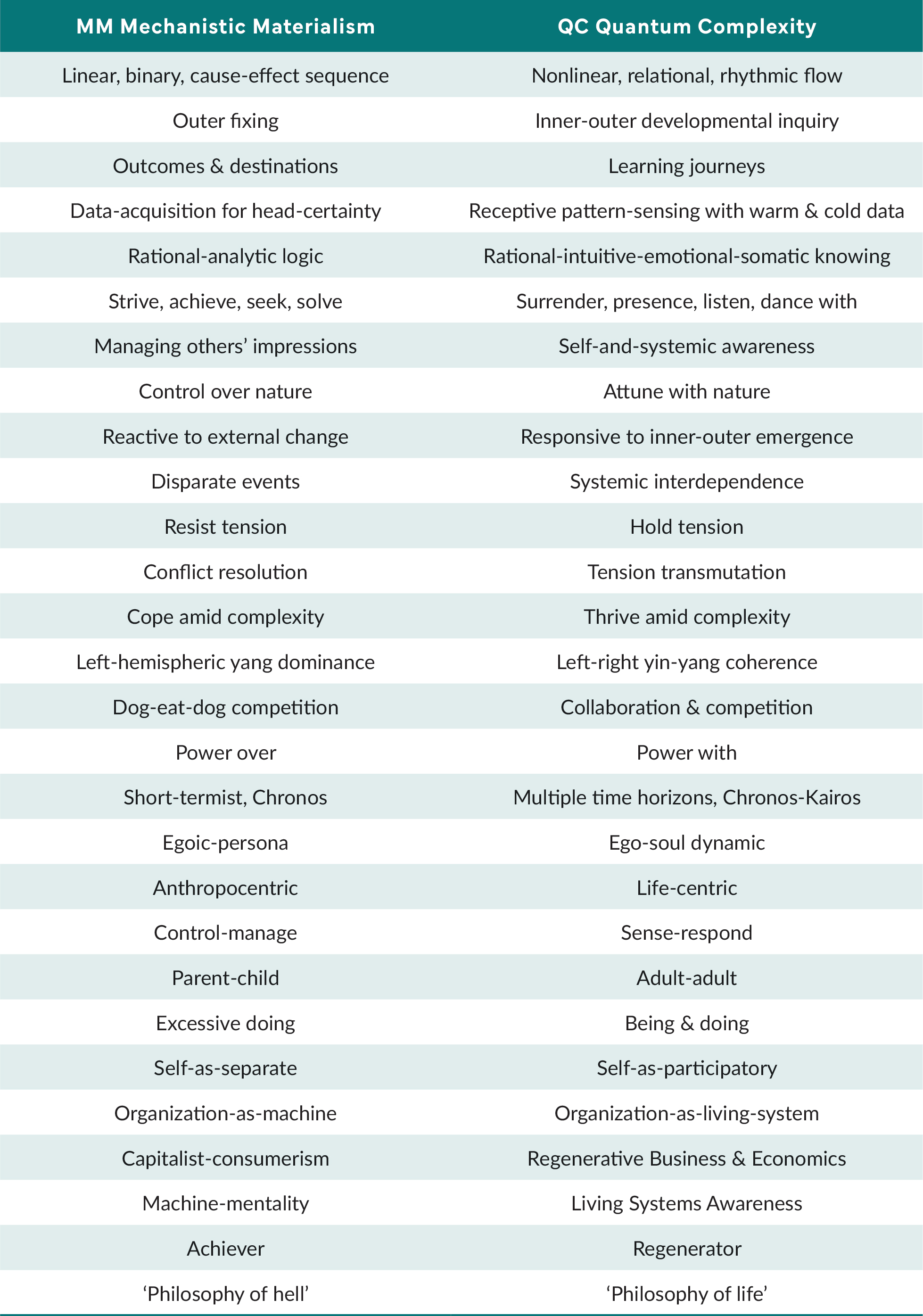
Why is this Quantum Complexity worldview important for Future-fit L&OD?
Durable, sensitive connection to our own deeper natures, and the natures of our organizations, will be the critical success factor that separates leaders who struggle to cope with rising complexity from those who thrive. To thrive, you’ll need to embark on a journey that expands your meaning-making.
We expand our meaning-making and connect to our true nature to gain increased resilience and productivity while becoming more purposeful, centered, and authentic. Sure, we still incur struggles, but we will make meaning out of the challenges in a different way. Our life stance – the way we show-up, lean-in to, and experience life – will subtly shift. So too our sense of place and purpose, and our receptivity to change. No longer control-managing against change, we will be sense-responding with change. It’s time for humanity’s upgrade—enhanced creativity, embodied empathy, increased resilience, and improved agility for future-fitness.
Future-fit L&OD involves vertical development – a shift in ego-stage development – a shift in awareness in terms of how we perceive our life experiences, relate with others and the world, respond to change, and make meaning out of our challenges. In adult developmental psychology, this process or journey necessitates ‘vertical development’ or ‘ego development’, which we’ll now summarise.
Adult Developmental Psychology & Vertical Development
Vertical development draws on adult psychology and leadership development research into how people’s ego-stage development (level of consciousness) influences what they notice and become aware of, and therefore, what they pay attention to, prioritize and act on. This research shows that a leader’s effectiveness to lead systemic change amid rising complexity enhances as one moves up a stage in meaning-making, i.e. vertical development expanding our capacity to become a Future-fit Leader.
Whereas ‘horizontal development’ informs what to know by acquiring new skills and capabilities within the same stage of meaning-making, ‘vertical development’ transforms how we know by up-stretching us into a new stage of meaning-making. An individual’s vertical development stage (level of consciousness) significantly affects how they function in work and life, not just the tools and skills they have but the way they embrace complexity and guide the up-stretch of their organization toward future-fitness.
Let’s use the metaphor of filling-up a cup, as indicative of horizontal development. We pour into the cup more skills and content through courses and training. Nothing wrong with this, as it equips us. Yet, if the cup is shaped by MM, then our learning and development will be limited by the constraints of machine-mentality – the size of the cup. Finding a bigger cup is indicative of vertical development. We significantly expand the amount of knowledge and embodied wisdom we can hold and work with through an expanded worldview. MM’s narrowed reductive cup becomes a far larger QC vessel, and we call upon far more wisdom for navigating the metacrisis.
The last few decades have witnessed increasing research corroborating what adult developmental psychologists found throughout the 20th century, that the psychology of our adulthood moves through spiralling ego-stages that affect how we lead and operate, and also how we structure our organizations, institutions and social systems.
The pioneering adult developmental psychologist Clare Graves notes that adults live in an ‘open system of needs, values and aspirations, but often settle into what appears to be a closed system.’ We have a habit of settling into a relative Comfort Zone of habits and conditioned norms that, after a while, arrest our development, constraining our ability to up-stretch. Our task is to cajole ourselves out of the Comfort Zone, endure the Fear Zone, in order to embrace the Learning and Growth Zones.
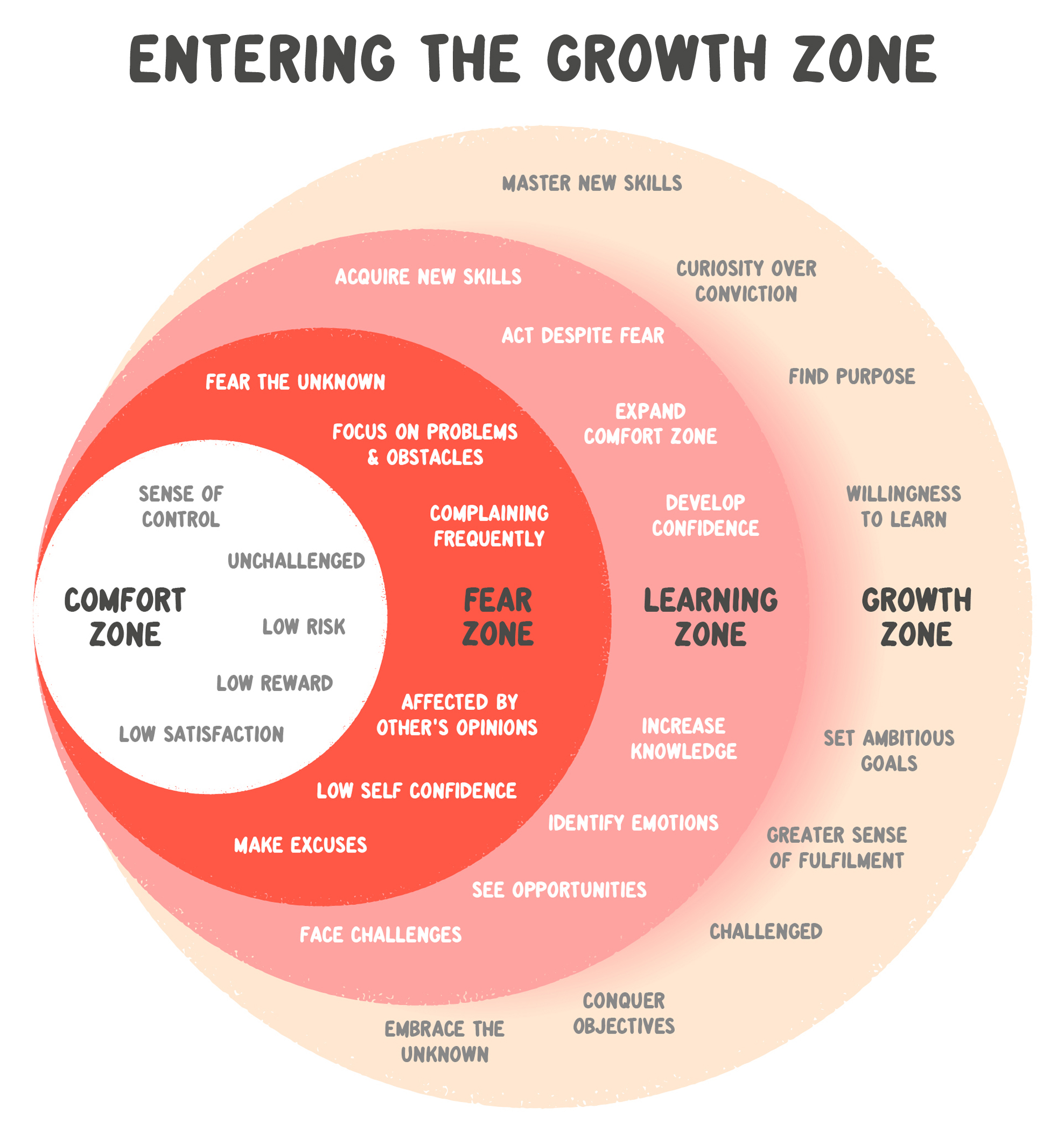
With courage, challenge and perseverance, we become more versed in undergoing frequent moves out of the Comfort Zone into the Learning and Growth Zones. We develop a growth mindset along with increasing self-awareness. In deepening our self-awareness we ready ourselves to exit out of one ego-stage and enter into a more expanded state of meaning-making. The organization’s culture can help catalyse and support a move through increasing levels of ego-stage development, and so aid future-fitness. When an organizational culture and its leadership recognizes and embraces this vertical development, then the organization may be referred to as ‘developmental’, or in the words of Harvard adult developmental psychologists Robert Keagan and Lisa Lahey, a deliberately developmental organization.
I have spent many years studying numerous adult developmental approaches applied to leadership development models, and have found there to be seven main stages of leadership consciousness relevant for Future-fit L&OD.
This model – Seven Stages of Leadership Development – has been corroborated by specialists in their field and also by my own empirical evidence in coaching hundreds of leaders, their teams and wider organizations through vertical development shifts. This model draws widely from a number of well-researched psychological development models including but not limited to the work of Susan Cook-Greuter, Jane Lovenger, Ken Wilber, Barrett Brown, David Rooke, Bill Torbert, Robert Keagan, Lisa Lahey, Don Beck, Chris Cowan, Christopher Cooke, Clare Graves, Frederic Laloux, Donah Zohar, Chis Lazslo, Abraham Maslow, Carol Sanford, Robert Moore, James Hollis, Bill Plotkin, Carl Jung, Richard Barrett, Margaret Wheatley, Antoinette Braks, Richard Boyatzis, Bill Joiner, Stephen Josephs, and more.

Exiting one stage and moving into another involves a substantive leap in our meaning-making. The leap involves an uncomfortable yet emancipating death-rebirth process: letting-go of old ways, integrating shadow aspects of our deeper nature, and embracing new ways of seeing ourselves, each other and the world. Our self-other-world dynamic shifts with each new stage.
Drawing upon the research of Professors Robert Keagan and Lisa Lahey at Havard University, we find three main phases within the seven stages that are worth highlight here.
Three main adult developmental phases:
1) Socialized Mind – Focused on the ideas, norms and beliefs of the people and systems around us (i.e. family, organizational culture, society, etc.).Corresponds to Amber-Diplomat and early Orange-Expert. Change-averse, feedback resistant, comfort zone, social-centric.
At this stage we are change-averse, keen to fit-in to team dynamics and organizational norms, and feel a sense of family/tribe within the organizational culture. We struggle with tension and are uncomfortable with fast-moving change, need consistency and clarity on what to do and how to do it. We take too much personal responsibility for how other people experience us. As a result, we spend too much energy managing others’ impressions of ourselves and avoiding hurting other people’s’ feelings.
We look for external validation to derive our sense of self, with our identity is largely shaped by a need to fit-in. In Maslow’s Hierarchy of Needs this correlates with ‘social need’, a desire to feel included, gaining a sense of belonging from the tribe or peer-group. At this stage, there is a need for order, control, clear processes and parent-child top-down decision-making protocols.
Feedback can be seen as something to defend against rather than embrace as learning, and is preferably structured into a formalized timebound process, like the end of year review. A leader at this stage, is largely parent-child and control-manage, hence more a ‘manager’ than a ‘leader’, and in need of clear procedures and guardrails for managing others within.
2) Self-Authoring Mind – Increased emotional intelligence means we take responsibility for our own inner states and emotions, and realize we are always change and learning, while developing a sense of authority and voice. Corresponds to Orange-Expert/Orange-Achiever and early Green-Pluralist. Embrace yet control change, open to feedback, outer-performance focused, human-centric.
This is a significant up-stretch beyond the Socialized Mind whereupon we quest for our own values, beliefs and sense of purpose. Our identity breaks-out of socialized conditioning and we become more self-aware of our own uniqueness. Our change-aversion eases significantly as we realize the opportunities for growth and learning that come with change. In Maslow’s Hierarchy of Needs this correlates with ‘self-esteem’, a desire to feel respected by others, while also having respect for other’s differences.
This is a transcend-and-include move-on from Socialized Mind in that we still feel a desire to be part of an organizational culture, team or tribe, yet in a way that resonates more deeply with our own individuating sense of purpose and values. There is a tendency for labelling identities in ways that form identity/personality types limited to ‘horizontal development’ (ego persona, outer presentation, extrovertive-introvertive mannerisms) rather than ‘vertical development’ (ego-soul integration).
Our self-awareness is significantly greater than when at the earlier Socialized Mind. This self-awareness and sense of self integrity allows us to navigate through conflicting external expectations. Though, we are only just (if at all) beginning to tap in to our deeper more intimate soul-nature and shadow-side (personal unconscious and collective unconscious aspects that influence us).
Feedback is seen as a useful part of one’s ability to learn, achieve and perform. At this stage, there is a need for enhancing one’s expertise, a desire to outwardly achieve, stand on one’s own two-feet, take control of our schedule and time, and take self-responsibility for our own growth and development. Most leaders and in organizations today reside in this Self-Authoring Mind phase, and with it comes an increasing desire for freedom and creativity as well as order and structure. Entrepreneurialism and agility are on the increase.
Our outlook and belief system is likely to still be ensnared in the dominant MM worldview of the day with its mechanistic-humanism of self-as-separate and organization-as-machine. One’s sense of self is still largely contained within the ego-persona, and one views nature as ‘out there’ with humanity separate from nature. This underlying sense of separateness breeds a backdrop of anxiety, judgement and fear amid fast-paced change. While we still try to control change, with a reactive or assertive life-stance, we move through the uncomfortableness and confusion of change more quickly than we did at the Socialized Mind. We realize that the Fear Zone leads to the Learning & Growth Zones. We learn to become comfortable with the uncomfortableness of change, noticing our own habits and needs for certainty and control. It’s in this Self-Authoring Mind that we may start to engage in deeper self-reflection, perhaps even shadow work (see later section for more on shadow work).
While there’s strong hints of parent-child and control-manage in its leadership dynamic, explorations into agile ways of working, high-performing teams, growth-mindset, adult-adult developmental culture and self-managing ways of working spark interest, while often framed within the desire for increasing performance, reducing inefficient bureaucracy, and increasing entrepreneurialism.
3) Self-Transforming Mind – We are no longer held prisoner by our ego-identity. Instead, we explore our deeper soulfulness and sense the underlying interconnectedness of life. Corresponds to later stage Green-Pluralist, Teal-Strategist and early Turquoise-Alchemist. Dancing with change, holding tensions and polarities, systemic feedback, trust in life, life-centric.
For most adults in contemporary MM society, the move into Self-Authoring Mind is all we achieve this lifetime. But for a small yet growing percentage of adults a metamorphic mid-life crisis may occur that invokes a profound psychological reorientation in us. Occurring at any age in our lives from late thirties to late sixties we undergo a multi-year death-rebirth journey that signifies a radical shift in meaning-making out of Self-Authoring into Self-Transforming. In doing so, we possess a deeper sense of self, which enables us to be comfortable with conflicting ideologies and change-agendas, and able to hold tensions and paradox while working systemically amid complex systems change. We may still experience uncomfortableness even confusion amid fast-paced change, but we find our centre more readily and so are more resilient, adaptive and evolutionary. Change is no longer seen as something to manage – ‘change management’ is an anathema for the Self-Transforming Mind. Rather change is seen as the very fabric of life; it’s what brings forth creative advance. Organizational acupuncture replaces ‘change management’ – continual pin-prick interventions that cultivate a healthy living-organization for thriving amid rising complexity.
In Maslow’s Hierarchy of Needs this correlates with ‘self-actualizing’, a desire for creative self-fulfilment in realizing one’s deepest potential. Here we thrive amid flow, emergence and tension, and facilitate developmental learning environments across the inner-and-outer nature of the organization (its culture and its stakeholder ecosystem). Feedback is a continual reciprocating relationality of sensing across the system while noticing oneself: self-and-systemic awareness. We have a regular discipline of shadow work, presencing and deep listening, that informs our right-relation of self-other-world.
Our ways of being-and-knowing are no longer dominated by the rational-analytic linearity of MM, and we welcome-in intuition, somatic sensations, creative imagination and Nature’s Wisdom. This level of consciousness creates future-fitness across diverse value propositions and diverse communities, where the mission is aligned toward improving the vitality of its wider ecosystem (life-affirming).
This is the shift into what depth psychologists call Second Adulthood or True Adult whereupon our ego-soul dynamic reorientates from ego-as-dominant to ego-as-servant to soul. It’s this shift that I refer to in my work on Regenerative Leadership Consciousness as the Achiever to Regenerator U-Journey that involves a multi-year death-rebirth metamorphosis. This unfolds greater depth of inner-outer nature attunement, and a realization of the interconnectedness of life within which the living-organization is entangled.

Our psychological center of gravity is now grounded in our deeper soul-scape. This soul-centric way of being-and-knowing in the world is also life-centric. This is a significant move on from the human-centric (anthropocentric) MM mechanistic-humanist worldview into an animistic-humanist QC worldview with self-as-participatory and organization-as-living-system. This shift in our self-other-world dynamic bringing us into right relation with the more-than-human-world as we learn to attune with how nature works. Ancient wisdom traditions and cutting-edge findings on consciousness studies all ring true in us as we see the glaring fallacies of post-modernity. The metacrisis becomes the catalyst for this new movement in the symphony of human identity, evidenced by more and more adults embarking on this significant transition in meaning-making. We become the ones we’ve been waiting for.
‘The worlds problems stem from the gap between the way people think and how nature works.’ Gregory Bateson, systems scientist
If you are involved in holding-space for an organizational culture – whether as CxO, NED, Head of People, or L&OD coach/consultant – it’s likely that the organization will have a significant portion of its staff residing in the earlier phases of Socialized Mind and Self-Authoring Mind. However, seeing as you’re reading this paper, there’s also a likelihood of an emerging Self-Transforming Mind, a ‘latent potential’ in the organization(s) you serve. How conscious the leadership team and overall organizational culture is to awakening and catalysing this latent potential is vital for its overall success during the volatile times ahead.
It’s paradoxical that while the shift from Self-Authoring Achiever into the Self-Transforming Regenerator involves a deep sense of interconnectedness, the rise of AI, Quantum Computing and digitization might just be one of main driving factors that informs the ‘business case for vertical development’. As anything that relies solely on transactional and analytic knowledge will soon be undertaken more efficiently and effectively by digital means. To avoid AI-cannibalization one has to move into propositional knowledge and wisdom as a regular way of being-and-knowing across organizational leadership and top talent. Hence, a focus on agility, authenticity and true adulthood becomes the smart response to the increasingly digitized, hyper-volatile, post-modernist marketplace in metacrisis.
While only a small percentage of leaders transition into Self-Transforming Green/Teal/Turquoise, there’s more and more astute impact investors, customers, suppliers, partners, top talent, entrepreneurs and future leaders inquiring into the developmental nature of an organization’s culture. The smart money knows that if the organization is focused on how best to thrive rather than merely cope during the volatile years ahead, then it will avoid a race-to-the-bottom and the inevitable cannibalization by AI. Put simply, if the organization is unable to stimulate vertical development within its culture its days are numbered.
Yet, a developmental culture needs to be able to hold-space for the developmental needs of all levels at the same time. No matter how much emerging Self-Transforming Mind there is in the organization, the challenge is to cultivate learning conditions that hold-space for all developmental needs. Developmental diversity is a good thing and provides for a rich feedback-learning environment for all involved. One powerful way I have found that works wonders for holding-space for diverse developmental needs is Leadership Immersions in nature-settings, away from digital devices with open minds and hearts, to sense deeper beyond ego-identities and socialized personas.
To Summarize
Our leaders, teams and organizations find themselves amid a tumultuous level of rising complexity and change upon change. To attempt to cope with this level of increasing complexity with the same level of consciousness that created the widespread problems and fragility in the first place is, at best, unwise. Yet all-too-often this is exactly what we are unwittingly doing when applying leadership and organizational development frames and interventions that reside solely at the horizontal rather than also vertical i.e. consciously aware of ego-stage development aka ‘developmental’.
It’s all fine and dandy to host a training course, workshop or off-site on learning to embrace change, give and receive feedback effectively, or foster better team relationality and communication, which may provide useful skills, perhaps even give a temporary lift in moral, save some staff from handing in their notice or taking sickies less often. But leadership development fails to cultivate the future-fitness of the individual, team and organization in a more durable way if it overlooks vertical development, self-awareness, shadow-work and developmental learning.
I have the real pleasure of coaching Directors of People & Culture from diverse organizations around the world, and it still surprises me how few people in the HR/L&OD world feel confident in cultivating developmental cultures. Sure, it’s easier to focus on horizontal development, skills needs mapping and training courses, but that fails to future-proof the organization. Gone are the days of ‘change management’. These are the days to Dance with Change. The good news is, in learning to dance with change, we’re learning to dance more deeply with our own selves and with life itself. The metacrisis is the very breakdown-breakthrough learning-edge that’s the making of our humanity, if we dare to engage in death and rebirth that is. Are you ready?
For more on dancing with change, you may enjoy this podcast dedicated specifically to the topic:
https://open.spotify.com/episode/77pG7Cm2D3izOeWDvnHS7T OR https://shows.acast.com/leading-by-nature/episodes/dancing-with-change-a-new-life-stance-for-future-fit-leaders OR https://gileshutchins.com/podcast/
Also, my latest book Keys for Future-fit Leadership is designed for the leader and practitioner wishing to facilitate developmental cultures that thrive amid rising complexity.
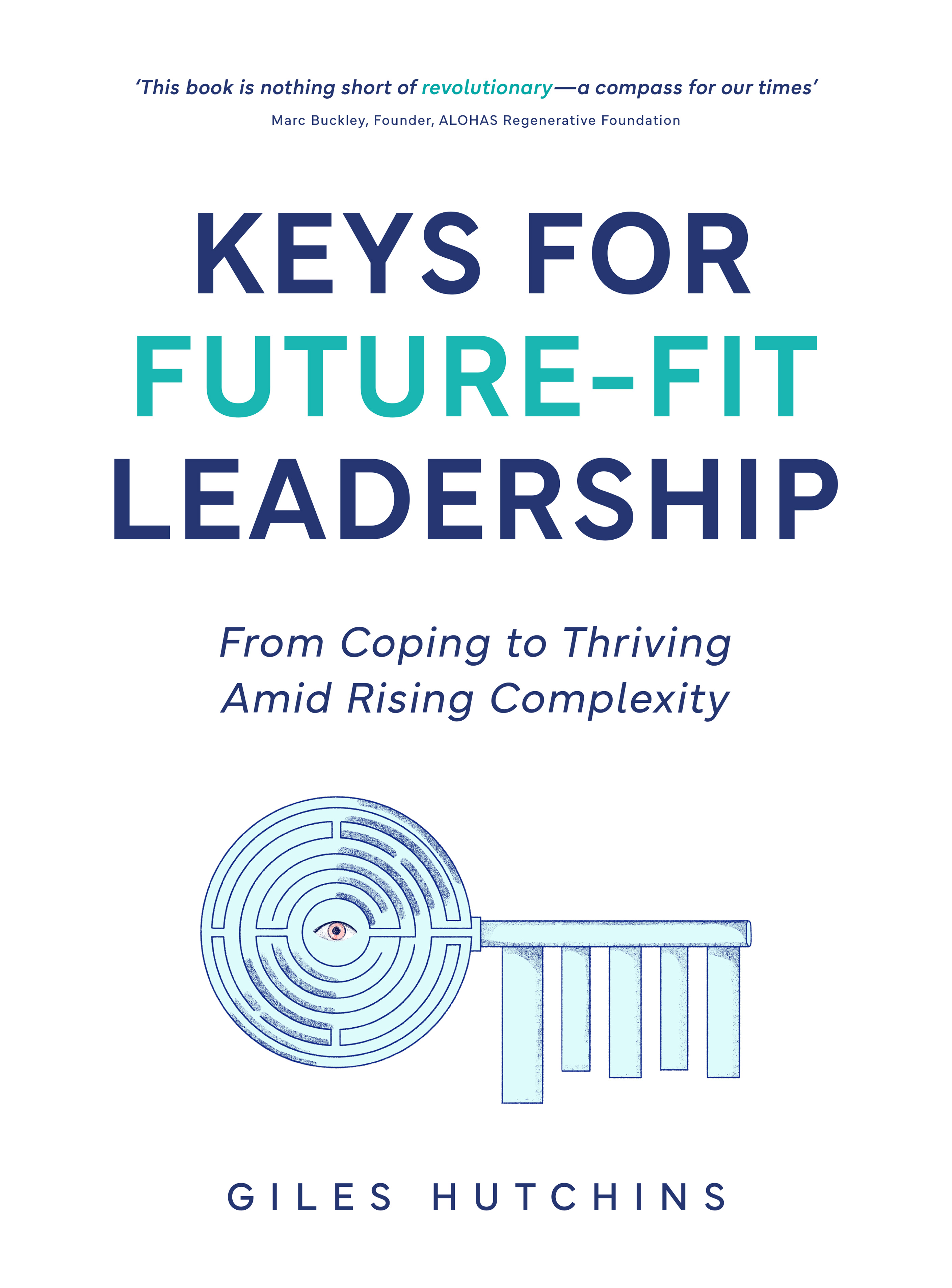
‘Keys for Future-fit Leadership is nothing short of revolutionary—a compass for our times, providing the formula humanity urgently needs to navigate the seismic shifts we face.’ Marc Buckley, Founder ALOHAS Regenerative Foundation
‘Giles’ book – Keys for Future-fit Leadership – is impressively comprehensive and very generous. With a large amount of frameworks, tools, and visuals, it acts as both a reference work and a source of daily inspiration. It can be read cover to cover or dipped into as needed. The book also features a selection of guest chapters with real-world stories from leaders applying these ideas in diverse industries and contexts. This brings his insights to life, grounding them in lived experience. It’s not just about insight — it’s about practice. In short, Keys for Future-Fit Leadership is not just another leadership book. It’s a distillation of 30 years of inquiry, practice, and deep listening to what our times require. It invites us to move beyond surviving the future — and instead, to co-create it through presence, wisdom, and alignment. I highly recommend it for leaders, coaches, and practitioners working at the edge of business, human development, and systemic change.’ – Elisabet Lagerstedt, Founder & Director, Future Navigators
You can purchase the book from the ethical publisher here, or through main channels: https://www.wordzworth.com/sales/authorbooks?ISBN=9781783243532
For more on 121 journeys or immersions with Giles, visit https://gileshutchins.com/coaching/
 The Nature of Business