Every leader, organisation and society around the world has been affected by the COVID-crisis. We have all been affected by the same challenge at the same time. It’s remarkable. Yet, we have each had very personal experiences and varied losses.
Routines and ways of living and working have been upset. Many have been altered permanently, with no possibility of going back to ‘normal’. We might question what is ‘normal’ anyway. Suggesting a ‘new normal’ may provide some solace that things will settle into a new rhythm, and yet the astute and prescient know this is illusory. Perhaps one might speak of a ‘new natural’ where we adapt to a way of living and leading that can embrace shocks, upsets, volatility and instability as part of the natural context of life as ever-changing, intimately interconnected and ultimately uncontrollable.
One thing is certain, we can expect more systemic shocks to come. Regardless of whether we get a new vaccine on-stream quickly, we face a long list of systemic risks of which harmful viruses are but one.

Today’s world is characterised by multi-dimensional stress – economic stress, personal and social stress, ecological and climate stress.
Economic stress – Economies the world-over are reeling. Sovereign, corporate and consumer debt is mushrooming to unprecedented levels. Global supply chains have shown how fragile they are to supply shocks. Businesses are folding, redundancies are rising, with the inevitable repercussions this creates. The system is being stressed to near breaking point.
Social and personal stress – Mental and stress-related illnesses across developed (and many developing) economies were rising exponentially before COVID hit, and things have not magically improved. People have suffered all sorts of psychological stresses and strains amid lock-down. That said, people are in no rush to get back to how things were before lock-down. A recent YouGov poll in Great Britain showed only 9% of people want to go back to ‘normal’. A sense of loneliness in urban environments was already a rising theme before COVID, and interestingly – amid social distancing – some people have felt more connected to others due to a common feeling of us all being in this together. Rather than caught up in the usual must-get-on rush from one task to the next with little time to pause and listen to those around us, many have found moments when they can actually be present to what is going on within their neighbourhood and family. Yet others have found family and community relationships strained at times. Before COVID, 1 in 4 people in England were on addictive prescribed drugs, a trend that is rising. Things are far from healthy. No wonder we don’t want to go back to ‘normal’ when ‘normal’ is far from sane. New ways of working are now emerging due to COVID, as is the meshing of work and family life, which brings a range of risks and opportunities. I’m a coach with a diverse client base of varying age, culture, gender, privilege, seniority and background. During lock-down, it has been interesting to observe the emotional roller-coaster many people have been experiencing. Post lock-down may be no less challenging. Many people are asking deeper questions about to whom or what is their work actually serving? More and more people are starting to question why our economic system is creating futures no one wants. Why is economic growth undermining the wellbeing of ourselves and our social systems? Why would we wish to go back to ‘normal’ when ‘normal’ is damaging ourselves, societies and ecologies?
Ecological stress – We all know the Climate Crisis has not gone away due to COVID, nor have any of the other systemic challenges we face, such as the impending water crisis, plastics in our oceans, global biodiversity loss, widespread deforestation, desertification, soil erosion, peak phosphorus, etc. Put simply, we are plundering our planet at an alarming rate. Yes, general awareness of this ecological ruin is increasing. Yet, in the desire to kick-start our own enterprises and the wider economy post lock-down, will this plundering ramp-up again? Many of us have found ourselves noticing nature more as a result of lock-down. We notice the reduced air and noise pollution. We see pictures of polluted water-ways running clear again, like the seas around Venice or the River Ganges where porpoises have been seen for the first time in years. Many are questioning whether all the rushing around, consuming, manufacturing, travelling and working we do is actually serving us. How we emerge post-COVID in terms of economic stimulus packages that trigger sustainable investment and innovation while reducing ecological and social degradation will be telling. Can we learn and evolve from this situation or will the desire to ‘get the wheels back on the road’ out-trump are innate love of life and our children’s future? Some scientists have made the indirect link between ecological degradation, ecosystem fragility and the rise of pandemics such as COVID. Might we see that how we consume, work and behave interrelates with the health of our planet?
This triage of economic, ecological and social/human stress creates a trialectic context that has the potential to invoke a meaningful and lasting step-change in our evolution at individual, organisational and societal levels.
In short, the situation we are in, can cajole us out of the dominant status quo, or freeze us caught-in-the-headlights of our own global car crash. The stress can trigger our evolution or it can suck us into stuckness. The choice is ours. This is a supreme moment. It’s far more than a ‘war on the virus’ or a ‘war on carbon’. It’s so much more. It’s about our humanity, about who we truly are, and our capacity to evolve as Homo sapiens – wise beings. Can we live up to this name of ‘wise beings’? The window we are now in will define us.

Can we learn, evolve even, from this pandemic?
Interesting times indeed!
So much is uncontrollable, so much is unpredictable, so much is new and unforeseen.
For sure, what these times do call for is real leadership – leadership of the conscious and authentic variety.
In times of crisis, sometimes it can become clearer what we really need: Leadership that actually works with the currents of life, rather than swimming against the stream and stressing ourselves and our social and ecological systems; a way of leading that enables us to create futures that we all want, futures that enhance society rather than undermine it.
The Covid-19 pandemic will go down in history, for many reasons. One fact that will not go unnoticed is how the prevalent-normality of rushing around has had to pause. A significant reduction in global and local travel, along with a reduction in activities of all sorts beyond the essential, has had a dramatic effect on pollution levels and the stress we place on our ecological systems day-in-day-out. One person recently said to me, ‘it’s as if the world has been able to breathe deep and rest easy for a moment.’ Our frantic socio-economic model of rampant consumerism gone-mad has slowed. And this has been beneficial for the fabric of life we all depend on. Rivers have run clear again in polluted areas, and ecological systems start to repair themselves from over-use.
Yet this may only be a short-lived pause. And of course this pause has created untold economic upset, and ruined many businesses and livelihoods. Supply chains have been affected across every industry.
Debt levels have risen. The already fragile economic ‘recovery’ (if there ever really was one since the Global Financial Crisis of 2008) has ended. The financial implications of this pause will be felt for a long while post-pandemic.
This pause has ruptured our hedonic-economic model, yet the non-human world seems to breathe a sigh of relief.
We might question how much of our activity actually contributes to enhancing our lives beyond superficial materialism and short-lived pleasure seeking.
Might the wit of our humanity be able to see the pearl of wisdom this pandemic is revealing?
Each challenge in life reveals wisdom, just as each virus aids evolution in the adaptation it triggers. Can we evolve from this virus?
Or will our incessant urge to revert to the norm mean we fail to learn in any lasting way?
My co-author Laura Storm lives in Denmark which went into lock-down ahead of the UK and is now preparing to come out the other side, with schools preparing for children to go back this week.
Does that mean things start to return to ‘normal’? What actually is ‘normal’? Surely what we called ‘normal’ before this pandemic can now be seen in a different light if we so choose. We might be able to gain perspective on how we lead our lives, how we lead at work, how we wish to be in the world, individually, as families and friends, as a human-collective. We might question how our work is actually enhancing our lives and also the lives of others, and the wider fabric of life on Earth. What actually are we working for? What makes us truly happy? What gives us a sense of meaning and fulfillment in our lives?
This time – amid pandemic and beyond pandemic – is a time of transformation.
This is why Laura and I offer the first chapter of our book on Regenerative Leadership for free download here so any one who feels interested can start to activate next-stage leadership today.

Regenerative Leadership is a way of living and leading that puts life at the centre of things. A way of leading that creates the conditions conducive for life to flourish, for ourselves to become more whole, vibrant and purposeful, and for our organisations to come alive while all our stakeholders thrive. It is rooted in the Logic of Life, honed by 3.8 billion years of R&D, drawing upon advanced adult developmental psychology as well as leading-edge research on organisational and leadership development. Laura and I have research many different organisations, and worked with leaders across all parts of society who are blazing a new way. This is what Regenerative Leadership activates – futures that we all know in our hearts is achievable in the here-and-now if we so choose.
In this book Regenerative Leadership – the DNA of life-affirming organizations geared for the 21st century – Laura Storm and I combine pioneering frameworks, case studies, storytelling, tools & practices: Everything the leader needs to contribute to a future where organisations flourish, people come alive and ecosystems thrive again.

“It’s about time leaders wake-up to the realities of our world. It’s time they step-up and into a new leadership-logic where organizations leave more value than they take and become a true force for good. But how? This was the question we heard again and again so we decided to join forces, connect the dots between the insights of pioneers and offer a new tangible regenerative leadership framework easy to apply and integrate to gear organizations for the 21st century” – Giles Hutchins & Laura Storm
The former Executive of the UNFCCC Christiana Figueres who steered the negotiation process towards a successful Paris Climate Agreement is thrilled about this Regenerative Leadership framework: “The world is changing fast and organizations are not keeping up with the pace of transformation. This book invites leaders to catalyze the necessary regeneration to not just catch up, but to lead the world into the 21st century.”
The former CEO of the 157 Group and the Leadership Centre of Excellence, Dr Lynne Sedgemore CBE says, “This is the must read book of the year. I couldn’t put it down. The clarity, inspiration, synergy and wisdom of this book is breath-taking”
The Head of the Scientific and Medical Network, David Lorimer notes, “This book is a brilliant and succinct synthesis of leading-edge scientific, philosophical and ecological ideas with practical examples of how readers can apply regenerative leadership to their own working lives. It is written with admirable clarity and articulates exactly the regenerative vision we now require to work with the principles of nature. Sustainability is no longer enough – we need to co-create a regenerative future and this highly informative book lays out an implementable road map ahead.”
To download for free Chapter One of the book visit the book’s website here.

“Both Giles and Laura have captured the vision and practical skills regenerative business leaders need today, to create a climate fit for life, tomorrow.” Nigel Stansfield, President of Interface EAAA
“A must read for anyone who wants to shape a regenerative organization, the only one type which will survive. This practical book elegantly brings together different theories helping leaders grow to the level of consciousness needed to build the regenerative solutions the world absolutely needs.” Jean-Claude Pierre, CEO Scott Bader

join the Leadership Immersions LinkedIn group if you have not already:
https://www.linkedin.com/groups/13767578/
and the New Business Paradigm Facebook group:
https://www.facebook.com/businessinspiredbynature/
Giles Hutchins is a pioneering practitioner and senior adviser at the fore-front of the [r]evolution in organizational and leadership consciousness and developmental approaches that enhance personal, organizational and systemic agility and vitality. He is author and co-author of several leadership and organizational development papers, and the books The Nature of Business (2012), The Illusion of Separation (2014), Future Fit (2016) and Regenerative Leadership (2019). Chair of The Future Fit Leadership Academy and Founder of Leadership Immersions, co-founder of Biomimicry for Creative Innovation and Regenerators, he runs a 60 acre leadership centre at Springwood Farm, an area of outstanding natural beauty near London, UK. Previously held corporate roles – Head of Practice for KPMG, and Global Head of Sustainability for Atos (150,000 employees, over 40 countries). He provides coaching at individual and organisational levels for those seeking to transform their personal and/or work lives. He is also a keynote speaker on the future of business.
Can the Darkness of Crisis Reveal a New Dawn?
We live amid great upheaval. The Pandemic of Covid-19 is creating upset worldwide and this will be felt for many months to come. Often it is the most vulnerable who are most greatly affected. Yet a global crisis at every level and across all levels can be leveling. We are all in this together. We are all experiencing a tremendous change to daily routine. We are all connected in this crisis, paradoxically, while keeping our distance from each other.
The phrase ‘social-distancing’ has been used. I have also heard the term ‘physical distancing’ being used in some circles, in recognition that we can still be emotionally and psychologically connected while maintaining an appropriate physical distance. We can reduce physical intimacy yet still be socially ‘in contact’ with each other.
Some people I have spoken with over the last few days have fed-back how they have actually felt more socially-connected with some people in their lives – parents, young children, spouses, neighbours – thanks to the virus-crisis.
I do not wish to overlook the immense stresses and strains this crisis is creating within us individually and as a society – for key workers, health systems, vulnerable people, entrepreneurs, employers and the self-employed (no one is spared). And yet, I do wish to invite an opening-up to the possibility that this crisis can reveal an opportunity for us to learn, grow and connect more deeply. It can reveal shadows and strengths that aid our individual and collective development.
I suggest that if we come out of this crisis the same as we went in to it, we shall have missed the pearl of wisdom that this virus-crisis offers. However, if we come out of this crisis fundamentally different from whence we came, then the gift of this crisis reveals itself.
In short, I sense this crisis contains within it an initiation – a threshold crossing – for us as individuals, families, neighbourhoods, societies, and wider human-civilisation. And with the obvious respite it provides the ecological life-support systems of our heavily polluted and over-stressed planet. For instance, fish have been seen in the sea near Venice, the first for a long while, and NASA’s satellite pictures show pollution clouds over Italy and China have temporarily lifted.
This Covid-19 virus can teach us many things if we so choose. After all, to sense into challenges and see learning and development is what life is all about. I re-emphasise – I do not wish to overlook the immense stresses and strains this pandemic unleashes nor to ignore the pain and potential fatality it has for people.
What I do see and hear – amid my many conversations through phone, internet and physically-distance in-person conversations– is people sharing how they have never experienced anything like this before in their lifetime. Many of us are noticing an oscillation of feelings, emotional reactions and physical responses amid this unique time. We might one minute be feeling great anxiety, and the next feeling a sense of liberation as we see beyond the normality of groundhog-day style routines. One minute we might feel a sense of separation and isolation, the next a sense of deep connection with self and others due to the ‘new norm’ of this crisis. One person may find themselves losing their temper with someone not respecting an appropriate physical distance in a supermarket queue, for instance. Then, the next moment catching someone smile or wink, revealing a connectedness that we are all-in-this-together.
I invite us to pause amid this oscillation. To notice within the moment what we are feeling, what is arising within us. Not to judge it. Not to assume a feeling of anxiety is wrong and a feeling of liberation is right, or vice versa. Just to pause and notice what is arising within.
How often do we give ourselves this gift of simply noticing and being with our own selves in such an intimate and non-judgemental way amid our everyday busyness? The ‘must get-on!’ vibe of the usual groundhog-day routine can itself be put-on-pause if only for a split-second, so a deeper reality which we all participate within can reveal itself.
And then there is the oscillation of the need to survive, and look after ourselves amid crisis; while also feeling a need to be of service, to help others amid crisis.
This oscillation of survival and service is not new to us. In fact, I believe it is core to who we truly are as Homo sapiens (which means ‘wise beings’). I suggest that as human beings we can reveal wisdom by surfing this tension of survival-service, rather than collapsing the tension into one side (overly survival-orientated = selfishness, greed, individualism, egotism which leads to the undermining of society) or the other side (overly service-orientated = excessive altruism, self-crucifixion and martyrdom which comes at the expense of our own self-survival).
It reminds me of health-and-safety in-flight videos we all got bored of watching during the pre-pandemic days of flying planes. The videos advise us to put our own oxygen mask on first before turning our attention to those around us, as otherwise we cannot adequately help others. And yet, when we grab for the proverbial oxygen-mask and hoard up food for the uncertain future, we take from others around us. I am reminded of key-workers who find empty shelves in supermarkets because others have got their first and hoarded, leaving nothing for those who are actually helping everyone. It is an interesting time, and we are each being tested, just as our collective systems are being tested. I have hope and faith in humanity and our innate sense of community which I believe is more pervasive than that of competition. Competition and self-survival we find throughout all levels of life, and yet the closer we sense into the Logic of Life the more the wisdom of collaboration, facilitation and contribution to the whole is revealed.
To emphasise why I feel that surfing this tension of survival-service is fundamental to what makes us human, I turn to Anne Baring and Jules Cashford who have spent decades painstakingly researching our human history through the lenses of anthropology, mythology, cosmology and archaeology. They note:
‘Our ancestors had two fundamental kinds of vision: the myth of the goddess, which is the image of wholeness and eternality, and the myth of the hunter, which is the myth of survival. Both these myths are essential to human experience. When the myth of survival is contained within the myth of meaning, all life is experienced as sacred. But when the myth of survival gets split off from the myth of wholeness and eternality, we suffer the loss of soul and lose our sense of the sacred.’
I suggest that this crisis can act as a gift for us to learn about this tension in life of survival-service. Each of us, all of us, are now being put in a situation that might just help us collectively wake-up from the individualistic, fractured, consumerist society we have become inured in.
This virus-crisis brings tension and challenge. It can also reveal in us a new dawn, a new way of perceiving life within and all around us.
As this virus challenges the status-quo norms at all level, it can be a great humbling that challenges our hubris. It can be a great grounding that strengthens our connectedness.
While I oscillate between fear, anxiety, survival, service and love, the image that this virus most vividly creates inside of me is one of the journey towards wholeness. This journey is not neat-and-tidy, it’s a messy affair, with trip-wires and muddy threshold-crossings.
We can learn to live up to our name as Homo sapiens – wise beings – by allowing the grit to become the pearl of wisdom within our daily attentiveness. To pause and notice our human feelings, oscillations, tensions, and give ourselves some compassion, so we may find the space for empathy with others while they inevitably oscillate with tensions.
Out of dis-ease we may find wholeness, out of separation we may find reconnection, out of pollution we may find regeneration. This is the hope we carry as human beings. Not some mere wishful-thinking, but a real capacity to manifest the future we know in our hearts can become reality.
Out of the darkness a new dawn is revealed. We open up to wholeness, each day, each hour, every moment. I am thankful to be alive amid this crisis.
Here is a quote, purported to be from a Hopi Elder. Laura Storm and I refer to it in our book Regenerative Leadership, as it is apt for our times of breakdown/breakthrough:
“You have been telling people that this is the Eleventh Hour, now you must go back and tell the people that this is the Hour. And there are things to be considered…
Where are you living?
What are you doing?
What are your relationships?
Are you in right relation?
Where is your water?Know your garden.
It is time to speak your truth.
Create your community.
Be good to each other.
And do not look outside yourself for your leader.Then he clasped his hands together, smiled, and said, “This could be a good time! There is a river flowing now very fast.
It is so great and swift that there are those who will be afraid. They will try to hold on to the shore. They will feel they are being torn apart and will suffer greatly.
Know the river has its destination. The elders say we must let go of the shore, push off into the middle of the river, keep our eyes open, and our heads above the water.
And I say, see who is in there with you and celebrate. At this time in history, we are to take nothing personally, least of all ourselves. For the moment that we do, our spiritual growth and journey come to a halt.
The time of the lone wolf is over. Gather yourselves! Banish the word ’struggle’ from your attitude and your vocabulary. All that we do now must be done in a sacred manner and in celebration.
We are the ones we’ve been waiting for.”
For more on how to live and lead amidst these times of breakdown/breakthrough, you may find the book Regenerative Leadership a useful practical guide and toolkit to read while working from home, see Regenerative Leadership for more information.
Best wishes to one and all during this time of crisis,
Love, Giles
Feel free to join the LinkedIn group if you have not already:
https://www.linkedin.com/groups/13767578/
and the Facebook group:
https://www.facebook.com/businessinspiredbynature/
Giles Hutchins is a pioneering practitioner and senior adviser at the fore-front of the [r]evolution in organizational and leadership consciousness and developmental approaches that enhance personal, organizational and systemic agility and vitality. He is author and co-author of several leadership and organizational development papers, and the books The Nature of Business (2012), The Illusion of Separation (2014), Future Fit (2016) and Regenerative Leadership (2019). Chair of The Future Fit Leadership Academy and Founder of Leadership Immersions a 60 acre leadership centre at Springwood Farm, an area of outstanding natural beauty near London, UK. Previously held corporate roles – Head of Practice for KPMG, and Global Head of Sustainability for Atos (150,000 employees, over 40 countries).
What a start to the decade… How to best respond ?
We live in interesting times! What a start to the decade – its only March, three months in and so much has unfolded already.
Some nation-states attempt lock-down, some organisations try and control who travels where, others blanket-cancel external events while allowing internal events, some schools are closed while others are open. Many are confused what to do. Old rules no longer apply.
Having spent time with senior leaders this week, one can viscerally sense which are consciously sensing-and-responding to the unfolding nature of the Corona-crisis, and which are anxious and uneasy with not-knowing what to do or how to plan when yesterday’s predict-and-control logic is flying out the window.
Often, there is no right or wrong – we are simply learning as we go.
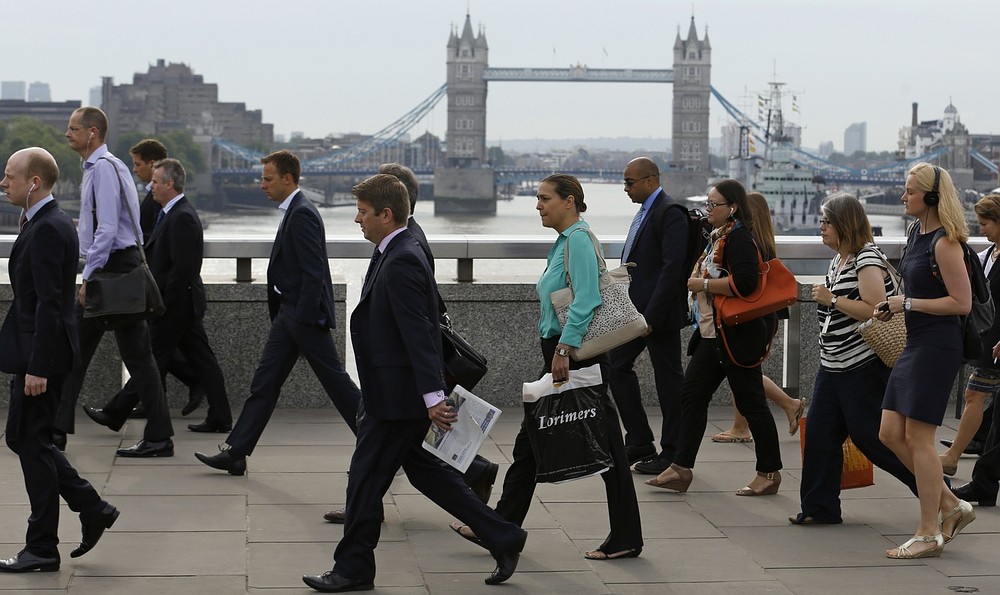
(Photo credit: DBPost)
This unpredictability is part of a new-norm that’s here to stay. How do we get used to this new-norm? How do we let go of the deep-seated need for controlling that which is uncontrollable? How can we learn to sense when to apply linear-control logic and when to let-go of the need for control? How do we get comfortable with the uncomfortable?
This morning, the UK’s Chief Science Advisor Sir Patrick Vallance provided a balanced coherent explanation of what is unfolding and how best to embrace this new-norm. On the BBC’s Today programme, he explained that there could well be another virus next year, and the year after. Hence, we ought learn to adapt to this new-norm. He put forward that while we can find sensible ways to protect the most vulnerable groups in society, the majority of the population can build resilience to this and other viruses through mitigation and adaptation as we embrace the need for ‘herd immunity’.
Our mechanistic world view relies on command and control and is unable to deal with this new reality. We have to sense, respond and adapt to these situations. What does this mean in practice?

It means we first need to recognise the limit of our control and avoid taking actions that give us the ‘illusion of control’ yet do little to constructively adapt and evolve to the unfolding situation. It has been interesting to witnessed different organisations (and nation-states) reacting with ‘lock-downs’ or rather sensing-and-responding as the situation unfolds.
Recognising the systems in which we live and work while accepting the anxiety that comes from our lack of control of these emergent systems is part of embracing this new-norm. We can learn to open-up beyond fear and control, and become more conscious of how we best respond to emergence.
A current example is being self-responsible for our hygiene and how we best relate with each other to mitigate any infectious spreading where possible, self-isolating if need be. This helps slow the pace of the virus spread so we give our infrastructure systems, health and emergency services, the time and space to respond while building up our collective and individual resilience. It also means that ‘herd immunity’ can build up over the longer term. It is futile to try and block-out a virus through lock-down control-mechanics, yet we can become conscious of how we adapt to a new-norm. Anxiety and reactivity can transmute into self and system response-ability.
This exemplifies the need for Regenerative Leadership – a kind of leadership that is sense-and-respond orientated and systemically –aware rather than control-and-predict orientated and mechanistically-focused.

Changing our fundamental view of how we engage with the fast-changing world we live and work in, asks us to become conscious of our individual and collective desires for mechanistic, control-based logics. There are times when top-down hierarchy can be effective – for instance, giving consistency of messaging around response-protocol across diverse hospitals and doctor networks over short time-frames. Yet, there is also a need to sense into the interconnected and emergent nature of how life really is beyond illusions of control. There is a deeper Logic of Life that as Regenerative Leaders we can learn to become conscious of. We can learn to more coherently sense-and-respond amid volatility by opening-up to how life really is.
Although this shift from one world view to another can feel unsettling and can create anxiety, it is actually an exciting transformation that is encouraging us to become more aware, adaptive and resilient so humanity is able to adapt, evolve and thrive, while finding deeper harmony with life on Earth – which is interconnected from soil to sea, and bacteria to business, regardless of country or class.
So what does that mean right now? A simple but effective step is to recognise what we actually have control over, what we can influence, and what is beyond our influence. If we can’t control or influence it, then it’s a waste of our precious energy to get anxious about it. Nick Triggle, Health Correspondent for the BBC, summed it up: keep calm, carry on, take the advice to wash hands regularly, isolate if we develop symptoms and take steps to protect our most vulnerable. This virus is with us now, is likely to return in myriad forms, and is an example of our interconnected global reality.
Rather than relying on totalitarian George Orwell-style ‘lock-downs’ that create confusion amid the illusion of control, we can learn to better sense-and-respond at local levels, take personal and collective responsibility for how we engage both locally and globally and cultivate personal, organisational and community resilience.
If you are interested in learning more about how we can lead in ways that unlock the Logic of Life within ourselves, our teams and our organisations – you can:
- Read the book Regenerative Leadership by Giles Hutchins and Laura Storm
The clarity, inspiration, synergy and wisdom of this book is breath-taking
– Dr Lynne Sedgmore CBE, former Chief Executive of 157 Group, Centre for Excellence in Leadership
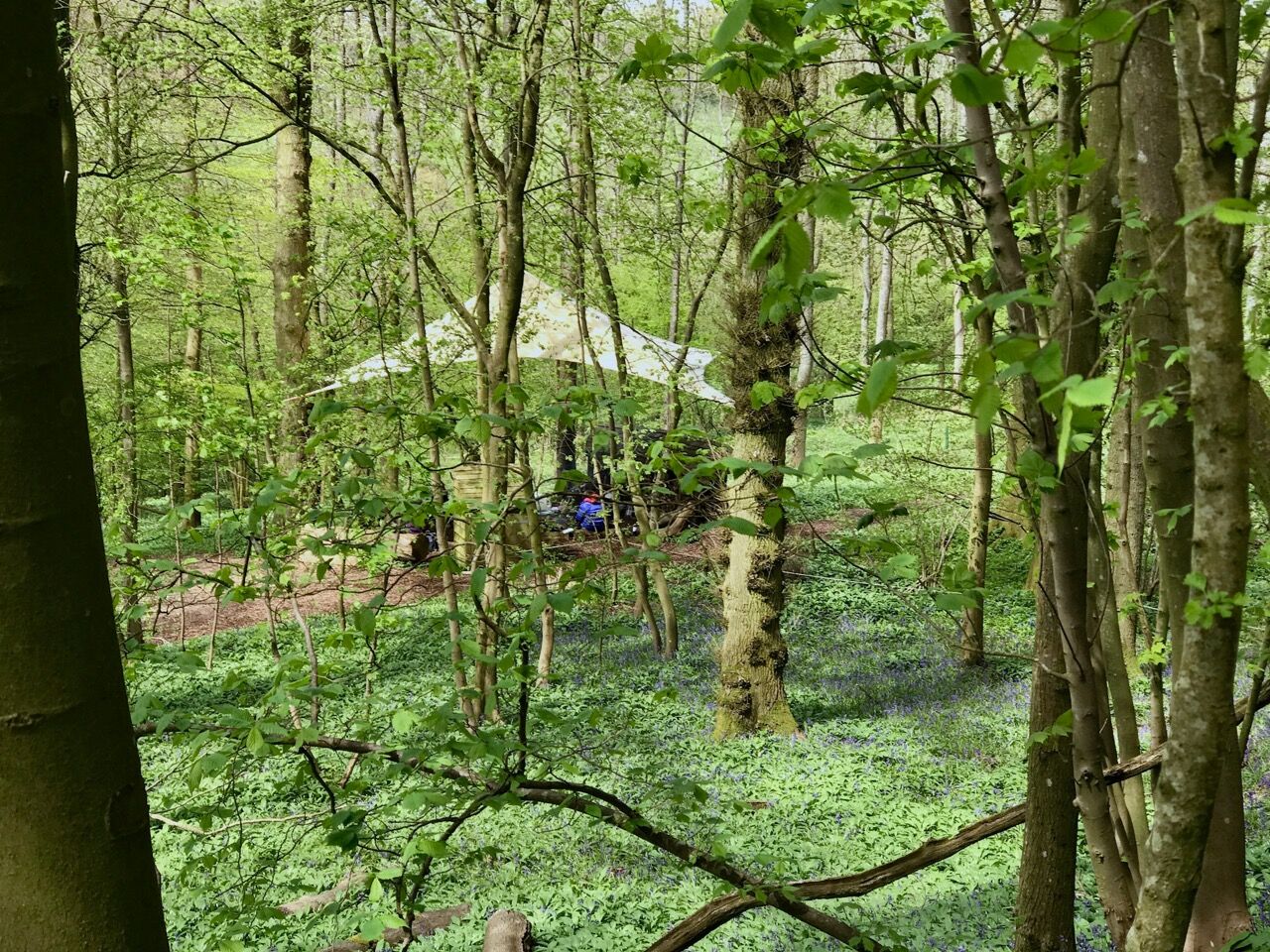
2. Immerse yourself in the practicalities of Regenerative Leadership with practitioners Darren Hilton and Giles Hutchins’ immersion in the ancient woodlands of Springwood Farm, easy access from London, car and train networks, with suitable Corona-Virus hygiene in place, providing a get-away from it all while exploring next-stage leadership for this new-norm. For more information, see https://tappingthesource.com/events/
This blog has been co-authored by organisational and leadership development specialists Darren Hilton and Giles Hutchins.
feel free to join the LinkedIn group Leadership Immersions, here https://www.linkedin.com/groups/13767578/
and next-stage leadership Facebook group here: https://www.facebook.com/businessinspiredbynature/
Will your organisations die, survive or thrive in the 2020s?
Leaders of today face increasing complexity. The old ways of leading are no longer adequate when facing into the rise of complexity.
With a toxic cocktail of rising stress at work, market volatility, disruptive innovations, and spiralling bureaucracy, many leaders feel overwhelm as do many employees . And yet there are some simple yet powerful tools that can help us reach beyond complexity, and cultivate conditions for our organisations to thrive and our people to come alive.
I have been exploring the ‘new norm’ in leadership for over a decade now, and my latest book, co-authored with Laura Storm, Regenerative Leadership draws together a wealth of experience, practical tools and a depth of case studies on next-stage leadership.
Experiencing and embodying the practicalities of next-stage leadership is vital for our leaders and practitioners. This is where the 60acres of ancient woodland at the beautiful Springwood Farm, with easy access to London, come in to a world of their own. In nature, we can learn how to embrace complexity, activate the leadership consciousness we need, and go deep with our personal and collective sharing of what we are noticing as practitioners and leaders in these transformational times.
Time and again I am struck by the power of round-the-fire dialogue where we can get underneath the surface tensions we all face and sense into the underlying root challenges to unlock practical ways forward for future-fit business.
This is why I have paired up with Leadership, Team and Organisational Development Practitioner Darren Hilton to run a special leadership programme with two one-day workshops in nature, with mid-point check-ins and peer-to-peer coaching. See here for more info, places are limited www.tappingthesource.com/events
feel free to join the Leadership Immersions LinkedIn group if you have not already:
https://www.linkedin.com/groups/13767578/
and The Nature of Business Facebook group:
https://www.facebook.com/businessinspiredbynature/
Giles Hutchins is a pioneering practitioner, business futurist and senior adviser at the fore-front of the [r]evolution in organizational and leadership consciousness and developmental approaches that enhance personal, organizational and systemic agility and vitality. He is author and co-author of several leadership and organizational development papers, and the books The Nature of Business (2012), The Illusion of Separation (2014), Future Fit (2016) and Regenerative Leadership (2019). Chair of The Future Fit Leadership Academy and Founder of Leadership Immersions, he runs a 60 acre leadership centre at Springwood Farm, an area of outstanding natural beauty near London, UK
It is an exciting yet challenging time to be a leader, when so much of what we thought we knew about how to lead and operate is in need of transformation.
Global leadership studies show a widening ‘complexity gap’ amongst today’s leaders. As our organisations need to be more agile, innovative, responsive and purposeful to become future-fit, so too does our leadership logic.
The good news is: reaching beyond the complexity gap does not require us to add yet more complexity, burdensome methodologies, measures, models and metrics to an already busy and often stressful leadership dynamic. Quite the opposite, in fact.
While more ‘head-learning’ may have worked in the past; the future now calls for something new, something altogether more embodied and experiential in its pedagogy.
Over the last decade, my action research on applied living-systems approaches for leadership and organisational development, have revealed to me a secret, a simple yet powerful secret inherent within life.
The other side of complexity is beautiful simplicity.

We transcend the complexity gap in our leadership mind-set by doing nothing more – nor nothing less – than opening ourselves up to the Logic of Life.
I have come across leaders of different backgrounds in different sectors applying this living-systems mind-set to enable their organisations to not just survive in these times of volatility but to truly come alive and thrive.
For instance, the CEO of a UK bank dealing with the toxic cocktail of increasing regulation, BREXIT noise, rising risk-aversion hand-in-hand with spiralling bureaucracy and disruptive market innovations left right and centre. Instead of applying yesterday’s machine logic of tightening power and control across the organisation-as-machine, a threshold is crossed, a complexity gap is transcended. Rather than grasping tight, there is an opening up. A more human approach to leadership unlocks brilliance. Creativity starts bubbling through the hierarchy, people self-organise and think-outside-the-box more, the culture becomes purpose-led from the inside out, talent is attracted and retained. Soon the company is outperforming while providing higher quality products and services to its clients. This takes courageous leadership to move away from tried-and-tested methods of power-and-control into a space that unlocks human brilliance within self and system.
Another example: A housing association in the North East of England, dealing with the toxic cocktail of austerity, fickle government policy and spiralling social challenges. Instead of locking-down the organisation through ever-tighter power-and-control leadership, a threshold is crossed, a coaching culture at all levels of the organisation is nurtured, reinvigorating teams to come up with innovations that provide award-winning client services that cut through complexity. Moral increases, talent is attracted and retained, and a virtuous cycle spirals upward as the organisation comes alive and people thrive.
There is a key leadership dynamic to embodying this next-stage future-fit leadership. It’s an unlocking, a peeling back of our innate human capacities. It is an opening up to the emergence inherent within life, rather than a grasping tight to power-and-control habits of yesterday.
No need for yet more head-stuff, more methodologies, leadership-models, company-wide questionnaires or strategy management courses. What is really needed is to directly experience and embody the beautiful simplicity the other side of complexity. Through powerful practices – which we activate in this Learning Journey on Regenerative Leadership in Action – we unlock the brilliance inside ourselves as leaders, and in-so-doing unlocking the brilliance inside our teams and wider stakeholder ecosystem. It’s this fundamental step that will activate life-affirming futures for leaders and organisations.
At the heart of this unlocking and revealing process, is a ‘crossing of the threshold’, a personal transformation where we let-go of the machine-logic of old and open-up into the Logic of Life.
This threshold crossing is what enables us to become more human, more alive, more conscious. We bring in a fundamentally different way of being-and-doing than the level of consciousness that created our problems in the first place.
‘The greatest breakthroughs of the 21st century will not occur because of technology, they will occur because of an expanding concept of what it means to be human.’ -John Naisbett, futurist
‘In times of turmoil, the danger lies not in the turmoil itself, but in facing it with yesterday’s logic.’ – Peter Drucker, management consultant
If you are a leader, coach, change agent or adviser wishing to develop the capacity-building you need for future-fitness, while learning to embody the living-systems Logic of Life, then take a look at this programme which activates the latent capacities you need to be a regenerative leader today.
Regenerative Leadership in Action programme
Giles Hutchins is a pioneering practitioner, business futurist and senior adviser at the fore-front of the [r]evolution in organizational and leadership consciousness and developmental approaches that enhance personal, organizational and systemic agility and vitality. He is author and co-author of several leadership and organizational development papers, and the books The Nature of Business (2012), The Illusion of Separation (2014), Future Fit (2016) and Regenerative Leadership (2019). Chair of The Future Fit Leadership Academy and Founder of Leadership Immersions, he runs a 60 acre leadership centre at Springwood Farm in an area of outstanding natural beauty near London, UK
You can connect with Giles Hutchins on LinkedIN here
You can also join this Facebook community on the new business paradigm here
If interested in next-stage Leadership Immersions, you can join this LinkedIN Community here
A Guide to Regenerative Leadership in Practice
Since the military acronym VUCA was first coined in the late 1980’s, leaders and organisations have been waking up to a growing appreciation of the unpredictability and complexity of highly interconnected problems as the ‘new norm’. Yet whilst this is creating a growing appreciation of the nature of ‘wicked’ problems, and contexts of change that are volatile, uncertain, complex and ambiguous, our observation is that the levels of thinking and behaviours required to address them has remained fairly unchanged. The dominant narratives shaping change management, human resources, business transformation, leadership development, process improvement, cultural change and organisational development are still largely rooted in a 18th/19th/20th century mechanistic logic. This logic is no longer suitable for dealing with the turbulent and complex challenges 21st century leaders and organisations now face.
The requirement to embrace complexity is shaped by numerous inter-dependent factors. Prof. Peter Hawkins’ of Henley Business School’s 2017 global research study identified key drivers requiring a shift in leadership and organisational development as:
- the increasing rate of change
- the technological and digital revolution
- the hollowing out of organisations and the growing complexity of the stakeholder world
- globalisation
- climate change
- the need to learn and adapt faster
When Deloitte recently surveyed over 14,000 CEOs across 23 industries, they found a clear complexity gap in leadership consciousness, with leaders lacking the necessary cognitions and skills to deal with rising complexity. To engage effectively with the multiple change-factors our organisations now face, and to bridge the complexity gap in our leadership consciousness, there is a clear need to face the future with a new logic fundamentally different from the mechanistic logic that created our systemic problems in the first place. In Peter Drucker’s words, ‘In times of turmoil, the danger lies not in the turmoil itself, but in facing it with yesterday’s logic’.
There is emerging evidence that a new set of logics is already starting to emerge from a range of thought leaders. In 2018 the world’s largest strategy consultancy McKinsey & Co launched a report, The 5 Trademarks of Agile Organizations, which stressed the importance of moving away from the mindset of ‘organisations as machines’ and towards organisations as living systems. In Reinventing Organizations, former McKinsey consultant Frederick Laloux identified specific examples of next-stage living organisations as operating to the principles of self-organisation, authenticity, and actively engaged in living out evolutionary purpose. MIT professor Otto Scharmer and the Presencing Institute’s awareness-based systemic change framework Theory U emphasises a shift from ego-driven change to ecosystem sensing into emergent possibilities of the living field. Business philosopher Nassim Talib’s Anti-Fragile is another important contribution that explores the need to embrace the interdependent and emergent logic of living systems. And the recent work of Giles Hutchins and Laura Storm on Regenerative Leadership articulates and applies this living-systems logic to leadership and organisational development. These are just some way-markers on the unfolding journey from machine-mentality towards living-systems approaches enlivening the organisation as a complex adaptive and emergent system in ongoing relationship with its environment. This living organisation is not only agile enough to cope with the systemic challenges but is life-affirming in its culture and purpose.
To summarise this shift in logic is a shift from ‘mechanistic’ to ‘living systems’, and can be contrasted as follows:
Mechanistic Logic Living Systems Logic
LINEAR & PREDICTABLE CIRCULAR, INTERDEPENDENT & EMERGENT
EXCLUSIVE & EXTRACTIVE INCLUSIVE & REGENERATIVE
CONTROLLING DEVELOPMENTAL & SELF-ORGANISING
POWER OVER POWER WITH
TRADE-OFFS SYNERGIES
SHORT-TERMISM INTER-GENERATIONAL
SEPARATE INTERCONNECTED
RATIONAL-ANALYTIC THINKING EMBODIED BEING-AND-KNOWING
It is worth emphasizing here that the organisation has always been ‘living’ rather than ‘machine-like’ in the sense that it has always been made up of unpredictable, interdependent, emergent human relationships. The organisation has always been a complex, dynamic and evolutionary ‘living’ system, in this regard. By shifting our leadership consciousness, we are merely starting to sense into the organisation as it really is.
The above is an extract from the paper A Guide to Regenerative Leadership in Practice co-authored by regenerative leadership practitioners Giles Hutchins & Katherine Long – to read the full paper go to The Future Fit Leadership Academy’s blog, or download the PDF here
If you wish to engage in this work at a practical level, to become trained and equipped in the action-logics and tools required for next-stage future-fit regenerative leadership there is a 2020 programme Giles Hutchins & Katherine Long are co-facilitating, with limited spaces available – for more details on this programme you and read this article, and contact Katherine Long on mail@katherinelong.co.uk
To join the LinkedIn group dedicated to Leadership Immersions, visit: https://www.linkedin.com/groups/13767578/
To join the Facebook group on next-stage leadership, visit: https://www.facebook.com/businessinspiredbynature/
For more on the unique 7 mth programme Regenerative Leadership In Action, visit: http://ffla.co/regenerative-leadership-in-action/
We are the ones we’ve been waiting for…
The global traction gained by sustainability initiatives in the current climate is certainly promising, but why aren’t we seeing the impact desired on the scale required?
This is a guest blog by Megan Hall from global leadership provider Impact who recently attended one of Giles Hutchins’s Leadership Immersions :
I spent two days in an ancient woodland as one of a diverse group of eight participants, learning about regenerative leadership under the guidance of Giles Hutchins (a pioneer in leadership consciousness)[1]. We slept beneath trees and cooked over an open fire, all the while looking both inwards and outwards for insights into the flows and cycles of life. When putting into words what I learned from this magical experience, I decided to set aside my academic background in Psychology and tune into all four of my ways of knowing- intuitive, emotional, somatic and rational.[2]
‘And here is my secret, it’s a very simple secret: It is only with the heart that one sees right, what is essential is invisible to the eye.’ The Fox, in The Little Prince
There is a running theme of deep disconnect in modern society. Interventions working to promote sustainability are too often implemented with a mechanistic mindset, focussing on measurement and control while neglecting the internal development necessary for true progress. As a result, the change facilitated by such initiatives remains incremental rather than transformative.
Most of us fail to recognise the broader systems in which we exist, moving through life without any thought as to the materials, systems and people involved in the manufacture/growth/development of the products that we use every day. This disconnect of internal and external worlds is key. Reuniting the head with the heart and the gut enables one to nurture more sustainable, regenerative cultures.
What is needed is a shift in leadership consciousness from a mechanistic logic to one of living systems, founded in open minds, open hearts and open will. This requires personal growth and reflection, as well as systemic change – change within stimulates change without. As humans, employees and leaders we must begin to look at the world as a series of interrelating parts, systems within other systems, whose dynamics and energy are constantly fluctuating. These relationships are not limited to human constructs, but also exist between humans and nature.
With this perspective, it is possible to support organisations to adapt and succeed under ever-changing conditions. Value is found in every aspect of a business, in every member of the community and in every existing tension. This forces us to move from a mindset of individual gain towards one of collaboration, collective-intelligence and co-creativity. With a collective purpose, individuals are empowered and motivated to drive innovation and change regardless of their position in a system or knowledge of a subject.

Life is a cycle, a rhythm which may be experienced multiple times over a day, in the span of a week or across many years. Where the trajectories of self-awareness and systemic awareness cross, there is opportunity for regenerative leadership consciousness. In order to fully engage with life, to have confidence in our actions we must know ourselves deeply. What assumptions and emotions are we beholden to and what would happen if we could release ourselves from these and be fully present?
Systemic awareness instead allows us to appreciate the broader qualitative inputs of a system and the relational flows between facets. Combining the two leaves a person with an awareness of their unique way of interacting with the living systems of their world and how best to harness this.

This is a guest blog by Megan Hall from Impact who recently attended one of Giles Hutchins’ Leadership Immersions feel free to join the LinkedIn Group on Leadership Immersions
[1] Hutchins, G. & Storm, L. (2019) Regenerative Leadership: The DNA of life Affirming 21st Century Organizations UK: Wordzworth. pp.3-24
[2] Jung, C. G. (1932). Psychological types London: Pantheon Books. pp. 425
Giles Hutchins is a pioneering practitioner, business futurist and senior adviser at the fore-front of the [r]evolution in organizational and leadership consciousness and developmental approaches that enhance personal, organizational and systemic agility and vitality. He is author and co-author of several leadership and organizational development papers, and the books The Nature of Business (2012), The Illusion of Separation (2014), Future Fit (2016) and Regenerative Leadership (2019). Chair of The Future Fit Leadership Academy and Founder of Leadership Immersions, he runs a 60 acre leadership centre at Springwood Farm in an area of outstanding natural beauty near London, UK
You can connect with Giles Hutchins on LinkedIN here
You can also join this Facebook community on the new business paradigm here
There is an old Chinese saying,
‘May you live in interesting times’
When someone said that to you, it was viewed as both a blessing and a curse.
A blessing, because interesting times meant change, volatility and uncertainty which invoke adaptation, transformation and a reaching beyond the existing status quo into new found heights.
A curse, because change and uncertainty disrupts the status quo, upsets ego-comforts, and challenges norms and routines.
Facing into the decade of 2020-2030, humanity finds itself amid interesting times of breakdown/breakthrough.
Back in 2010, as we entered the 2010-2020 decade I wrote articles and spoke at conferences about the decade ahead becoming one of volatility and uncertainty – a time when the old logic, the old way of doing things, would start to be seen by the mainstream as no longer adequate to deal with the challenges of the day.
As we leave the 2010-2020 decade behind us, our hindsight may see that it was the beginning of the VUCA Age – volatile, uncertain, complex and ambiguous times of disruptive innovations and wicked systemic challenges becoming the ‘new norm’.
During the decade just passed, leadership research has shown a widening ‘complexity gap’. The old mechanistic logic we used to lead and operate by is no longer fit-for-purpose. Our status quo leadership consciousness is left wanting, unable to deal with the systemic challenges organisations now face.
Whether it be the intent of business shifting from the unflinching focus on shareholder value to a wider perspective of stakeholder value, or corporate responsibility shifting from a narrow focus on risk, control and compliance to wider systemic value. The widespread take-up of the United Nations Sustainable Development Goals, integrated reporting initiatives such as Future-Fit Business Benchmark, and the shift towards the Circular Economy exemplify a sea-change in business. Come 2020, and we find positive signs that business can become a force for good in the world. The rapid rise of B-Corps, for instance, with over 3,000 organisations across 150 sectors in its ranks, and rising by the day. I predict 2020-2030 will see significantly more of these systemic adaptations, as business evolves to a new-norm. It’s the Law of Nature – adapt or die.
This is just the beginning; there is much work to be done for leadership and operational practices to be truly future-fit. The challenges as we enter 2020 are seismically bigger than when we entered 2010. Yet, there is increasing acceptance amongst leaders of a ‘new norm’ demanding a new way of leading and operating. My contributions to Professor Peter Hawkins’ ground-breaking research at Henley Business School on Tomorrow’s Leaders Today’s Leadership Development helped flesh out the need for this next-stage leadership development.
What enables organisations to thrive in the transformative times ahead is their ability to cultivate life-affirming regenerative leadership across all levels of the organisation.
It’s this that transforms our organisations from 19th & 20th century bureaucratic, soul-sapping, toxic, monolithic machines into 21st century agile future-fit organisations. This calls upon a step-change in leadership consciousness.
Adult developmental psychologists and leadership development specialists have spent decades researching different levels of leadership consciousness. For instance, a robust and detailed study of adult developmental research from Clare Graves has been further enhanced by practitioners like Don Beck, Christopher Cooke, Frederic Laloux and Ken Wilber.
In the book Regenerative Leadership, which has been referred to as an evolutionary blueprint for next-stage leadership, Hutchins & Storm explore this next-stage leadership consciousness now unfolding. It correlates to the Orange, Green and Yellow/Teal levels of Clare Graves research. Hutchins & Storm draw on contemporary leadership and organisational development approaches such as Teal/Evolutionary (Laloux’s work on Reinventing Organisations) and Theory U (Otto Scharmer’s work at the Presencing Institute and MIT) as well as living systems theory, Complexity Theory, and latest research on developmental organisations.
This image below shows the step-change. It’s a model taken from the book Regenerative Leadership where Hutchins & Storm articulate the shift from 19th/20th century organisation-as-machine into 21st century organisation-as-living-system:
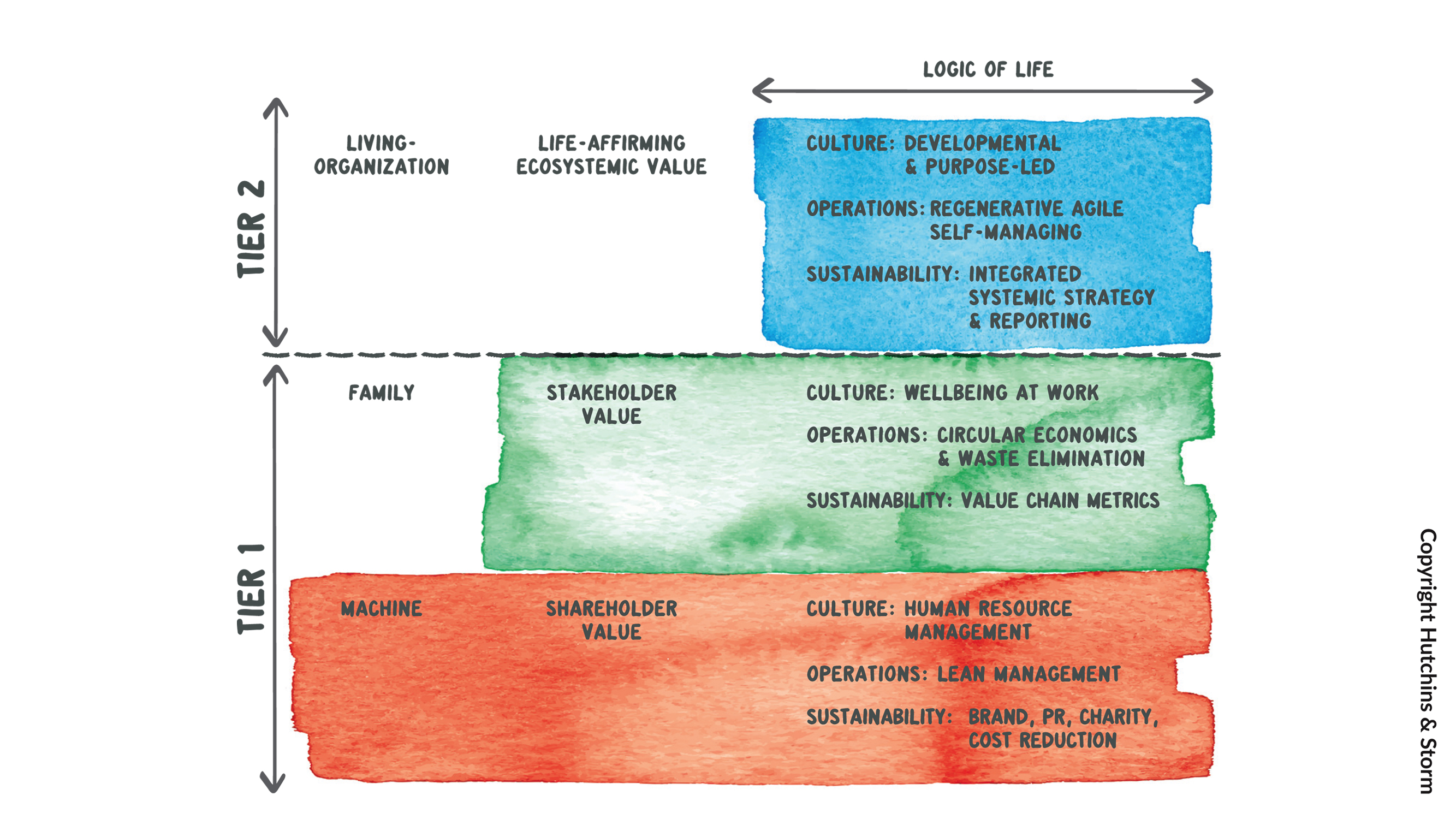
This is a momentous step-change in how we lead and operate. The 2020-2030 Decade of Transformation will witness life-affirming business practices becoming mainstream. This is the leading-edge of organisational innovation beyond techno-led digital strategy, AI and robotics.
Here are some key words for future-fit leaders to contemplate as we enter 2020: Purpose, Diversity, Emergence, Regenerative, Synchronicity… let’s briefly unpack each of these key words:
Purpose: The word ‘purpose’ is bandied about a lot in business circles these days. Suffice to say, Purpose is much more than the crafting of a catch-all mission statement. It’s about cultivating a ‘living purpose’ – a lived intent that pervades the organisational culture, where a threshold of people in the organisation deeply resonate with this purpose, and live it in the day-to-day. The living purpose is not just espoused but embodied through the behaviours and cultural glue that binds the organisation. It provides the coherence and inclusivity that counterbalance the living-organisation’s thirst for agility and diversity.
Diversity: Life itself banks on diversity. And human evolutionary conditions in the 21st Century demand we embrace diversity. The ability to tolerate and thrive amid a wide variety of conditions, perspectives and contexts is critical to becoming future-fit. Such diversity of experience, perspectives and outlooks builds resilience and increases the capacity to cope with stress – individually and organisationally. Co-authors John Rety and Richard Manning of Go Wild call this ability to embrace diversity ‘re-wilding’ ourselves, breaking free from the restrictions and regimentations of modern life that estrange us from who we truly are. We literally unlock the power of life-affirming evolutionary forces within us when we learn to embrace diversity.
Rather than the monocultural, corporate mentality we see practiced in many areas of society, we need to think outside the box and invite in unconventional mindsets, work across departments, and bring in different perspectives. As explored in the book Regenerative Leadership, Hutchins & Storm show that the best ideas are not born in silos or by avoiding feedback and input from a broad spectre of stakeholders; the best ideas are created by going beyond borders and getting curious about other approaches, cultures and procedures. 21st century Regenerative Leadership welcomes diversity in terms of age, creed, culture, gender and differing perspectives across the working environment. Leaders can stimulate diversity by working across boundaries both within the organisation (holding space for people from different silos across the business to share perspectives) and beyond the organisation (holding space for external stakeholder groups to share perspectives).
This diversity thrives amid a coherent sense of purpose and a rich developmental culture. The diversity sparks creative tensions, vibrancy and new thinking (divergence), while the coherence of the living-purpose provides the alignment and sense of direction (convergence). Out of this alchemy of divergence and convergence comes emergence. Emergence is the dynamic through which the living organisation adapts and evolves.
Emergence: All living-systems including the living-organisation exhibit the property of emergence. A key for leaders navigating the transformative times ahead will be their ability to sense into the emergent patterns unfolding within the living-organisation they are working in. Next-stage leadership development needs to enhance our capacity to sense and stimulate emergent patterns within the social systems we lead. The first step is for leaders to let-go of perceiving the organisation-as-a-machine that can be control through push-pull levers, and out-dated management tools. Instead, start to perceive the organisation as a complex adaptive system made up of non-linear emergent human relations. These emergent human relations can be nurtured so the organisation becomes more responsive and future-fit.
Christopher Alexander’s work on pattern language, Warren Weaver’s research on organizational complexity, Ralph Stacey’s research on organisations as complex responsive processes of human relating, Steve Johnson’s work on emergence, Jane Jacobs’s work on energy-flow networks enriched by Sally Goerner, Dan Fiscus and Brian Faith’s research on Energy Network Science, etc., contribute to a rich body of research exploring emergence within organisations and other social systems. In Regenerative Leadership, Hutchins & Storm draw upon these sources and others while exploring emergence for next-stage Regenerative Leaders.
As philosopher Alfred North Whitehead noted, emergence is nature’s creative advance. It is the way of nature – the way life adapts and unfolds to the ever-changing terrain. Understanding the emergent patterns within the relational dynamics we lead will be a critical success factor for the Decade of Transformation ahead.
Regenerative: The word ‘regenerative’ means creating the conditions conducive for life to continuously renew itself; to flourish amid ever-changing life-conditions. This primary principle underpins life-affirming leadership and organisational development. Organisations that thrive in the volatile times ahead will be ones that learn to become regenerative, to serve life rather than plunder and pollute life. See here the DNA model of Regenerative Leadership which is unpacked in Hutchins & Storm’s book of the same title:
This Regenerative Leadership DNA model embraces both the inner and outer technologies, tools, and consciousness that are required for the new regenerative business paradigm to unfold. It’s a unifying framework that integrates vast bodies of research, different domains, and specialist methodologies.
‘Giles Hutchins and Laura Storm bring their vast experience and deep wisdom to create an evolutionary blueprint for a sustainable future for business, people and the planet’
Richard Barrett, President of the Barrett Academy for the Advancement of Human Values
Regenerative leadership is about creating life-affirming cultures where people learn through developmental and respectful cultures, and where value-propositions and products create real value that enhance society, our wider humanity and the fabric of life on Earth upon which we all depend. This is not some utopian dream, it’s quietly going mainstream, and the business examples packed into the 350 pages of Regenerative Leadership evidence this. Business can – and must – become a force for good in the world. There is no other viable option for 21st century leadership.
This book invites leaders to lead the world into the 21st century
Christiana Figueres, Executive Secretary UNFCCC 2010-2016
That leaves us with the final word to contemplate as we begin this Decade of Transformation:
Synchronicity: The ground-breaking psychologist Carl Jung explored synchronicities as ‘meaningful coincidences’ – seemingly unrelated events have a meaningful relation that defies our orthodox understanding of space-time. Quantum discoveries help give scientific explanation to such synchronistic moments that we have often felt occur in our lives yet struggle to explain through rational logic. The more we sense into how life works, the more science shows us a sea of interconnections that pervade all living systems – whether in our organisations, communities or everyday life.
In terms of leadership consciousness, recall the image earlier in this article with the levels of Orange, Green and Teal. At the Orange level of leadership consciousness we perceive the organisation-as-machine and we view life through a mechanistic lens. At the Green level, our lens of perception has widened to include wider society and a systemic perspective of stakeholder interactions. At the Teal level, we embrace a living-systems perspective where we intuit the innate interconnectedness of how life really works. We learn to sense not only the emergent patterns of organisational behaviour but also sense the synchronicities that abound amid everyday interactions. We cultivate a leadership consciousness that can see past the surface noise and sense the underlying wisdom pervading every person, interaction and learning experience life affords us. This ability to see beyond the surface and sense the synchronistic interconnected nature of life provides a foundation for peace, empathy and gratitude. This wisdom underpins our leadership capacity amid the hectic busyness of the transformational times ahead.
This book is full of wisdom and determination! It will inspire leaders to succeed in the 21st Century.
Tim Flannery, scientist
Welcome to the future manifesting today. As leaders in organisations, institutions, teams and communities the world-over, we have a duty to step into a way of leading that is life-affirming and regenerative. Why wish for anything less!
As the well-respected business futurist John Naisbett predicts:
‘The greatest breakthroughs of the 21st Century will not occur because of technology. They will occur because of an expanding concept of what it means to be human.’
What an exciting yet challenging time to be alive, when the old rule-book is being ripped up before our eyes, leaving a wide-open horizon for our leadership consciousness to expand into.
Living in interesting times may be seen as a blessing or a curse. It’s up to each of us whether we wish to transform ourselves and our systems amid this time of challenge, or get sucked under by the fearful ripe-tides of change.
Giles Hutchins is a pioneering practitioner, business futurist and senior adviser at the fore-front of the [r]evolution in organizational and leadership consciousness and developmental approaches that enhance personal, organizational and systemic agility and vitality. He is author and co-author of several leadership and organizational development papers, and the books The Nature of Business (2012), The Illusion of Separation (2014), Future Fit (2016) and Regenerative Leadership (2019). Chair of The Future Fit Leadership Academy and Founder of Leadership Immersions, he runs a 60 acre leadership centre at Springwood Farm in an area of outstanding natural beauty near London, UK
You can connect with Giles Hutchins on LinkedIN here
If interested in next-stage Leadership Immersions, you can join this LinkedIN Community here
You can also join this Facebook community on the new business paradigm here
Regenerative Leadership: A New Approach That Values Life
There is no doubt. We are living in a time marked by great upheaval and volatility. Leaders – both political and business – are being forced to cope with rising challenges: resource scarcity; high levels of stress in the work place; disruptive innovations; social inequality; constant competition for top talent; rapid digitization and globalization; mass migrations; fragile supply chains; mounting social tensions; political extremism; and much more.
On top of all this, the climate of our planet is breaking down and we are facing what scientists have called the sixth mass extinction.
Our production systems are based on a linear, take-make-waste approach. Our financial systems based on short-term profit maximization that ignore life and debase human integrity. Our organizational systems are dominated by hyper-competition, power-and-control hierarchies, and rising stress.
We need a new approach that values life. A new leadership logic where organisations flourish, ecosystems thrive and people feel alive. This is what Regenerative Leadership is all about. This book is written by leadership and sustainability specialists Giles Hutchins and Laura Storm, and has been referred to as the ‘must-read book of the year’.
“This book invites leaders to catalyze the necessary regeneration to not just catch up, but to lead the world into the 21st century.”
CHRISTIANA FIGUERES, EXECUTIVE SECRETARY UNFCCC 2010-2016
Find out more about the book here: www.regenerativeleadership.co
This book weaves a new leadership framework with inspiration from pioneering thinking within biomimicry, circular economy, adult developmental psychology, anthropology, biophilia, sociology, complexity theory and next-stage leadership development. It connects the dots between these fields through a powerful DNA model that enables leadership to become regenerative, building thriving, prosperous, flourishing organizations amid these transformational times.
Regenerative organizations will be tomorrow’s success stories. Those that hold-on to yesterday’s logic will become yesterday’s news. It’s simple: adapt or die.
“This book is full of wisdom and determination! It will inspire leaders to succeed in the 21st Century.”
TIM FLANNERY, SCIENTIST
Regenerative Leaders bring vitality and wellbeing to all our living systems….In-so-doing, we wake up to what it really means to be fully human – Giles Hutchins & Laura Storm
Feel free to connect with both Giles Hutchins and Laura Storm on www.regenerativeleadership.co
be a part of the new business paradigm discussions with the Facebook community and if interested in Regenerative Leadership Immersions see the LinkedIN Group

