The Essential Ingredient for Future-Fitness
I have been in business now for over twenty years, and now – at the age of 45 – my business career has consumed more than half my life. During that time, I have seen so many aspects of our current business paradigm, from investment management, project management, change management, leadership development, business intelligence, business process improvement, sustainable business, conscious business, Teal/evolutionary business, purposeful business… you name it – I have immersed myself in consulting-speak acronym city, and worked with the C-Suite of all sorts of organisations from start-ups to global monoliths, from non-profits to multi-billion machines.
I promised myself upon entering the city that I would not lose my connection with what really matters. By the skin of my teeth, I have just about made good on that promise.
Because, for far more than twenty years I have deeply felt in my heart and soul that what pervades our plethora of problems – whether it’s rising mental illness in the workplace, rampant consumerism or the widespread violation of life on Earth – lies a deeper root problem. It is root problem we ignore at our peril. And yet this is all-too-often exactly what we do – overlook what is before our very eyes, so caught-up we have become.
The root problem – the Mother of all Problems – is dis-connection: disconnection within our own selves (our deeper sense of selfhood), with each other (the relationality of our community), with life itself (the rich tapestry of human and more-than-human life – the physical, phenomenological, psychological, imaginal, soulful and transpersonal).
This dis-connection pervades our inner and outer worlds in varying ways.
Our outer world perspective is influenced by the stories we tell ourselves about how we think the world works. Our cosmologies and worldviews influence our socio-economic narrative which influences how we behave in our organisations and communities, which influences our home life.
Our inner world dis-connection manifests in how we attend to each evolving moment in our midst: the quality of attentiveness, coherence and presence we bring to bear on life.
Here and now, 2018, numerous studies point to a crisis within our inner and outer worlds.
It would seem we are living through a supreme moment in our human history; a moment of simultaneous breakdown and breakthrough.
The stories we still tell ourselves about how we think the world works are starting to crumble, giving way to a richer deeper understand of reality.
All sorts of shifts are happening at deep and partly unconscious levels calling in to question our dominant worldview, and our sense of place and purpose within this world. At once it is a tumultuous time of upset, fear and disturbance as well as an unfolding rebirthing, reconnecting and remembering.

All change please – the crisis of our inner and outer worlds offers the chance to see into the eye of the storm.
This is how our outer worldview is undergoing a metamorphosis:
Today, our dominant worldview is still rooted in separation, control, hyper-competition and domination. We still serve up a largely Neo-Darwinist logic of separateness in many of our schools and business schools today. Yet, at the forefront of myriad scientific disciplines we now know that this out-dated logic has had its day. A deeper understanding about how the world works is dawning upon us.
Worldviews and socio-economic narratives twist us down certain behavioural pathways. Habituations, constrictions and acculturations filter our inner-scape, narrowing-down and warping how we attend to ourselves, each other and life.
A worldview rooted in separateness creates a mechanistic objectifying logic in business, which then infiltrates our personal life. We get caught up in a feedback loop of dis-connection, and before we know it, we believe hook-line-and-sinker a story of separation, control and competition, without realising it is nothing more than a projection we are projecting on to the world. Worldviews create worlds. We don’t see life as it really is, but how we have engrained ourselves to see it.
We now know that life, evolution and consciousness have far more to do with co-creation, participation and inter-relation than objectification, separation and control.
What we thought we knew about how the world works is now looking inadequate and outdated as a richer and more coherent worldview is shape-shifting not just our cosmological, scientific and socio-economic narrative but also how we perceive organisations and leaders.
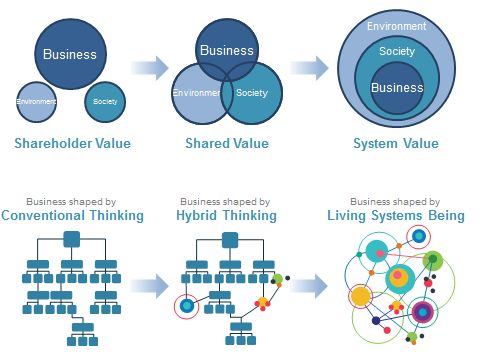
No longer is it adequate to view the organisation as a machine sweating its assets, we are beginning to see the organisation as a living system creating value in an interdependent emergent world. The exponential rise in the purpose movement, conscious capitalism, sustainability, values-driven business, Teal-Evolutionary and B-Corps, for instance, exemplify the early stages of this metamorphic unfolding into a worldview that sees connectedness, not separateness, as essential to life.
Likewise, our inner-scape has the potential to metamorphose from an increasingly dis-eased, fragmented, distracted and overly-analytic attentiveness into a deeper more coherent connectedness.
The exponential rise in mindfulness in the workplace, wellbeing at work initiatives, the search for personal purpose, consciousness-raising approaches, transformative learning journeys and vision quests, embodied practices such as yoga and T’ai Chi, as well as extreme sports or silent retreats, is all part-and-parcel of this unfolding metamorphosis of inner-outer connectedness.
This is good news. While it can often seem confusing and unsettling as the status quo safety slips away amid volatile choppy times, we are birthing change within our inner-outer worlds at personal, organisational and societal levels.
Many pioneering business leaders speak to this shift now upon us. For instance, John Mackey, CEO Whole Foods:
‘Perhaps the greatest change that we humans are experiencing is our rising consciousness. To be conscious means to be fully awake and mindful, to see reality more clearly, and to more fully understand all the consequences – short term & long term – of our actions.’
And the business futurist John Naisbett:
‘The greatest breakthroughs of the twenty-first century will not occur because of technology. They will occur because of an expanding concept of what it means to be human.’
Ringing in our ears is Einstein’s heavily-hackneyed insight – we cannot change today’s problems with the same level of consciousness that created them in the first place. This is a perfect insight for the manifold problems we face today and our way beyond them. Yet, so often we find ourselves doing just this, applying an outdated logic to today’s solutions. We simply don’t have time for this erroneous behaviour any more.
This is humanity’s hour of reckoning. It’s time to get radical and deal with the root cause, our pathological inner-outer dis-connectedness.
I believe that those of us reading this article in privileged positions, either within organisations or society, have a humbling responsibility to engage with, experience, embrace and embody this metamorphosis – to help catalyse this shift in consciousness unfolding within our inner and outer worlds.
This is urgent work. And yet it requires our relaxed attention, our innate receptivity.
First and foremost, this means gaining a personal perspective of what this connectedness – receptive attentiveness – feels like. Through our first-hand experience, we experience how this simple shift influences our way of relating with our selves, with others, and with our world.
Within this viscerally felt, embodied receptivity, we transcend the very consciousness that created our problems, and bring to life a richer perspective – a more holistic relationality.
Tapping in to our innate receptivity is the fertile ground from which a coherent and authentic responsiveness to our challenges arises. At root, we mitigate the risk of unwittingly applying the logic to our solutions that created our problems in the first place. The famous management specialist, Peter Drucker, knew this all-too-well when he noted:
‘In times of turmoil, the danger lies not in the turmoil, but in facing it with yesterday’s logic.’
We know this in our hearts, and yet we so often skip past this truth in our hurried dis-connected rush to get-on-with-it. And so we create more problems, more to-do lists, more holidays to take a break from the to-do lists…
What is now called for, in this hour of reckoning, is a step change in how we see the world, in how we attend to life.
With this shift in consciousness, we embody a deeper sense of place and purpose within this inter-relational world. Only then will our solutions tackle root causes while simultaneously mopping up downstream effects. Climate change, plastic oceans, racism, sexism, and the rest, are downstream effects which can only be effectively dealt with through a level of consciousness that doesn’t create the very separateness that causes them.
It is well within our capacity as human beings to wake up to this deeper level of consciousness – a receptive inter-relational attentiveness – it requires nothing more, nor nothing less, than us creating the conditions for our humanity to authentically flourish.
I have created mini-learning journeys to explore first-hand just this. I have been struck by my findings. Leaders of all sorts of backgrounds enter into Nature-immersions with me while exploring future-fit leadership, and they come away with this felt-sense of receptive connectedness – a shift in consciousness occurs.
Several people have asked me to further explore consciousness-shifts as ‘one-offs’, and more enduring sustained shifts, specifically in terms of how this relates to transforming our inner-outer worldview and our approach to our systemic wicked problems.
Watch this space for more on this action-research during the weeks ahead.
Findings from a Conscious Business Lab I recently co-facilitated in London with Sara Vaughan highlight ‘vulnerability’ as an important quality for conscious leadership. Vulnerability is an opening-up of our inner-nature through our outer behaviour; an integrating of our inner-outer authenticity or wholeness within ourselves. This vulnerability helps create the safe space for others to feel able to be more vulnerable, and so helps catalyse their authentic integration towards authentic wholeness. Vulnerability is us opening up with receptivity, whereupon we find ourselves more able to respond authentically to what emerges in our midst; receptivity enlivens our responsiveness.
In a recent conversation I had with Jayn Sterland, the CEO of Weleda UK, we touched on the work of Parker J Palmer and his emphasis on integrating our ‘backstage’ inner aspects with our ‘onstage’ aspects of our self, so that any sense of separation within ourselves can be integrated. Creating the safe space where people feel able to be vulnerable in the workplace – to be more of who they really are, rather than projecting masks and conditioned bias behaviours – is central to cultivating a more human workplace. It is enabled by leaders being courageous enough to be vulnerable themselves.
As the writer Paul Levy notes,
‘The word ‘vulnerable’ is related to the Latin word vulnus, which means ‘wound’; it is only through our being vulnerable, which can be a wounding experience, that we become able to heal…When we get in touch with the deepest, most true part of ourselves, it is the part of us that is most unique and personal, while at the same time, there is a universal aspect, in that it is the same Self that is incarnating through everyone. To experience this paradox consciously is itself the expansion of consciousness which initiates a transformation in ourselves, and by extension, the world around us. This is to paradoxically step into being a genuinely autonomous, independent being, while at the same time realizing our interconnectedness and interdependence with other autonomous, independent beings. It is this ‘shared felt sense’ that deeply connects us with each other, cultivates compassion, helps us see through the illusion of the separate self’
This vulnerable unfolding to life through our innate receptivity is not just a ‘nice-to-have’, it is essential for our future-fitness, it’s essential for the evolutionary potential of our organisations, and rather more importantly, it’s essential for the evolutionary potential of life on Earth.
This is the essence of what is now required within ourselves, within our relationships, within our organisational cultures and leadership development approaches.
A revolution in consciousness no less
To explore ‘the new paradigm’ further, join the Face Book community here and for more on the Future Fit Leadership Academy visit www.ffla.co and for Giles Hutchins’ personal website www.gileshutchins.com
It is now clear to many leaders, managers and change agents that we need a new way of operating.
Yet, so often we seek solutions ‘out there’, a new way that has been invented elsewhere, packed-up, tried-and-tested and ready for us to buy off-the-shelf so we can solve our problems: a silver-bullet, a cook-book approach that, with enough budget, senior management buy-in and will-power, we can implement – job done, tick, move-on, next!
There is something within our psyche that definitely prefers the safe, tried-and-tested, well-documented, easy-to-follow, clearly illuminated straight road ahead. But life is not like that. And things are only set to get more volatile, more uncertain and more ambiguous for a great variety of reasons. Our search for neat off-the-shelf solutions may satisfy the desire to ‘get-the-job-done’ and move-on, but in our hearts we know something deeper is now required.

There is increasing evidence that today’s managerial mind-set and organisational development approaches are not just inadequate for dealing with the challenges that lie ahead of us, they are actually undermining our creative potential and adaptability right where we most need it.
So what to do!
In my recent conversations with a CEO, of a global firm actively exploring deeper ways forward, she succinctly said, ‘its time to start looking in’. Yes, we need to look out, but first we need to look deep within, and then take that in-spiration into our looking out, so that we see, relate and attend to what is required in our organisations with a new way of perceiving, of thinking, of attending. From this insight and self-awareness comes the foresight and systemic thinking we now need to deal with the challenges upon us.
If we are honest with ourselves, we may begin to realise that the major problems we face within our ways of operating and organising results from much of our ‘doing’ having become de-coupled from our ‘being’. Let’s just pause on that for a moment. How often in our daily activities do we do things in a harried and hurried way due to our need to ‘get the job done’ while undermining the quality of our ‘beingness’ in the process, in turn undermining the quality of interactions we have with others, eroding our innate sociality and empathetic connection with our environment. We professionalise our masks and personas as we learn to be masterful at persuasion and manipulation, yet in-so-doing we distance ourselves from our authentic nature, desensitising ourselves and our empathic inter-relationality in the process. Enter the mechanistic bureaucratic soul-sapping corporate culture of today.
As the now trendy insight from Einstein so aptly highlights, we can’t change our problems with the same logic that created them. And yet we so often do exactly this. Whether it be, for instance, force-fitting a cook-book approach to holacratic self-organisation into our governance or sending our top 1% of talent on largely academic leadership courses to efficiently download how to be a better leader.
When it comes to us exploring different approaches outside-the-box of our current thinking, our decision-making systems constrain us. Procedure demands we quantify the learning objectives and outcomes so a business case can be signed-off. So caught up we are, that our mindset and culture prevents investment in the very approaches we need to get us out of the logic that created the problems in the first place.
Most middle managers and senior executives have been encouraged to think that in order to succeed, we need to climb the ladder, take on more responsibility, lead a bigger project, and accumulate more academic accreditations. We look outside ourselves in terms of what we can accumulate. This has its place and needs to be commended to a certain extent, but only if our doing is aligned with our being, otherwise we are doing stuff for some external reward chart or ‘tick-box’ exercise while further de-coupling ourselves from our being. We so often take on more external commitments, giving ourselves less time to reflect on how we are being – and so we get more stressed, seeking fleeting respite through holidays or external stimulations, which often involves yet more busyness. Enter the contagion of consumerism in our midst. How often do we give ourselves a chance to question why on Earth we are doing what we are doing anyway. What actually is the deeper purpose of the organisation I work for and how does that resonate with my deeper purpose?
The more we externalise and objectify the more we distract ourselves from sensing into how we are truly feeling. We don’t give ourselves the space-time to tune-in to who we truly are and how we are truly feeling, because we are for-ever grasping at things ‘out there’. We relentlessly get busier and busier in an increasingly complex fast-moving digitised world that demands more and more of us. Becoming more profitable, more sustainable, more creative, more resilient, more responsible, more purposeful, more conscious – these are at risk of becoming ‘things’ for us to get our head round, climb over and achieve efficiently with the masks and personas we know serve us well in the current acculturated mindset. We fail to actually question or address the underlying mindset, and so unwittingly prevent ourselves from opening up to the deeper wisdom we now need to move beyond ‘the box’ we have got ourselves caught up in.
It’s time to step back from this myopia we have entrapped ourselves in, so that we can allow ourselves to see with fresh eyes, while bringing in deeper insights within and all around us, beyond ‘the box’.
‘The one who looks inside awakens’ – Carl Jung
The good news is, these very times of volatility and upheaval are providing the ideal alchemic conditions for our old ways to be seen for what they are – holding us back from who we truly are, and undermining our organisations’ and social systems’ ability to thrive.
Many are now increasingly realising that our social systems and organisations are actually living systems rather than mechanistic machines. This is one of the greatest challenges, perhaps THE challenge our leaders and managers face today: embracing a shift in our way of perceiving from an outdated mechanistic and control-based managerial mind-set to a recognition that our organisations are living systems immersed within the living systems of society and our more-than-human world. This comes with a worldview shift from a dog-eat-dog world steeped in self-agency, individualism and competition to a deeper recognition that our world is steeped in inter-connected reciprocating relationships.
For ourselves, our teams, our organisations and stakeholder ecosystems to become vibrant, adaptive, thriving, purposeful living systems amid these times of unceasing transformation, we first need to embrace the aliveness within us, and the connection and coherence that enables this aliveness to flourish through our relationships. In other words, our ‘being’ needs to underpin and infuse our ‘doing’. This is not some wishy-washy soft-and-fluffy new-age vibe, it is simply the only way to take ourselves outside-the-box and transform our thinking beyond that which created the problems in the first place.
Old Logic New Logic
Mechanistic Living
Separateness Inter-connectedness
Competitive self-agency Collaborative inter-relationality
Hierarchic management Locally-attuned emergence
Individualism Individuality within community
Homogenisation Diversity within unity
Profit first Profit follows purpose
Exploitative Regenerative
There is now clear scientific evidence showing that complex living systems – our social and organisational systems, as well as our own selves – greatly improve their ability to thrive amid volatility by enhancing their connection and coherence at personal, team and systemic levels.
The well-respected scientist Ervin Laszlo speaks of the importance of super-coherence within living systems. All living systems need to be both intrinsically and extrinsically coherent in order to thrive. By coherence we mean the ability for all the aspects within us and within our organisations to be aligned and in-tune. Yet, today, much of our managerial approaches, decision-making protocols, day-to-day meeting conventions and approaches to work actually stifle our coherence both within ourselves at personal levels (creating anxiety, fear, control issues and frustration while undermining our creative potential and sapping our motivation) and extrinsically beyond ourselves in terms of how we relate with others across our organisational boundaries (creating silo-mentality, competitive them-versus-us thinking, risk-adverse herd mentality, and institutionalised status-quo rigidity). This undermines our personal and organisational coherence, in turn, undermining the resilience and well-being of ourselves and organisations. Rather than turning up for work with full-bodied aliveness and vitality, much of the time we find ourselves switching-off or leaving aspects of ourselves at the door, putting on a mask so that we can get by in the mechanistic artificiality and political quagmire of today’s corporate mentality. We have learnt to get-the-job-done, tick-the-to-do-list, reach the destination as quickly as possible so we can move on to the next thing, and get out of the soul-destroying work place as quickly as possible while hopefully picking up a pay rise or promotion as compensation for our enslavement. We all know in our hearts it does not have to be this way.
So how do we develop this ‘super-coherence’ within ourselves and our organisations amid these times of increasingly uncertainty and challenge? This, I argue, is THE inquiry for any leader interested in creating vibrant flourishing enterprises that do not just survive the years ahead but actually thrive. In other words, this is THE inquiry for every leader awakening to this ‘new norm’, and we can go further by saying this is also THE inquiry for every human seeking a future that is life-affirming, a future for ourselves and our children that enhances life rather than degrades it, that leaves the garden richer than we found it rather than recklessly burning our future for today. As Ervin Laszlo notes,
‘In the last few hundred years, and especially in the last decades, human societies have become progressively incoherent both with respect to each other and with their environment. They have become internally divisive and ecologically disruptive… Species are dying out, diversity in the planet’s ecosystem is diminishing, the climate is changing, and the conditions for healthy living are reduced. This crucial epoch is to regain our internal and external coherence: our supercoherence. This is not a utopian aspiration, but it calls for major changes in our thinking and behaving. Striving effectively to regain supercoherence requires more that finding technological solutions to patch up the problems created by our incoherence. It requires reconnecting with a mindset…a mindset based on a sense of oneness with each other and with nature…rediscovering the power of love [as] a profound sense of belonging to each other and to the cosmos. This rediscovery is timely, and it is not mere fantasy: it has roots in our holographically whole, non-locally interconnected universe.’
Cultivating Coherence Through Connection
When we align our doing with our being we align our outer work with our inner-selves, and cultivate coherence. First we need to be aware of the quality of our beingness (as today there is much to distract us in today’s hurry-up-and-get-on-with-it world). Then, we can learn to align our doing with our being.
In opening up to more of ourselves, we perceive more of how life really is (beyond the habituations, acculturations and control-based frames of yesterday’s logic). We allow a deeper and richer perspective to form within us. We learn how to reframe our strategic intent, day-to-day interactions and meeting conventions from a linear, control-based, mechanistic frame to a regenerative living-systems approach that embraces more of our humanity and a deeper sense of place and purpose within this more-than-human world. In the process we learn to become wiser folk.
To explore ‘the new paradigm’ further, join the Face Book community here and for more on the Future Fit Leadership Academy visit www.ffla.co and for Giles Hutchins’ personal website www.gileshutchins.com
As we face increasing systemic challenges, fast-shifting consumer patterns, complex global-and-local supply chains, and inter-connected wicked problems, we find the 20th century ‘organisation-as-machine’ is giving way to the 21st century ‘organisation-as-living-system’. With it comes a profound shift in how we lead, relate, partner-up and perform.
There is much we can learn from the living systems of nature and its 3.8billon yrs of R&D. One over-arching principle is that of divergence, convergence and emergence.
Divergence is a diversification, a celebration of diversity and difference. In practice this means opening up artificial boundaries between departments within the organisation and opening up stakeholder relations beyond the organisation. We allow these diverse relations to become more generative, more alive.
We need to balance this divergence with convergence, otherwise things can get too open, chaotic and lack integrity. Convergence is a bringing together, a unifying of diverse aspects through a common resonance or purpose. Traditionally, convergence has come through power-based hierarchies of control, which attempt to normalise and control discrete relations through top-down bureaucracy. This is part of the old mechanistic mind-set we need to move beyond, as this stifles agility and responsiveness in times of fast-moving change. Instead, this convergence can come through a clear sense of purpose and shared strategic intent, aligning different relationships while allowing the freedom and empowerment for these relations to adapt to local market conditions.
Out of this tension of divergence and convergence arises the third, emergence. Emergence is the flow of life, its everywhere, an unfolding evolutionary imperative that every living system and ecosystem needs to thrive.
The more effective the living system becomes at sensing into the deep sources of emergence within its ecosystem of relations, the healthier it becomes. This is a critical success factor for future-fit business, and it calls for future-fit leaders to cultivate a culture that encourages this divergent-convergent empowerment while letting-go of control-based bureaucracy.
So often, we find ourselves bumping up against all sorts of cumbersome, bureaucratic and out-dated modus operandi. This stifles the organisation’s potential for greatness. We are our own worst enemy, confining our organisations instead of freeing them up to adapt and thrive.
The old machine mind-set views stakeholder relations as point-to-point chains of exchange: either a win-lose relation where we use cost as the key driver to maximise profits at the expense of the other; or a win-win where each party benefits through a mutually beneficial relation of exchange. We manage these point-to-point relations through centralised functions with quantised metrics, formal tender procedures, overarching bureaucratic mechanisms, and pre-defined account management functions. That’s just the way we do things around here. This logic undermines what could be possible, and it’s certainly not the logic of life. Yes we need structure and formality, and yet we first-and-foremost need humanity, aliveness, shared purpose and relationality.
The aliveness and responsiveness of our organisation is intimately entwined with the aliveness and responsiveness of our stakeholder relations. The more alive, personable and synergistic we allow our relations to be, the more we will deepen our organisation’s emergence.
Generative stakeholder relations treat each relation as an inquiry, an exploration, an authentic undertaking, where we seek win-win-win outcomes that benefit not just each other but the wider ecosystem of relations we are operating in, including society and the environment.
Cultivating these generative stakeholder relations becomes less about formal tenders and more about creating the right conditions conducive for generative discussions.
We hold generative discussions with each stakeholder, to openly explore the synergistic value of the relation and the shared concerns, insights and opportunities that an emergent future may bring us.
Then, we bring a variety of different stakeholders together, through group generative dialogue discussions in settings conducive for authentic informal explorations – for instance a two-day away workshop including some time to walk together in nature, so our work masks can drop away to reveal our deeper humanity.
Diverse stakeholders from different yet interconnected parts of our ecosystem come together and openly share. It may be uncomfortable, perhaps even clumsy, for some people to start with. Messy is fine, its real, and it gets us to interesting places. We begin to see the interconnections in the eco-system, we sense the synergies and opportunities, and we see the bigger picture, identifying ways to co-innovate a brighter future.
Some may sense they are competitors with others, or partners and suppliers, or have never come across each other before. We create space for these diverse stakeholders to share openly about how things are now, the problems and opportunities, and how we can best adapt for our emerging future together. All sorts of wonderful insights come into view when we bring diverse groups together. The trick here is holding-the-space in a generative, respectful and deep way.
We are allowing an aliveness to unfold in our ecosystem of relations. We are welcoming humanity back into our relations. This aliveness spawns win-win-wins beyond business-as-usual, it creates co-creativity and co-innovation, it creates connectedness. This yields resilience for one and all.
Beyond the separateness of discrete stakeholder contracts, we sense into the emergence of a living system of interconnected relations. Today’s world requires our organisations to become ever more emergent, purposeful and organic. In turn, our stakeholder relations become portals for these vital synergies to thrive through a generative field of feedback, learning and sharing. We help spark the change we wish to see in the world, and have fun in the process.
Thought leader, adviser and speaker Giles Hutchins is author of The Nature of Business, and Future Fit, he is also Chairman of The Future Fit Leadership Academy and blogs at www.thenatureofbusiness.org
To explore ‘the new paradigm’ further, join the Face Book community here
For my latest TEDx talk on this shift in consciousness now required in business and beyond see:
In this short article, and supporting 17min TEDx talk at Wycliffe College, we are going to immerse ourselves in a revolution: A revolution with profound consequences for ourselves our systems and our civilisation.
This revolution isn’t about digitisation, globalisation, disruptive innovation or the other macros-trends futurists often point to.
NO.
In fact it’s not out there at all.
It’s in here, in our hearts-and-minds , a revolution in consciousness that is ripping up the rule book about how we view life and our sense of place and purpose within it.
I have been in business for more than twenty years now, and yet it has been many more years of my life that I have deeply felt that what lies at the root of our plethora of challenges and crises – from mental health through to rampant consumerism, from climate change through to the widespread degradation of life on Earth – is dis-connection; dis-connected from ourselves, from each other, and from the world around us.
‘There is a tendency in our age to rush to change the manifest effects of wrong actions without seriously considering the root causes.’ – Joseph Milne
This dis-connection pervades our outer world through our dominant socio-economic narrative, and the way we behave in business today. It pervades our inner world through the quality of our attention and the perceptual filters we habituate and acculturate.
This is what this 17min TEDx talk addresses.
Einstein’s over-used and now heavily-hackneyed insight, we cannot change our problems with the same level of consciousness that created them is bang on the money, a perfect insight for the manifold problems we face and our way beyond them. Yet, we so often find ourselves doing exactly this, applying the very same thinking that created our problems in the first place to our well-intended solutions. We simply don’t have time for this anymore. This is humanities hour of reckoning. It’s time to get radical and deal with the root cause, this pathological dis-connection.
The TEDx talk explains how we are now manifesting new ways of operating in business and beyond that work with connectedness rather than separateness. The potential is huge, and the time in now.
As the well-respected business futurist John Naisbett notes,
‘The greatest breakthroughs of the 21st century will occur not because of technology, they will occur because of an expanding concept of what it means to be human.’ – John Naisbett, futurist
Now I love that, to be involved in this expanding concept of what it means to be human, to helps us live up to our name as Homo Sapiens, wise beings, in a deeply wise, interconnected and sentient world.
What is stopping us? What is holding us back?
As the great Sufi mystic Rumi notes,
‘Why do you stay in prison, when the door is wide open?’ – Rumi, mystic
This is perhaps our greatest challenge, to notice our own constricted lenses of perception and to learn to cleanse them: to reach beyond our small selves into something much deeper, much wiser. To embrace each day as a learning vehicle to become more conscious, more connected, more coherent. As John Macey, CEO of Whole Foods puts it,
‘Perhaps the greatest change that we humans are experiencing is our rising consciousness. To be conscious means to be fully awake and mindful, to see reality more clearly’ John Mackey, CEO Whole Foods
To see reality more clearly and to create the conditions for others in our organisations to see reality more clearly- this is the defining factor for future-fit leaders.
To explore ‘the new paradigm’ further, join the Face Book community here
To watch the TEDx see:
Flowing with Purpose: What is Purpose and how does it relate to Conscious Leadership?
Earlier this year I was invited to speak at Impact International’s flagship event LearnFest – where leading companies, heads of HR and OD, and practitioners in the field coalesce to learn about what is going on at the juicy edges of organisational development amid a festival environment in the Lake District. It was a world-class event, run brilliantly by Impact International, and a huge success for those who attended.

After my talk I gave a workshop to a group of about 40 people, who wanted to dive deeper into ‘the organisation as a living system’. One of the things we explored was the role of purpose in helping our organisations become more emergent, vibrant and resilient. It was an absolute honour to have one of the world’s leading specialists on purpose at the workshop Richard J Leider, best-selling author of Repacking Your Bags and The Power of Purpose, and the founder of Inventure – The Purpose Company. Richard and I became engrossed in conversation afterwards, and I got to share insights with his lovely wife too.
In this article, I share some of the insights that come from Richard’s 30 years’ of exploring purpose, and blend it with some of my own findings along with findings from the extensive research by Mihaly Csikszentmihalyi and his team on flow as the optimal human experience.
From interviewing and working with numerous leaders over his 30 years, Richard identified three themes when people look back over their lives:
- Step back, pause, reflect – people regret not spending more time reflecting, pausing to sense into the over-arching storylines, the inflection points, and moments of transition. We all-too-often become too busy, too caught up in the relentless pressure of life that we do not adequately gain perspective on what is really going on. There’s an old saying, ‘we can’t read the label while sitting in the jar.’
- Take more risks – people regret not taking more risks, being more courageous in exploring what makes their heart sing and then changing their lives to actually do what makes their heart sing, rather than merely dreaming about it. This is also about being courageous enough to find a good work/life balance, to sense deeper into our ‘calling’ and start making changes in our outer life in ways that enlivens and engages this inner calling.
- Deepening our sense of purpose – Richard notes that if there was a pill we could take that makes us live happier, longer and more meaningfully with no negative side-effects, we would take it. Well that pill is purpose. By spending time to check-in with ourselves, sense our purpose, and bring this into our lives, we improve our wellbeing, authenticity and success.
So what actually is purpose? The word ‘purpose’ is everywhere these days, but what does it really mean when it comes to living more purposeful lives?
In this ‘Agile Age’ the nature of leadership is fast transforming. Fortunately, there is a powerful learning environment available to us – Nature. Nature is emergent, adaptive, resilient, co-creative, receptive and responsive, the very qualities we need as future-fit leaders.
Not only can we learn from Nature, we now know that being-in-Nature helps us to become more agile, emergent and co-creative.
This short article explains why Nature is an ideal learning environment for future-fit leadership.
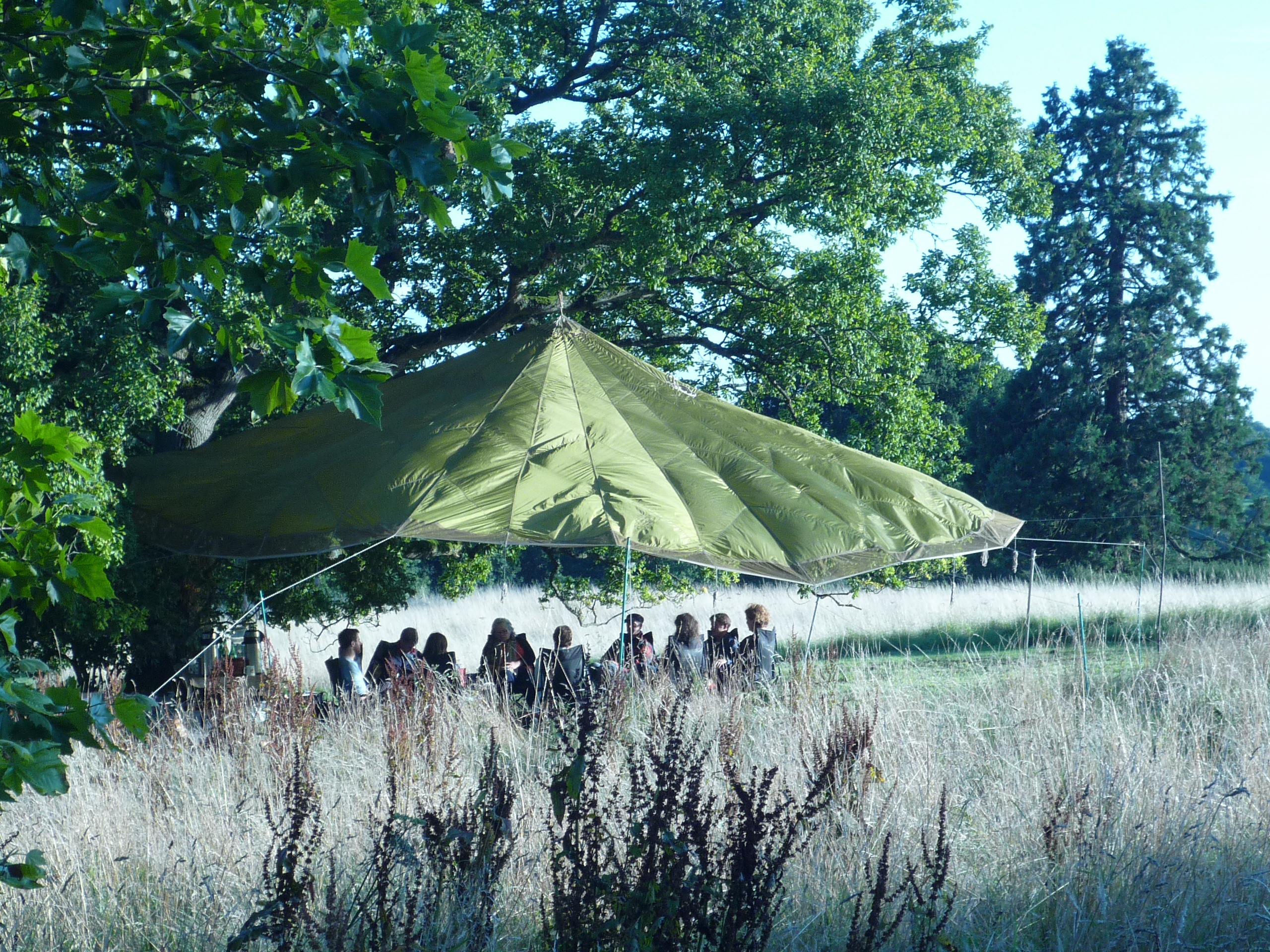
There are three levels by which Nature helps future-fit leaders learn:
- Science now shows us that simply being-in-Nature improves our wellbeing, creativity, empathy, agility, self-awareness and natural ways of being-and-knowing (intuitive, rational, emotional, somatic intelligences). After being in Nature for at least 30mins, are hormones change, our senses liven, brain synapse connections enhance, left and right brain hemispheres inter-relate more readily, and we are able to draw upon more of our natural embodied wisdom. Being-in-Nature is not just good for us, it is congenial to exploring our sense of purpose, sensing into personal and organisational challenges, opening up to fresh insights, better empathising with different viewpoints, while gaining perspective on our stuck patterns and biases.
- There is a zeitgeist shift in the air, a revolutionary shift in worldview, affecting how we perceive life and our sense of place and purpose within it. This challenges us at deep and partly unconscious levels, calling in to question how we create and deliver value in business and beyond. This transforms how we view life, from separateness (in business this manifests as viewing the organisation as a machine, with compartmentalised problems, and piece-meal reductive solutions) to connectedness (realising the organisation is a living system, that our challenges are systemic in nature and that our living organisation is intimately entwined with stakeholder relations at local and global levels, economic, social and environmental). With this shift comes a realisation that our solutions need to be created with a different level of consciousness from that which created the problems in the first place. Being-in-Nature helps us with this shift. In Nature, we can sense more readily into the agile, responsive and emergent leadership we now need for this ‘new norm’. We can take inspiration from living systems in terms of the patterns, processes, relationships and the eco-systemic nature of life. Biomimicry for creative innovation, redesigning for resilience, the purposeful living organisation, agile emergent leadership – these approaches are sourced from a living-systems mind-set. In Nature, we can sense into the divergence-convergence-emergence dynamics that underpin this living-systems logic. This helps us sense into the ‘new norm’ of the organisation-as-living-system. It also encourages a shift in our consciousness from the reductive analytic problem-space into the curious, exploratory emergent-space whereupon we sense into our emerging future with fresh eyes.
- To operate in today’s fast-moving ever-changing business environment, we need to call upon all of our natural ways of being-and-knowing. We need ‘full spectrum’ consciousness if we are to move beyond surviving into thriving amid these challenging times of breakdown and breakthrough. Those leaders who are better able to sense-and-respond effectively will not only do better in navigating these volatile unchartered waters, but will also create the conditions for their teams, organisations and wider eco-system of stakeholders to perform more effectively. Whether it be deep dialogue round an open fire, reflective solo time in the woods, embodiment practices in the open air, or applying living-systems insights from nature into business, time in nature offers something special as part of a leadership learning journey. It helps cultivate and deepen our ways of being-and-knowing, so that we can call upon our intuitive, rational, emotional and embodied intelligences more effectively. This helps shift the collective intelligence of the group. Regardless of the group mix, I have witnessed throughout all the future-fit nature immersions I have hosted that leaders gain a visceral felt-sense of this shift in personal and collective consciousness, so that they can call upon this embodied shift in being-and-knowing more readily amid the stresses and strains of the everyday workplace.
I often check-in with participants after they have experienced a future-fit nature immersion, to see how they are getting on and whether they are embodying shifts in their being-and-knowing – by example, here is feedback I received yesterday from a busy senior programme manager:
‘thank you for following up on our wonderful session earlier this year. I have to say I feel I have been performing at another level since then’
And feedback from a CEO who attended a workshop a few weeks back:
‘what a fantastic group you brought together, and what a deep space for heart-felt sharing you held for us. One of the things I am still reverberating with is a deep connection – both self-awareness and system-awareness …thank you so very much.’
And feedback from a Partner of a global consultancy:
‘Please receive fully my heartfelt gratitude for this wonderful retreat. It is exactly what I needed at this time – to feed my mind, heal my heart and soothe my soul…the way you held the process and the group was awesome.’
Future-fit leadership is about dealing with ambiguity and uncertainty, with curiosity and spontaneity. It is a shift in our attentiveness from reactivity to responsiveness; a shift in consciousness from separateness to connectedness. It is about surfing the edge of the wave of knowing and unknowing, of surrendering and flowing. Then, as future-fit leaders, we can more deeply listen-in to ourselves and our system, while creating spaces for our teams, organisations and eco-systems of stakeholders to become more vibrant, more alive, more resilient, and more life-affirming.
Giles Hutchins a coach, adviser, and Chair of the Future Fit leadership Academy, see here for more on these future-fit nature immersions, and a short three minute video on the book Future Fit
To explore ‘the new paradigm’ further, join the Face Book community here
Reawakening the Sacred in Everyday Living
The seismic challenges facing us throughout society and the environment are now patently clear to those with ears to hear and eyes to see.
There is global and local momentum building behind a range of social and environmental issues, from climate change to local food banks, from ocean plastics to food recycling. This is good work. Yet, what is often overlooked is that these plethora of challenges are symptoms of a deeper malaise, a malaise which is actually before our very noses, within in each breath we take.
To deal with symptoms without adequately addressing root causes is very much part of today’s flawed logic. We know we cannot solve today’s challenges with the same consciousness that created them. And yet to actually shift our consciousness requires a radical undertaking. This radical undertaking is not easy, and one we may wish to turn away from, and yet it is a simple one. It is nothing more, nor nothing less than us becoming more attentive, more aware of how we are being.

While this deepening – or raising – of our consciousness may be uncomfortable and unnerving, as it brings light to our habituations, constrictions and masks we hide behind. It is also a liberating and rejuvenating undertaking. We may begin to allow our ordinary everyday activities to become doorways into a sense of the innate sacredness of life, and its enchanting wisdom.
For many years now I have followed the profound work of the Sufi teacher, mystic and writer Llewellyn Vaughan-Lee. In his latest book, co-written with Hilary Hart, they put forward 10 simple practices that help us bring in a deeper way of attending into our everyday, so that we can reawaken the sacred, and deal with the root cause at the heart of our multiple crises.
It is now becoming more apparent to many at the leading-edges of leadership and organisational development that there is much we can learn from nature for future-fit business.
We now know that simply being in the great out-doors improves our ability to learn, be more creative, open up to different perspectives, be more empathic, listen deeper, share better, and be more insightful. Scientific research shows that being in nature improves us physiologically as well as psychologically in myriad ways, some of which we are only just starting to understand. Here are some of these findings:
- Being in nature reduces pulse rate, blood pressure and cortisol levels (Chiba University)
- Being in nature and disconnected from multi-media increases creativity by 50% (Atchley et al, 2012)
- Being in nature leads to improved cognitive functioning and mental well-being (Kaplan, 1993, 2001)
- Spending time in nature boosts the immune system and increases resistance to cancer cells (Qing Li, 2009)
- Walking in nature improves memory by up to 20% (Berman, et al, 2008)
- Connection with nature has a significant positive effect on autonomy, personal growth, and sense of purpose (Nisbet, Zelenski, Murphy, 2011)
- Affiliation with nature gives a greater sense of meaningful existence which in turn boosts well-being (Howell, Passmore, Buro, 2012)
This is all good stuff.
And yet there is something else, something deeper; something more phenomenological and – dare I say it – psycho-spiritual to this ‘being-in-nature’. And to describe this, I am now going to use Nature with a capital ‘N’ and also use the term ‘Mind-of-Nature’. Here, Nature is not just ‘out there’, its within and all around us, the implicate and explicate realms of life, the Mind permeating all matter, the Tao and its ever-flowing élan vital or life-force that enables us to become more human in this more-than-human world of ours. It is this deeper Nature that we must learn to cultivate within ourselves and through our relations to be more conscious, more agile and more harmonious as future-fit leaders in these times of increasing volatility and uncertainty.
Let me explain.
There is more to life than what we generally perceive of with our daily conscious awareness. Psychologists might call this daily awareness ‘ego-consciousness’ or the rational mind. I would like to draw on the profoundly influential and insightful work of the 19th century American philosopher, William James, who lived from 1842 to 1910 and whose work has influenced many great minds after him such as Bergson, Husserl, Wittgenstein, Putnam, Whitehead and Bertrand Russell.
James explored how everyday experience has a depth to it, an interiority that goes beyond what the ego-consciousness or rational mind can easily grasp at and yet is influenced by.
James noted, ‘Reality, life, experience, concreteness, immediacy, use what word you will, exceeds our logic, overflows and surrounds it.’ For James our mind-world relation is a stream of consciousness. He famously said:
‘Our normal waking consciousness, rational consciousness as we call it, is but one special type of consciousness, whilst all about it, parted from it by the filmiest of screens, there lie potential forms of consciousness entirely different.’
As we allow our ego-consciousness to permeate more readily, we allow more of these deeper realms of consciousness to pervade our awareness. This is where Nature comes in.
Regenerative Logic – cultivating the business of the future
This is a review of the book Future Fit by David Lorimer, editor of the Science and Medical Network (SMN).
FUTURE FIT
Giles Hutchins
Self-published, 2016, 308 pp., £17.99, p/b – ISBN 978-1-530-153435
I met Giles at a conference of the Laszlo Institute in Italy in July, and realised that I had reviewed his earlier book The Illusion of Separation a couple of years ago for SMN. This followed on from his 2012 book The Nature of Business, and here he brings these two concerns together in a highly practical manner, providing a brilliant handbook for personal and organisational transformation. Giles has synthesised and organised a great deal of essential thinking, some which he summarises in excellent charts and diagrams so that the reader can gain a clear understanding of the transition from old linear ways of thinking to new systems-based ones. In the course of the book, it becomes very clear that 21st-century companies can no longer afford to use 20th-century logic. Theoretical understanding is no longer enough – it needs to be embodied, which is why Giles’s practical exercises, tips, reflective questions and case examples are so useful. In addition, he provides a bullet point executive summary at the beginning of each chapter.

Current turbulence and uncertainty means that a transformation of mind-set is required both personally and organisationally. The danger is represented by what he calls a complexity gap in our leaders’ ability to deal with our volatile times. He comments that ‘too many of today’s organisations find themselves caught up in a top-down, hierarchical, KPI-obsessed, siloed, control-based, defensive and reactive firefighting mind-set.’ Nor do we flourish as human beings in such an environment, which surely puts a damper on creativity and keeps under pressure to focus on the immediate task at hand. His new logic is both regenerative and resilient, aligned to service and a sense of real value and deeper purpose. This leads on to his characterisation of the firm of the future, with a particularly helpful chart and diagram on pp. 34-35. A regenerative firm will also be resilient, optimising, adaptive, systems based, values led and life supporting. Each of these characteristics is explained in greater detail, a particular strength of Giles’s book and which he applies in a number of chapters.
He sees the overall process in terms of personal and organisational gnosis or inner knowing – this is not a word that one expects to find in a business book, but it is clear that the inner state of leaders is critical to the way they function. Crucially, leaders need to schedule reflective time into their week if they are going to be able to stand back and regenerate themselves. Too frequently, this is exactly what goes by the board, so things continue on as before. Giles gives exercises for the feelings, breath and body and suggests some significant qualities that we can embody in challenging work environments: gratitude, surrender, trust, courage, humility and reverence.
Organisational gnosis affects both processes within the firm and its outside relationships. Here again, some of the key attributes and qualities might seem surprising: stillness, self-organisation, small steps, social, synchronicity and soulful, but Giles shows these can be implemented in a practical way using processes such as council, deep listening, open space, appreciative inquiry and circles of trust. At the end of this chapter, he uses the seven levels model of Richard Barrett by mapping seven stages of organisational development towards becoming a firm of the future. This means knowing what organisational actions and needs are at each level, with corresponding developmental tasks. Needless to say, very few companies will be operating consistently at the seventh level, but the firm of the future will be advancing in the direction of collaboration and service.
Leadership, as already mentioned, is essential to making this transition of logic, and Giles highlights five important areas for leaders to focus on as well as five qualities of conscious leadership. Such leaders are good listeners, coaches, facilitators and catalysts, operating as convenors and hosts within their organisations and using constructive criticism as a spur to further transformation. The book ends with a reflection on alchemy, showing how the qualities of Yin and Yang need to be finely balanced and embodied in wise action. There is then a series of health check questions for a future-fit organisation as well as details of a corresponding benchmark. Personally and professionally, we are all involved in a transformative process, and this refreshingly straightforward and clearly written book provides an invaluable route map based on the latest thinking in science, psychology, spirituality and business studies.
‘Many books call for new ways of thinking for modern leaders but until Future Fit none have provided such wise, well researched and practical approaches to guide leaders facing deeply complex challenges. In this compelling workbook Giles Hutchins is at the forefront of synthesizing new logics for business with the natural rhythms of life and the human mind that will revolutionize business. Future Fit is a must-read for every leader who wants to continue being successful or to move beyond what currently feels like impossible challenges. As an experienced Chief Executive I cannot recommend this powerful work highly enough.’ Dr Lynne Sedgmore CBE, Former Chief Executive of 157 Group, Centre for Excellence in Leadership UK, and ranked one of the UK’s most influential people in Debretts 2015 List.
‘Future Fit is a masterpiece of synthesis weaving together the emergent strands of wisdom from others with the author’s own extraordinary insights. This is a must-read for any business seeking answers to a deep inner sense that something different is needed for them and their organization to stay relevant in the 21st century.’ Mark Drewell, Senior Partner, The ForeSight Group, co-founder and former CEO of the Globally Responsible Leadership Initiative
‘Future Fit is prescient and practical. It describes the future as it can and should be, by drawing on a breadth of knowledge rarely seen in business books. It also makes big, abstract ideas more concrete, by offering examples and advice. This book will help managers navigate a complex world for a more sustainable world. Giles Hutchins is one of the most broad-reaching, forward thinking writers in business.’ Tima Bansal, Canada Research Chair in Business Sustainability, Ivey Business School
‘We see an emerging trend of moving from a mechanistic view of business to an organic, living organization framework, and Future Fit goes right to the heart of it. Packed full with practical insights to help activate and catalyze this transformation, this is a brilliant book that will help you wrap your head around the shifting paradigm at the vanguard of future business. Read it!’ Norman Wolfe, CEO of Quantum Leaders and author of The Living Organization
to see more on Future Fit, you can visit the book’s website www.futurefitbook.com here
And to join the Facebook community for Future Fit and the new paradigm see here
Meditations on Respect and Love in a Fragmented World
‘Man knows himself only to the extent that he knows the world; he becomes aware of himself only within the world, and aware of the world only within himself.’ Johann Wolfgang von Goethe, writer
‘What is within us is within everything. Once we understand this truth, we step outside of the parameters of our individual self and come to realise the power that is within us. This shift in awareness is a very simple step that has profound consequences’ Llewellyn Vaughan-Lee, mystic
‘And now here is my secret, it’s a very simple secret, it’s only with the heart that one sees rightly, what is essential is invisible to the eye.’ Antoine de Saint Exupéry, writer
‘Unlike the egoic operating system, the heart does not perceive through differentiation. It doesn’t divide the field into inside and outside, subject and object. Rather, it perceives by means of harmony…When heart-awareness becomes fully formed within a person, he or she will be operating out of nondual consciousness…where they will discover the resources they need to live in fearlessness, coherence, and compassion – or in other words, as true human beings.’ Cynthia Bourgeault, contemplative
The ability to deeply listen and speak from the heart while creating a space for generative courageous conversations is a primary aspect of the leadership we need in these times.
At its heart, generative dialogue is nothing more nor nothing less than speaking and listening with our whole-selves while being receptive and responsive to our social field. This is what allows ourselves and others to open up for an altogether more human sharing.
‘Dialogue is a conversation…taking the energy of our differences and channelling it towards something that has never been created before [an emerging co-creation] thereby a means for accessing the intelligence and correlated power of groups of people…You relax your grip on certainty and listen to the possibilities that result from simply being in a relationship with others.’ Bill Isaacs, dialogue specialist
Dialogue is like a dance, where the emergent space between the people and between the words shared is all important. The flow of the dance and the depth of openness between the dancing partners is what allows the dance to come alive and for deeper co-creativity to emerge.
Difficulties, tensions and disagreements are held in a generative non-judgemental way that provides a deepening of sharing rather than a rupturing of relationships.
As we deepen the receptivity and responsiveness of ourselves, the generative field widens; energy and creative potential is unlocked and the life-force of our people and wider system flows.
It is up to each of us as leaders to seed a culture of dialogue through the quality of conversational inter-relating performed by us in the day-to-day thick-of-it-all, whether informal corridor chats, email conversations, telephone calls or meetings.

The more we practice (often stumbling and failing, but learning as we go) the more we become aware of how we are influencing the generative field of our conversations and the generative field of our stakeholder ecosystem. In-so-doing, we consciously cultivate the conditions conducive for life to flourish – we become a conscious company through our respectful relations hand-in-hand with our sustainability reports, purpose statements and cultural charters.
Here, we are co-creating an empathic environment of love through our sense of connectedness with life: self-other-world. We can consciously sense when we are enclosing/fragmenting ourselves with inner turmoil, alienation, anxiety and over-sensitivity that then warps into blame, judgement, anger and polarisation in a botched bid to protect the wounded-self. We can also consciously sense beyond this ‘noise’ into the deeper vistas of life’s unfolding /enfolding implicate order of Nature.
Rather than being tossed this-way-and-that by the surface waves, we find our root-connection deepening into the Earth-and-universe to gain true perspective in a non-possessive non-fragmented transpersonal perspective. The universal kinship of the implicate order of Nature is seen not through the ego-eyed squint of separation and polarisation but as an evolutionary unfurling of growth and renewal. We participate in the evolution of life as a dance towards harmony (diversity-and-unity) rather than a competitive struggle towards domination and monoculture.
‘To love well calls for all that is demanded by the practice of any art, indeed of any human activity, namely, an adequate measure of discipline, patience, and persistence.’ – Roberto Assagioli, psychotherapist
It is worth reflecting on this famous poem ‘If’ by Rudyard Kipling :
If you can keep your head when all about you
Are losing theirs and blaming it on you,
If you can trust yourself when all men doubt you,
But make allowance for their doubting too;
If you can wait and not be tired by waiting,
Or being lied about, don’t deal in lies,
Or being hated, don’t give way to hating,
And yet don’t look too good, nor talk too wise:
If you can dream—and not make dreams your master;
If you can think—and not make thoughts your aim;
If you can meet with Triumph and Disaster
And treat those two impostors just the same;
If you can bear to hear the truth you’ve spoken
Twisted by knaves to make a trap for fools,
Or watch the things you gave your life to, broken,
And stoop and build ’em up with worn-out tools:
If you can make one heap of all your winnings
And risk it on one turn of pitch-and-toss,
And lose, and start again at your beginnings
And never breathe a word about your loss;
If you can force your heart and nerve and sinew
To serve your turn long after they are gone,
And so hold on when there is nothing in you
Except the Will which says to them: ‘Hold on!’
If you can talk with crowds and keep your virtue,
Or walk with Kings—nor lose the common touch,
If neither foes nor loving friends can hurt you,
If all men count with you, but none too much;
If you can fill the unforgiving minute
With sixty seconds’ worth of distance run,
Yours is the Earth and everything that’s in it,
And—which is more—you’ll be a Man, my son!
Easier said than done! But is this not the real challenge that lies before us? We might wish to hide from it, and engross ourselves in slumber, but it is real enough if we so choose to see…
Perhaps learning to respect ourselves, each other and our world is what being a ‘human being’ is all about. As we deepen this learning, as we become more respectful, we see the world more richly, we sense the inter-relationality, the ebbs–and-flows, the wider constellations and hidden connections. Each day becomes our sensing-and-responding learning school, each moment our opportunity to grow and deepen as a Homo sapiens ‘wise being’.
Every authentic relation in life requires us to open up beyond judgement and projection into a real sharing with-and-through love. This involves us being vulnerable. It requires courage. It requires constant practice, dedication and devotion.
When we think or comment with a judgemental tone, we project something of our own lack of self-love on to the other. With judgement, we see the world through a fragmented, separating lens which fractures and filters. This defending, rising animosity, polarises us-versus-them. It all originates in a lack of self-love, our own shadows. We get caught up in a vicious cycle of being wounded, wounding others; being judged, judging others. Sub-personalities cloud our deeper truth, we supress even more into the shadow and the polarisations heighten. Enter Trump.

When we centre ourselves in the heart, in our centre, then we begin to see rightly once again, and we can truly listen and truly share. This is our humbling, courageous response-ability. This is the core to sustainable living – yet so often over looked, in part because it’s ‘messy’, whereas in comparison supply-chain metrics are ‘neat’.
A human being flourishes through empathic, respectful relations with others, not through metrics although, for sure, metrics are useful.
This respectful relating is primary to any organisation seeking to enhance conscious living in today’s world. Seeking to enhance conscious living in today’s world is, arguably, the essential purpose of our time.
To explore ‘the new paradigm’ further, join the Face Book community here
For Giles Hutchins’ personal website www.gileshutchins.com

