Beyond Capitalism – Sacred Business
Let’s start with some definitions. What does the word sacred mean and what does the word business mean?
The word sacred derives from the Old French word ‘sacrer’ which originates from the Latin ‘sacer’ meaning dedicated, holy or reverence. Reverence means deep respect, deep admiration or deep affection – to love, venerate, cherish and respect.
St Ethelburga’s Centre for Reconciliation and Peace takes sacred to mean the reverence for life.
The word business comes from the Old English ‘bissinesse’ which means diligence and also a state of being busy. Also related is commerce, which originates from the Latin ‘commercium’ – com (collective) and merx (merchandise), the exchange of goods, services, intellect or social intercourse. Also related is profit, which originates from the Latin ‘profectus’ which means to make progress and ‘proficere’ which means to advance.
Capitalism is a particular economic and political approach which relies upon private ownership, capital accumulation and wage labour for profit and return on investment. It is now the dominant business paradigm in the West. Yet it is not what business is essentially about even though this prevalent logic might influence daily exchanges and interrelations whether in the West or beyond.
Capitalism is only a particular manifestation of the way business may be conducted. In fact, some may view it as a corruption of business, which undermines economic and social resilience. Its ideology spawns from an inherent corruption sown deep within the mind-set of modernity; a control-based abstract rationalism that defines ‘things’ as separate from their lived-in context with relationships as nothing more than self-maximising power-plays, where one ‘thing’ benefits only at the expense of the other. It is what the anthropologist and cyberneticist Gregory Bateson insightfully understood as the ‘original corruption’ which pits us against Nature in an evolutionary cul-de-sac of selfish ascendance.
The renowned business adviser Peter Drucker once famously said,
‘In times of turmoil, the danger lies not in the turmoil, but in facing it with yesterday’s logic’.
Yesterday’s logic is one that sets humans apart from each other and from the rest of Nature viewed through the lens of competition, control, separateness and rationalism. It is this flawed logic that is at the heart of all our crises – world poverty, climate change, biodiversity loss, social inequality, wars, etc.
As CEO of Unilever, Paul Polman has said,
‘Too many people think in terms of trade-offs that if you do something which is good for you, then it must be bad for someone else. That’s not right and it comes from old thinking about the way the world works…We have to snap out of that old thinking and move to a new model.’
This new model is actually as ancient as it is fresh, it is the logic of Nature and can be found within and all around us if we so choose to perceive life beyond this devastating illusion of separation. To do this, we can re-awaken the sacred through our deeper understanding and attunement of Nature.
By its very nature, attending to life beyond the illusion of separation allows for a culture of reverence to form, as our inner-outer relation attunes with the love and wisdom flowing through every moment in our midst. This is to experience the sacredness of life, beyond the corrupting confines of capitalism, materialism and rationalism. This sacred understanding allows us to re-cognise the reciprocity within and throughout Nature. It is not competition that is the inherent grammar of life, it is interrelations, co-creativity and fluid reciprocity – this is the business of Nature.
‘We have been, and still are, in the grips of a flawed view of reality – a flawed paradigm, a flawed world view – and it pervades our culture putting us on biological collision course with collapse.’ – Former Chairman and CEO of Interface, Ray Anderson
In business, as in Nature, everything works through relationships. Trust is the soil from which healthy vibrant relationships take root. Relationships struggle to survive without trust. Trust requires mutual respect and understanding, an empathic reaching out beyond oneself that allows for reciprocation. And so we may see that the true nature of business is the business of Nature.
Deep respect for ourselves, each other and Nature is not some luxury add-on which can be dispensed with in times of economic downturn, it is foundational to who we truly are; without it we become rudderless, tossed this way and that by inauthentic egotistic whims – distracted, dis-eased and deluded.

It is through the simple (yet not always easy) shift in our way of attending to life that we may open up to the inherent wisdom of Nature. Here we find the ground of our being beyond the fragmenting dichotomies of yesterday’s logic. Business can offer a richly texture, diverse, often windswept and turbulent, yet co-creative, participatory ocean for spawning right thought, word and deed.
Business follows in the wake of what is demanded of it, otherwise we have busy-ness for busyness sake – not exactly Homo sapiens living up to our name.

Rather than our culture’s infatuation with stuff fuelled by our egotistic incessant grasping and wanting due to our sense of separation and severance from Nature, imagine the creative potential and entrepreneurial flair of business minds following in the wake of demand for the pursuit of true happiness, of love, of soulful heartfelt attunement within the wisdom of life. This is sacred business and it is at the heart of any new society.
To explore ‘the new paradigm’ further, join the Face Book community here
View a short video clip on business inspired by nature here
View a presentation on ‘A Radical Review of Reality’ here
Leading Across The Threshold – Courage for Transformation
Much has been written about the fast-changing, transformative times we now live and work in and how this calls for new styles of leadership. Fritjof Capra, for instance, speaks of ‘emergent leadership’ which facilitates and fosters a culture of emergence in organisations and communities where continual change is embraced as the ‘new norm’. Palmer J Parker speaks of leaders being ‘midwives’ in facilitating the birthing of a new way of being and doing – a new consciousness no less – where diverse teams learn to deal with volatility with courage beyond the limitations of yesterday’s mind-set. Scilla Elworthy speaks of ‘awakened leadership’ as a way of envisioning and then pioneering future worlds beyond fear through developing what she calls ‘inner-intelligence for outer effectiveness’.

Emergent leadership, courageous leadership, awakened leadership and authentic leadership all share a common ground, which Zen Buddhist Master Nan Huai Chin sums up as seven places: awareness, stopping, calmness, stillness, peace, true thinking, attainment. It is through this inner-outer awareness that leaders can fully presence the evolving context they operate in and so nurture a collective learning environment. Accepting the present moment with an open heart, unlimited by pre-conceived notions and judgements – this is leading with courage (its Latin root ‘cor’ meaning heart) beyond fear, beyond control – and it’s not for the faint-hearted. It asks us to recognise the vitality of co-innovating new ways of operating beyond the confines of pre-defined outcomes: improvisation, conviviality, collaboration, creativity.
When it boils down to it, it’s all about relationships – how we physically and psychically relate with the world. In business and nature, everything works through flows of relationships. Trust is the soil from which healthy vibrant relationships take root. Relationships struggle to survive without trust. Trust requires mutual respect and understanding, an empathic reaching out beyond oneself that allows for reciprocation.
To be spontaneous while co-creating with others is to have innate trust in the relationships while letting go of control. In this way, trust allows an opening up to the present moment – a ‘presencing’ where upon we en-courage an aliveness to flow through all we are co-creating. Authenticity and spontaneity are dancing partners in transformation, nourished by trust and fuelled by courage.
We can encourage and accompany others through sharing our experiences. Likewise others can encourage and accompany us as new possibilities are encountered. In accompanying others in their learning quest into deeper awareness and understanding, we question and converse. After all, we Homo sapiens are primarily social creatures. This sharing of feelings and findings is immensely important and enriching for everyone involved. This is an inspirational and improvisational kind of facilitating. It encourages a meeting of minds through an appreciation both of what we have in common and of how our differences serve to complement our co-learning.
This inspirational facilitation provides safety and freedom – amidst the volatility and uncertainty – to question and share concerns, anxiety, motivations and experiential learning. A willingness to invite questioning of all kinds of assumptions and beliefs allows an opening up for new ways of thinking, listening and sharing. ‘Leaders’ in this mould are not leading ‘followers’; they are cultivating a co-creative environment where transformation happens. They may have special experience gained through personal pioneering experiences, and yet, with humility and courage, share this with others. In leading they are nurturing an open, receptive, loving environment for individuals and the community to tap into as they move forward in engaging fresh possibilities. In this way, preconditions, past-experiences, expectations and judgments can be aired and shared, allowed to either dissipate or transmute into learning. Likewise, leaders of this mettle are open to temporarily relinquishing, rotating, or taking a step back from, leadership when circumstances dictate.
Fear-based leading Courage-based leading
Authoritarian Emancipation
Leader-follower relation Co-creative relation
Motivated by power Motivated by love
Blame culture Compassionate culture
Risk-averse Pioneering
Adversarial Inspirational
Competitive Empathic
Command and control Improvisational
By its very nature, this kind of co-creative leading is neither hierarchical nor subservient nor adversarial. There is no ‘enemy’ to fight, mountain to conquer or power to manipulate; yet there is fear, trepidation, passion, courage, suffering, empathy, sharing, charisma and encouragement. It is less about orchestrating or conducting and more about facilitating the ability of others to attune themselves; energising and equipping oneself and others to make the right choices for the situation at hand. The result is more effective, resilient teams who are able to face increasing uncertainty with renewed inspiration, creativity and love.
The root word of ‘leadership’ is ‘leith’ which means to cross the threshold, to let go of old ways, mind-sets and logic in order to embrace the new. Leadership is, first and foremost, an attitude to life. These transformational times are demanding each and every one of us to become leaders in myriad ways: mothers and midwives, counsellors and CEOs, activists and administrators – the times we live ask us to ‘know thy self’ so as to reach beyond self-interest for the benefit of something greater. This is what authentic Homo sapiens do; it’s simply – yet not necessarily easily – a case of being true to our nature. As Zen teacher Susan Murphy Roshi puts it, systemic transformation ‘does not come about from a top-down approach. No living system has a boss. The boss is all of us, inextricably together, using the distributive wisdom of countless local actions occurring simultaneously…To be able to realize our real freedom within a sober, creative, playful awareness of reality is vital to get beyond the thinking that created the problem.’ This is the fresh, yet ancient, logic now required for the tumultuous challenges staring us down – it draws on the deep wisdom of nature. Ultimately, this is about evolution or extinction, anything else is mere distraction.
To explore ‘the new paradigm’ further, join the Face Book community here
View a short video clip on business inspired by nature here
View a presentation on ‘A Radical Review of Reality’ here
A Radical Approach To Natural Business – Holonomics
Giles Hutchins explores a dynamic way of seeing in business and beyond, in reviewing the book Holonomics: Business Where People and Planet Matter, authors: Simon Robinson and Maria Moraes Robinson.
Publisher: Floris Books, UK, 2014. ISBN 9781782500612 find here on Amazon
Much has been written recently about the increasingly desperate need for radical approaches to business, leadership, social change, politics and economics. We have Einstein’s words ringing in our ears in recognising that we cannot face today’s problems with the same thinking that created them. This much is certain. And yet when it comes to radically overhauling our way of attending, relating, engaging and thinking in business and beyond, we all-to-often find ourselves falling short, restricted by ingrained habitual frames. To truly see ‘outside the box’ in a systemic way is most challenging and yet nothing less is now called for.
Holonomics unpacks what it practically means to think differently, and is radical in its approach in going to the root of our mechanistic worldview. The authors provide an enjoyable and eloquent transformative path for the reader to consciously harmonise rationalistic logic with intuitive, organic phenomenological logic. Structured in three easy to digest parts; Part One – The Dynamics of Seeing – explores the ‘what’ of thinking differently and the ‘how’ of embracing new ways of thinking; Part Two – The Dynamics of Nature – the insightful work of Goethe, Schad, Prigogine, Darwin, Margulis and others, on perceiving relationships within and across living systems is explored; Part Three – The Dynamics of Business – provides inspiring examples of applied ‘holonomic’ thinking for leadership and organisational management.
The challenge now facing many us is how to encourage those in business and beyond to embrace an ecological perspective where intrinsic and extrinsic dimensions of complex systems are understood. The authors discuss ‘authentic wholes’ where the unfolding emergence of living systems is both intuited and rationally understood; with this conscious awareness comes a transformation beyond the mechanistic mentality whereupon we empathically inter-relate as well as rationally abstract. This radically alters how we attend to reality enabling us to transcend the illusion of separation created by Cartesian rationalism. It not just alters our intellectual understanding of sustainable business issues but also unlocks an inherent wisdom flowing throughout Nature. And so we find, through the techniques and practical suggestions provided throughout Holonomics, that we can shift into being inspired by AND becoming in harmony with Nature – radical sustainability.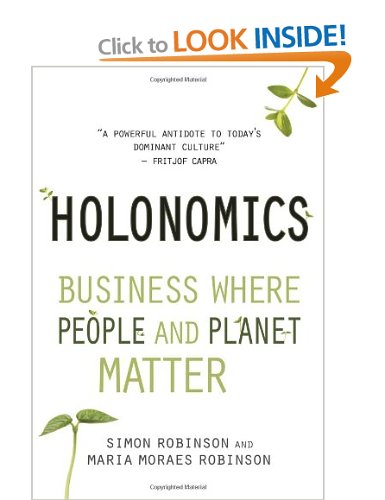
The authors are keen to point out the benefits to business in understanding this shift: creativity, innovation, collaboration, problem solving, resilience, sense of purpose, improved morale; all high priorities for forward-thinking organisations wishing to thrive in the volatile years ahead. And they note that there is no more successful business consultant than Nature – having myself worked as a management consultant advising a great variety of organisations for many years, I could not agree more. Biomimicry, for instance, is increasingly being taken up in business strategy and operations, yet what is often so vitally overlooked is a ‘holonomic’ approach of understanding and applying Nature’s wisdom. In our rush to solve todays problems we rarely challenge the thinking that created them, and so we copy Nature’s forms and patterns in an all too analytic and atomistic way missing the deeper wisdom Nature affords us – the recognition that organisations are living systems, both physical and psychical, best understood through the intuitive and rational logic of our heads, hearts and hands.
In facilitating our ability to perceive beyond the limitations of our prevalent paradigm, Holonomics provides the fertile soil from which right thought and deed take root, ensuring our sustainability solutions are freed from the narrow-mindedness that created the problems in the first place. To this end, Holonomics asks us to question all aspects of our personal and collective habituations. If we are honest with ourselves, how often do we have moments of unadulterated ‘presencing’ where we authentically relate with each other and the world around us, unencumbered by preconceptions? How often do we truly love the interrelating moment beyond expectation of what our individualistic ‘self’ can exploit? Clearly, these questions are profoundly relevant. What Holonomics skilfully achieves is applying the rich philosophies of phenomenology and holistic science to our daily business endeavours and for that reason it is ground-breaking and an important book for those seeking to shift organisational consciousness.
Here is a short video of co-author of Holonomics Simon Robinson talking with Satish Kumar who kindly wrote a foreword for the book
For more on the new paradigm and new thought in business and beyond you can join the face book community here
This is a guest blog by Mark Spokes of Ākāśa Innovation
I have three words to share with one person. They might not be what you are expecting. However, they carry a message that speaks to us all. These words remind me that hope springs eternal with each new generation of young people. They reassure me of the possibilities of creating a beautiful world full of flourishing life if we just give young people every opportunity to thrive. I believe that you will want to share these three words too.

Samia Khoury inspired me and called me to action with these words. She is one of the many Palestinians I have met over recent weeks who never give up hope, even in the most hopeless of situations. In her book, “Reflections from Palestine: A Journey of Hope – a Memoir,” Samia describes her life’s work to bring justice for her people. Now at the age of 80, she expresses some concern for the future as both a mother and a grandmother, but she continues to find hope in young people joining the cause.
Young people give hope to some of our most influential elders. The UN Ambassador for Peace and the famous primatologist, Dame Jane Goodall – another 80-year-old – recently voiced her fears about the global environment, but said that young people are giving her hope: “It almost seems that young people are different. They are rising to the challenges that lie ahead of them because of our mistakes.” In her book, “Reason for Hope: A Spiritual Journey,” she praised the “powerful force unleashed when young people resolve to make a change.”
Our best hope for the future lies with the next generation of young people. But we must share with them the wisdom of our elders. If we learn best from experience, then young people should hear from those who have more direct experience of the consequences of their actions over decades. Amartya Sen, the Nobel Economics Laureate and another 80-year old, recounts an old Bengali saying: “Knowledge is a very special commodity: the more you give away, the more you have left.” Many of our elders recognise that education not only prepares the leaders of tomorrow for the global crises they are inheriting, but also cultivates their own hopes that peace in the world is possible.
Education becomes more important with an awareness of the cycles of life and death. “We are like butterflies who flutter for a day and think it is forever,” wrote the cosmologist Carl Sagan, who would have been 80 this year. Some of our elders, who are reflecting on their twilight years, have perhaps come to understand the significance of another of Sagan’s pearls of wisdom: “To live in the hearts we leave behind is to live forever.” This knowledge of the meaning of the human experience must now inform how we help each new generation of young people learn to see the world anew. In his classic book, “The Pale Blue Dot: A Vision of the Human Future in Space,” Sagan wrote: “The visions we offer our children shape the future. It matters what those visions are. Often they become self-fulfilling prophecies. Dreams are maps.”
I am lucky to be working with Greta Rossi, the founder of Ākāśa Innovation. She has used her experience as a youth leader in human rights to now work in empowering other young people to follow their dreams of shaping a better future. Her commitment is the soul of the new Ākāśa Young Pioneers Programme, which is designed to prepare, inspire and empower young people to become sustainability leaders and help them make a brighter world. The twelve-week course that begins this autumn will be an exciting and transformational experience for twelve promising young people unable to afford or access expensive university courses and unpaid internships. Passionate and talented young people like Olivia and Michela have already joined Greta to work throughout the Ākāśa (50) Days of Summer towards raising funds to provide scholarships for each of our Young Pioneers.
I also feel fortunate to be working alongside Dr. Mike Edwards. He is one of the most talented educators that I have come across and will be guiding the Young Pioneers in developing the mindsets and skillsets they need to change the way we do business. Mike is also an adviser on climate change strategy to The Elders, a group of global leaders established by Nelson Mandela, who are passing on their knowledge to prepare the “youngers” to become the leaders we need now and in the future. Among these Elders, the former US President, Nobel Peace Laureate and another 80-year-old, Jimmy Carter, has been prominent in encouraging young people to become active ahead of the 2015 UN Climate Change Conference in Paris: “Young people will inherit our planet, our successes and our failures. As Elders, we urge them not to underestimate their power, influence and responsibility to address the biggest challenge of our time.”
To find the wisdom to pass on to coming generations, we probably need look no further than our most enlightened 80-year-old – the Dalai Lama. In the recent documentary film, “Road to Peace”, the Dalai Lama spoke directly to young people: “Now you are the real human generation who will make a new shape of this planet.” His wish is for the next generation of leaders to prepare themselves with an education that builds the skills and expertise needed for life in this century, combined with the sources of inner strength that come from the likes of determination, truthfulness, honesty, warm-heartedness, and compassion. The Ākāśa Young Pioneers Programme is one answer to that wish. Twelve young people build skillsets and mindsets throughout the twelve-week course. This prepares them for a unique work placement that brings them together as an innovation team working to help make another not-for-profit organisation flourish.
The Ākāśa Young Pioneers Programme is being launched to realise our hopes of young people; it is led by young people with hope for a better world; and it provides a space for young people to experience hope and realise their potential to inspire in others a hope for the future. The wisdom and experience of our elders is drawn upon to prepare, inspire and empower our Young Pioneers. In doing so, the sweeping grand narratives that currently dominate the field of sustainability are replaced with an enduring soul found in the meaningful connections we find in each other, within ourselves and with the planet.
The talented and passionate young people that I have met through Ākāśa Innovation fill me with hope. I now realise how important it is to return this hope and promise back to our elders within the simple three words that bring Samia such joy. And that is why I know the importance of the three words that fill Samia with hope. “As long as there is life there is hope,” she declared. “I continue to have hope as long as there are [active young people] in this world – and as long as there are children who come and say, ‘Good morning Grandma,’ there is reason to hope.” At the end of the first week of the Ākāśa Young Pioneers Programme in autumn, I will be travelling home for my Nanna’s 80th birthday. I will wake up on Sunday and go downstairs, where she will no doubt be ready with breakfast and say, “Good morning Nanna.” I will thank her for all of the love she has given her four grandchildren and promise to pass this on so that we can hope for a better world for coming generations. It will be Grandparents Day in the UK, so why not plan a visit, a phone call, or a brief moment to remember someone and share hope together. Hope dies last if we recall a Kenyan proverb: “The world was not given to you by your parents; it was lent to you by your children.”
Mark Spokes
Chief Flourishing Officer
Breaking through the ‘space barrier’ from abstract perception to alive natural perception
This is a guest blog written by scientist and natural philosopher Dr. Alan Rayner.
Imagine yourself standing petrified on the concrete edge of a swimming pool, while being jostled by those next to you. Someone splashing about in the water shouts to you. ‘Come on in, the water’s lovely!’ But you’ve never experienced full immersion in water before and you’ve never been taught how to swim. How do you feel?
Our cultural and educational institutions teach us, from a young age, to perceive our selves and others as if we were separate, isolated objects, both set apart from one another and boxed in by rigid boundaries.
In order to feel secure, we mentally sever ourselves from each other and the creative wildness of the natural world by setting in place an imaginary hard line or ‘cut’ – what I call ‘the space barrier’ – that enforces profound social and psychological conflict and environmental destruction.

Recall Hamlet’s famous soliloquy and where it led him: ‘To be or not to be, that is the question: whether ‘tis nobler in the mind to suffer the slings and arrows of outrageous fortune, OR, to take arms against a sea of troubles and, by opposing, end them’.
Do we give our selves the space and time to stop to think carefully about why we impose these definitive limits on ourselves – as present or absent – and Nature – as a sea of troubles.
Ask yourself what kind of a boundary could actually cut the space within you away from the space around you without itself including space?
Imagine drawing a circle on a still sheet of paper. You can’t do this simply by applying pencil point to paper – all you would get is a ‘dot’, a stationary point. Instead, you have to move the pencil point around to produce the circle, while not making the pencil point so sharp and hard as to cut a hole in the paper. The circle is formed by a combination of continuous paper with continuous pencil movement. Now, bearing in mind that paper is, like water, a tangible substance that can be cut, not a limitless pool of intangible presence, like space, think how this could relate to the way natural forms arise, through the movement of a presence within and around space that cannot be cut.
We can dispense with our imaginary need to hard-line ‘things’ by recognising how natural space and boundaries actually are distinct but mutually inclusive presences. We can do this by appreciating:
- Natural space as a presence everywhere that is not a substance but makes the existence of substance possible
- Energy as continuous motion that locally in-forms space into bodily presence
When we think about it, every ‘thing’ or ‘body’ is 100 % space PLUS energy, not part space and part energy. That’s how Nature is, including human nature.
 Now I think a vital principle of life and love as mutually inclusive presences begins to emerge –
All natural form is the co-creation of continuously mobile, informative presence (energy) and continuous receptive presence (space).
This different perception frees us from divisive belief in a struggle for existence (‘to be’) against non-existence (‘not to be’), to an acceptance of living bodily boundaries continuously circulating and reconfiguring within a limitless sea of receptivity, not holding their own against a sea of troubles.
As William Wordsworth once declared:
‘In nature, everything is distinct, yet nothing is defined into absolute, independent singleness’.
Now I’d like to introduce an observation that brought out this radically different, natural perception of everything to me.
‘Mushrooms and toadstools’ are, in reality, no more ‘all there is’ to a fungus than an apple is all of an apple tree!

Behind the scenes of that outward appearance is an extraordinary, hidden production team that does all the hard work of gathering in the energy required to make it possible. This is known as the ‘mycelium’ , a collective organisation of microscopic, branching tubes, called ‘hyphae’, which grow from their tips in a radiating pattern.
In abundance it multiplies; in scarcity it conserves and redistributes what it already has. Unlike our current, divisive social and economic systems, it does not borrow what it hasn’t got from a future that hasn’t come in order to gain a competitive advantage over its rivals!
Here is an important lesson I learned from Nature:
In Naturally Sustainable Organizations, Life is a gift of energy to be received, sustained and passed on in natural relay
Here death and degeneration are as vital to the ability of living organizations to locate, gather in, conserve and redistribute energy as their capacity to grow and network.
This brings me to recognize that evolutionary diversification arises through a dynamic transformational process of natural inclusion of each in the other, NOT, as envisaged by Darwinian selection theory, through the competitive exclusion and extinction of one by another. Instead, evolutionary diversification is perceived as a fluid dynamic process of cumulative energetic transformation, over vastly differing scales from microcosm to macrocosm.
We can dispense with defining things into an abstract, unnatural order and learn to live in a more naturally attuned, passionate, compassionate and sustainable way.
To explore ‘the new paradigm’ further, join the Face Book community here
We live in challenging times; a world fast-filling with strife: wars, competition, struggle, debt, exploitation, inequality, degradation, etc. And, if the findings of world-leading scientists are to be acknowledged, time is not on our side.
There is much to be upbeat about and plenty of inspiring examples to point to of people in all walks of life striving for a better more sustainable future. And yet, much of the time, the solutions we come up with to our many pressing challenges tackle downstream effects while leaving the underlying causes gapping. So often we apply solutions with the same mind-set that created the problems in the first place.
Is there an underlying source – an original corruption – that is the root of these ever-widening and deepening challenges?
I believe there is.
The ’original corruption’ is a way of attending that completely identifies with the ‘I’ or ego and its forms – physical, thought, emotion. This egotistic way of attending obscures reality in a way that sees our selves as separate from each other and from our neighbourhood. It projects a mental abstraction of ‘self’ as separate from our true nature, our soulful receptive presence which we were born with and is innate throughout Nature.
The egotistic self is a re-presentation, a mental abstraction that we develop as a tool for interacting with the world. It is like a split personality in that it separates a sense of ‘I’ from our true nature and then projects this ‘I’ as the mental image of ourselves as a defined, discrete ‘I’ dislocated from the world around us. Whereas a sense of ‘I’ is important for our personal development, analysis and planning, it becomes potentially abusive when consolidated into a projection that subsumes how we naturally are. The tragedy comes about not because of the existence of the ego but when ‘assistant’ considers it to be ‘master’ and so the fragmented self becomes the dominant way of attending and our true Self suppressed.

This mental abstraction brings anxiousness, defensiveness, competitiveness and fearfulness which encourages a modus operandi of ‘having’, ‘wanting’, ‘owning’, ‘consuming’, ‘exploiting’. Its hallmarks are impatience with the present moment, nervousness, boredom, resentment, jealousy, discontentment, vanity, resentment, etc.. We can notice these surfacing within us often quite regularly, especially in the humdrum distractive environment of today’s consumerist culture.
It is what Einstein called an optical illusion of consciousness – the ego’s mis-representation of reality that fast becomes an all-consuming masquerade that separates ‘I’ from the ground of our being. This is the root cause of our unsustainable socio-economic model: a sense of separation and dis-ease rather than inclusion and attunement. According to the spiritual teacher Eckhart Tolle, this illusion of separation is the ‘original sin’ as it is what creates all the problems we face in the world today.
So how do we go about rectifying this root cause?
‘To end the misery that has afflicted the human condition for thousands of years, you have to start with yourself and take responsibility for your inner state at any given moment. That means now.’ Eckhart Tolle
Many people increasingly speak of ‘presencing’ as a way to go beyond the confines of ego-consciousness. For instance, Peter Senge of MIT has explored how presencing is vital for the future of leadership and has set up a Presencing Institute focused at helping future business leaders. While there are many tools and techniques to help facilitate a state of presencing into our activities – for instance Otto Scharmer’s Theory-U – the essence of presencing is feeling the aliveness of the present moment beyond the ego’s sense of separation. This can be experienced by feeling our inner body; feeling the awareness beyond thought by shifting our attention from external form to aliveness inside us, the tiggling of energy in our fingers and toes, for instance, or the ebbing and flowing sensation of our breath, or the tides of love available to us as we authentically listen to each other, for instance. This ‘bodymind’ awareness helps ground us in the present moment.

To presence is to ‘let be’ without categorising or analysing what arises in our midst – easier said than done! Learning to let go of our mental abstractions and ego-identifications is not a plain sail yet it is vital for our evolution at this critical time. None but ourselves can undo our sense of separation from source. Now is the time to feel the aliveness of Nature, our true nature, the anima, the intense mystery and with it a humbling responsibility of co-creativity – alert, participatory awareness.
Ancient practices like T’ai Chi and yoga can help here as can meditation, mindfulness techniques, heart-based awareness, etc. to assist the quietening of mental chatter. This may allow the ego to loosen its incessant grip and permeate more readily with the ground of our being in our midst – this is to attune with Nature, Akasha, Tao, God – life beyond original sin. This is the heart and soul of living sustainably. It may feel like a struggle to begin with, especially while our minds are racing with the stress and busyness of today’s world – the list of things-to-do, twitter messages, meetings, rush hour traffic, bills to pay, phone calls to take, and so forth. Yet, if we wish to get to the root of our problems, we cannot avoid doing this most fundamental of undertakings – bringing our awareness into the unadulterated present moment. Emancipation from mental slavery, as Bob Marley would say, starts with our selves freeing our minds.

What is now called for is a new cosmology, a new story, which re-visions our inter-relations; this new logic re-cognises the vivid, lucid, aliveness of our inter-relational selves within Nature. In re-awakening to the all-pervasive presence of Nature flowing within and all around us, we open up to the oceanic aliveness in our midst. We are all of soul – anima – animate and conscious. Consciousness is flowing through all we do – tuning into this aliveness is the beginning of our sustainable future. It has direct benefit to our selves, our interrelations with each other and our engagement with the wider fabric of life – we become conscious co-creators rather than carcinogenic parasites.
Small moments of true aliveness come through being present in what we are attending to whether it be completely listening to the other person, freed from the desire to cut across or assert our view or prepare a response or say ‘I’. It is simple, yet not always easy, to open up the ground of our being. This is what makes us Homo Sapiens live up to our name of ‘wise humans’, this is the humility that grounds us as we place new steps of change.
As Mother Teresa says’ ‘we can not do great things, only small things with great love’.

Charles Eisentein speaks of any action – no matter how small or seemingly insignificant – that transforms the experience of separation into one of inclusion is a step towards the new story, whether acts of generosity, support, giving, encouragement, forgiveness, love. Anything that violates the old story of separateness opens up the new story through us and our ways of relating to others. We are the portals of the new paradigm, this is our destiny, and there is no time like the present. The more we open up to life the more we re-cognise that the solutions are all around and within us. Our own worst enemy becomes a true friend.
To explore ‘the new paradigm’ further, join the Face Book community here
View a presentation on ‘A Radical Review of Reality’ here
Business – The Way Nature Intended
Good business sense is creative, fun and opportunistic. Good business sense improves the individual, the organisation and the wider stakeholder community and environment. The daunting challenge of becoming a Firm of the Future can become an exciting opportunity; a path that once found becomes the only right path to follow.

There is indeed a significant gap between Natural Business and our current prevailing business practices, rooted in our scientific and cultural heritage as well as in our human nature which gives us the freedom to break the rules of Nature and learn (or not) accordingly. In that regard, ‘Nature’s Business Principles’ may appear idealistic but is there an alternative?

Bio-mimicry as a school of thought suggests that we can learn to play by the guidelines of Nature, which offer a very rich source of inspiration to challenge our current unsustainable business practices and invent new strategies. ‘Nature’s Business Principles’ are universal but there is room for specific individual behaviours and indeed we as individuals and business people need to invent our future in a great variety of ways. We ought to accept that we are stepping into the unknown and let go of the need to find an answer or singular goal to achieve. We should rather re-cognise that we are on a journey not towards the optimal organisation or business model, but towards the understanding of business as dynamic, emergent, constantly interacting, adapting and morphing to maintain right-balance and right-relationship in an ever- changing environment.
‘The new opportunity is to emulate nature, because in so doing, we bring our actions in alignment with our potential. We begin to get the design right. And as we get the design right, we create pathways through which new capacities, new innovations, new value can flow.’ – Tachi Kiuchi and Bill Shireman
In these challenging yet pivotal times for business and humanity, we must realize that to become truly sustainable, human and business life has to become scientifically inspired, emotionally connected and spiritually entwined with Nature and Gaia. Nature and business (as with Nature and humanity within it) must be symbiotic and operate in mutualism for there to be anything resembling a successful outcome. The sooner business realizes the opportunities that come with being attuned with and inspired by Nature, the better for humanity and for all species.
‘Gratitude for the bounty of Nature and gratitude for the opportunities coming our way to fulfill our highest potential as human beings by learning to live in abundant harmony with her’ – Victor Lebow
It Starts With Authenticity
The journey towards a Firm of The Future is as much about individual transformation as it is about organisational transformation, each being interconnected with the other. No man is an island and no organisation can thrive disconnected. In the same regard, this personal and organisational transformation is about being authentic and true to your values and value; the authentic self and the authentic organisation go hand-in-hand. Finding our authentic self and organisation is transformative and emergent – life in its beautiful way, is dynamic, continually giving us opportunities to learn and grow. It is our choice, our perception and state of mind that decides whether we become burdened by fear, anger, guilt and laziness, or whether we take each step with positivity, faith, hope and courage.
 This is the same for the high-performing team, the community of stakeholders, the organisation and its wider business ecosystem. Be the change you wish to see – take ownership and responsibility for how you want to be, act and provide value in the world as best you can. Only then can real progress towards a Firm of The Future be made; an organisation that seeks not just to limit its negativity on society and the environment but an organisation that gives and in return receives, that provides net-positive value enhancement to all its stakeholders and wider business environment. This is the future, and it is bright. Natural Business – The way life intended.
To explore ‘the new paradigm’ further, join the Face Book community here
View a short video clip on business inspired by nature here
Rethinking business strategy for a sustainable future
A new logic is now required in the formulation of business strategies, a logic that recognizes the holistic and dynamic environment organisations are required to operate in.
This is a guest article written by Maria Moraes Robinson, a consultant, lecturer and co-author of Holonomics: Business Where People and Planet Matter, Strategy Management: Experiences and Lessons of Brazilian Companies and The Strategic Activist.
Each year thousands of organisations engage in a strategic planning process. This includes adapting the existing strategy and rethinking fundamental assumptions, a process which involves many people from various departments and levels of leadership. Traditionally, the approach involves a study of future scenarios, an assessment of external and internal environments, a competitor analysis, a risk assessment, a SWOT analysis, and the definition of strategic guidelines for future project decision making.
These strategy practices were developed within the old logic of yesterday’s paradigm where the world is viewed as linear, hierarchic, predictable and controllable. For the volatile world organisations now face, we find such a logic becoming less and less effective. And so this annual ritual is now being questioned. Because of an increasingly complex, and at times chaotic, reality few organisations are managing to achieve their strategic goals that yesterday’s methodologies “guarantee”. Yet the problem is not solely with the outdated methodologies, but also with the way in which decision-makers make sense of reality. While decision-makers of yesterday were comfortable with the linear, atomised and fragmented approach to the definition and updating of their strategy, they now have to consider a level of dynamism which this linear affair largely overlooks.
There is now, therefore, an urgent need for a new way to develop the planning and management of strategy which is more in tune with reality. In our book Holonomics: Business where People and Planet Matter we discuss the need for an expansion of consciousness in business which we term ‘holonomic thinking’. If we can somehow expand our way of seeing, we are then given a choice as to how we see and understand complex scenarios. Do we see it in terms of its parts, which of course we often need to, or can we see the interrelations too? This is not the same thing as seeing the whole system, where we simply try to increase the number of parts or dimensions that we wish to model, describe, or understand in order to get a better picture of the system.
The development of strategy therefore not only requires leaders to apply systems thinking, but also to understand complex scenarios, and for this they need to make sense of reality at the deepest level. Humility becomes a powerful characteristic of leaders, since by softening the ego’s incessancy for control and linearity leaders can jettison prejudices and preconditions that no longer apply to the new horizons. Not only does prediction become more and more difficult across ever shrinking planning cycles, but sense-making in relation to understanding future scenarios becomes ever more not just a collective process, but a process of co-creation.
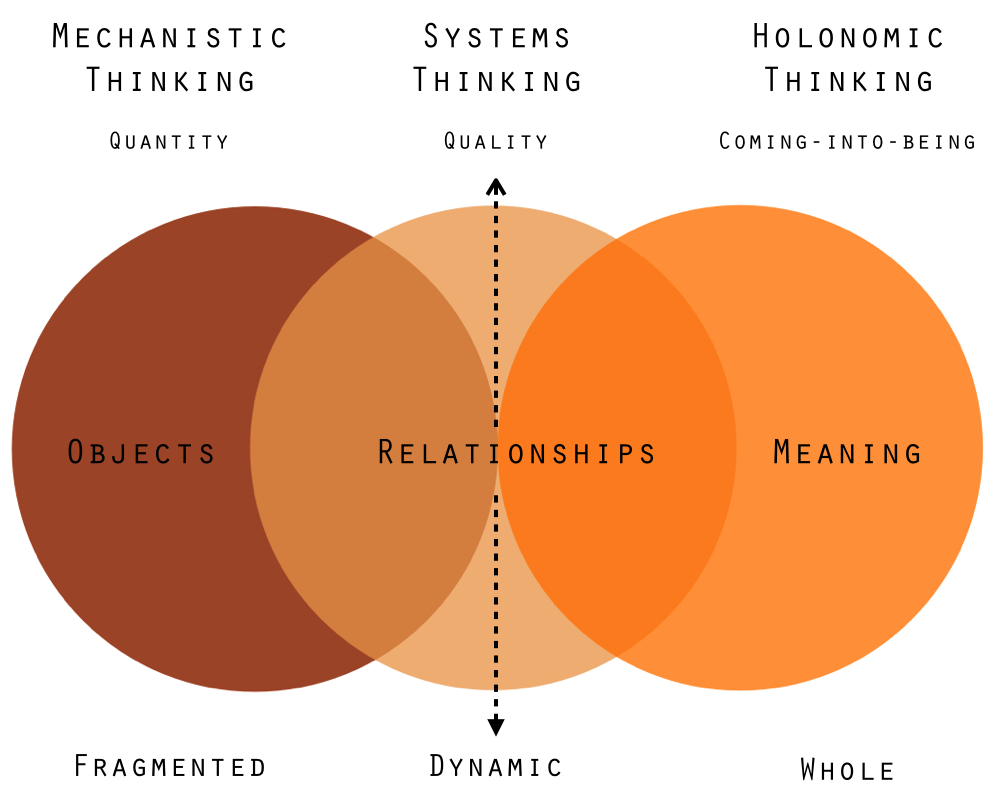
A new mental operating system is now necessary to deal with these new challenges. Holonomic thinking can play a key role in the shift of consciousness of business leaders and decision makers by empowering them with a dynamic way of seeing the world. Those businesses and organisations which are successful in the future will be the ones who understand that the difficulty with predicting scenarios in a complex world is actually an invitation to co-create these future scenarios.
Holonomic thinking is based on the dynamic and organic systems we find in Nature as well as being deeply rooted with the foundations of five universal human values – peace, truth, love, non-violence and right action. We are now beginning to see the emergence of enlightened organisations which understand the value of business strategies which acknowledge the preservation and evolution of life.
Planning, managing and redesigning the strategy becomes a natural process which is assimilated into the day-by-day activities of the organisation, which itself is conscious of its role in a dynamic co-created future. Co-creating future scenarios now becomes innovation which itself becomes sustainability and the life force of the organisation.
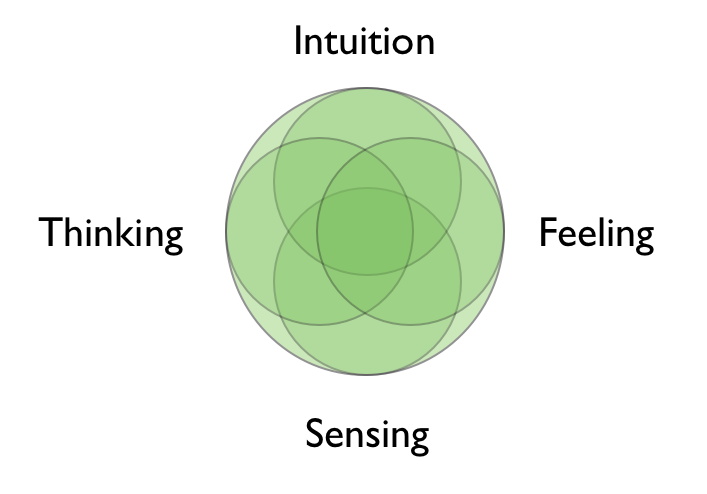
Maria Moraes Robinson is an economist and consultant in strategy, change management and the Balanced Scorecard methodology. Her current work is focused on developing innovative new business courses which integrate the teachings and philosophy of Schumacher College, human values in education, and insights from complexity science with business strategy, change management, process and organisational redesign.
The Future of Leadership
Is it possible to lead and be led at the same time? Might the leader be the quietest person in the room; invisible, even? What happens when there are no pre-agreed rules of engagement amongst those that you are leading? Does chaos or harmony ensue?
This is a guest blog written by James Allen of Olab http://www.olab.com.br/en/
A lot is being written about new kinds of leaders and new ways of leading and I would like to share with you my experience drawn from the Art of Hosting (AoH) network, which I joined after participating in one of their ‘encounters’ in Brazil. As many organizations are grappling with establishing less hierarchical management structures, the AoH approach suggests that it is those leaders who are able to listen to and draw upon different perspectives, and to strengthen connections between people and organizations through dialogue that will be able to bring out the best in those whom they are leading.

Brazil’s 14th AoH get-together was a five-day long meeting, set in beautiful woodlands not far from Sao Paulo in 2013. It is called an ‘encounter’, rather than a course, because learning takes place through active participation in a sequence of workshops that draw on different group dynamics, such as World Café and Collective Story Harvesting. Participants are encouraged to take the reins and lead different exercises, with the aim of drawing on and harvesting collective intelligence, i.e. the knowledge and wisdom of the whole group, rather than a chain of individual perspectives.
In this way, participants act as volunteer facilitators, responsible for leading each session, with the aim of ‘hosting and harvesting meaningful conversations’. For a conversation to be meaningful, participants must seek to listen actively and speak with intent. As such, the starting point is the individual’s relationship with herself. Silence and meditation techniques form part of the AoH toolkit, since the ability to listen well, both to yourself and to others, is a sine qua non of good leadership.
The relationship between the individual and the other within the group is first established through the most ancient form of dialogue, the circle. In the center of the circle, rather than a fire, is the group’s ‘purpose’, the issue or question that the collective is burning to address. Much time is spent on the wording and structure of that question so that the conversations and debates that follow are coherent and meaningful. Here the host plays an important role in helping to shape a powerful question, one that is both inspirational and practical.
What often follows in many of the participatory technologies shared in AoH are break-out groups of between four and six people. A group with that number of participants is large enough and sufficiently diverse to draw on a multitude of perspectives, without being so big that it becomes unwieldy. It is a model that reflects what is happening in many leading companies where self-organizing pods or cells are formed in order to deliver specific processes or results: Google (“…projects always start with a small group of people that make traction” – Larry Page) and Kyocera’s Amoeba management system are two such examples.

Disagreement within these groups is seen as healthy, indeed is actively encouraged. As management guru Peter Drucker is quoted as saying, the best decisions are based “on the clash of conflicting views, the dialogue between different points of view, the choice between different judgments. The first rule in decision-making is that one does not make a decision unless there is disagreement”. In fact, conclusions and good decisions (‘convergence’) can and should only occur after ‘divergence’ or discordance, where doubts are addressed through pertinent questioning. A good host knows how to needle and question, and embraces difference as part of a collective decision making process.
As such, to lead in this context means to accept the chaos that arises when different people bring their opinions to the table. At its purest form, a collective decision making process can be almost anarchic, in which the group or groups organize themselves and people fit in and contribute in the way they best see fit. Physicist David Bohm’s Theory of Dialogue proposes that a meaningful dialogue of enquiry should have no rules, no agenda and the participants should not be chosen but should put themselves forward. Many of these ideas permeate the AoH encounters: the ‘Law of Two Feet’ for example says that if ‘at any moment during our time together you find yourself in any situation where you are neither learning nor contributing, use your two feet and go somewhere else’.
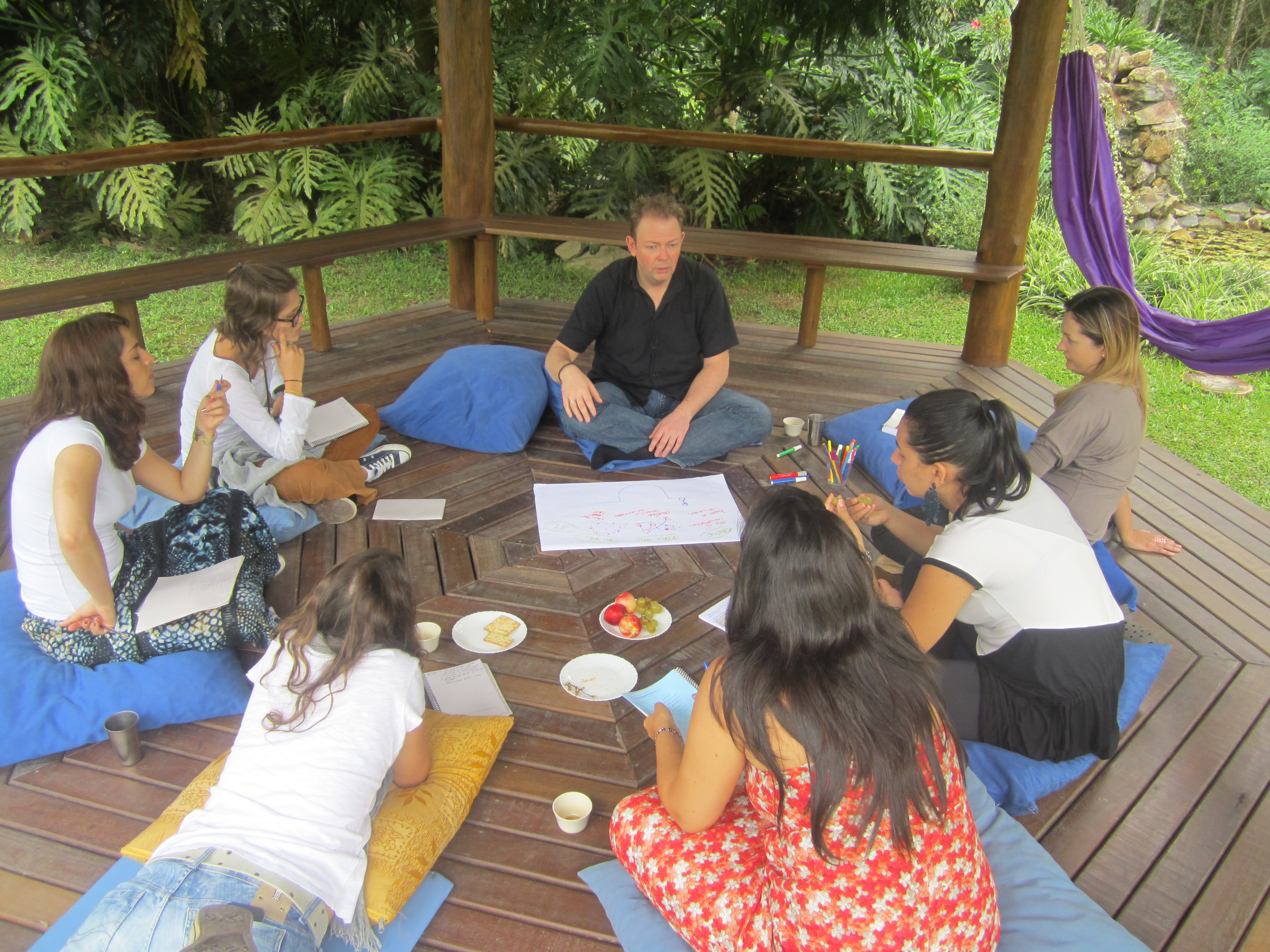
This approach to learning – free, open, self-run – can be wonderfully enriching, but also unnerving. Participants must accept a new way of learning that involves observing, experiencing, embracing difference and acknowledging mistakes. In this way, the AoH encounter also represents an emotional journey where anxieties can rise to the surface. In our group, a number of participants – perhaps half a dozen, mainly those working at larger corporations – had come with their own expectations of what they would take away, and by the half-way stage of the week-long encounter, began to question these precepts: “where was the manual?”, they asked; “why hadn´t the information been systematized?”. At one stage, these anxieties threatened to boil over into outright revolt. But on this occasion, our hosts stood firm, recognizing and accepting these concerns, but not veering from their vision that it was up to each participant to contribute and to take from the encounter what they would.
It is here that the art of leadership really comes in to play, as the host perseveres through those periods of chaos that certain participatory methodologies such as Open Space have built into their DNA. In these moments an effective leader will seek to operate in the background as much as possible, an almost invisible actor whose presence does not influence the way the group choses to operate; but she must be paying complete attention at all times, observing not just what is said, but what is done and how it is done – sensing the group’s energy. It is up to her to know when she must play the role of the chalice bearer, embracing, soothing and calming, and when is the time to intervene as the blade-wielding warrior, nudging, cajoling and, above all, questioning in order that the group might move forward.

Successful leaders are therefore those that are able to harness and catalyze collective knowledge and different talents around a shared purpose, weaving solutions that recognize and value the voices and opinions of the individual and of the collective. Where, previously, we were schooled in Isaac Newton’s mantra that it was possible to find singular answers to our problems through objective analysis, now we must accept a more inclusive and dynamic view of the world, which accepts that there is no one single, objective ‘solution’ or answer and that the observer herself influences the response as a direct result of her expectations or intentions.
To explore ‘the new paradigm’ further, join the Face Book community here
The Need For Metaphor: A Shift from Machine to Nature
The metaphorical use of words is vitally important for the transformational times we live in. Why? Why can’t the explicit meaning of words themselves suffice?
Metaphor originates from the Greek word meta meaning ‘across’ and pherein meaning ‘to carry’. Metaphor allows us to bring forth or carry over a deeper context which words on face-value can lack. As the writer Iain McGilchrist has explored, metaphor embodies thought and places it in a living context.
‘Metaphoric thinking is fundamental to our understanding of the world, because it is the only way in which understanding can reach outside the system of signs to life itself. It is what links language to life.’ – Iain McGilchrist
Let’s take a step back and explore the advent of the written word as a ‘system of signs of life’ in order to understand its limitations which metaphor may help transcend.
Originally language was not a code of representation but rather a generative creativity where the act of speaking was a participatory embodiment of the speaker within the lived-in environment; content as a participatory expression within context.

The phonemic singing of language still evident in many indigenous cultures today seems to have its roots in music. The pictographic ideograms and hieroglyphics found in Egypt some 3,000 BC, in China some 1,500 BC and in Mesoamerica around 600 BC enabled language to shift from purely oral to written and with that came a shift in sensory perception away from voice tones and body gestures very much within the sensory realm of the body to images.
Through syllables, concepts are represented in a way that the metaphoric essence of what is being expressed is relayed. These images portrayed the lived-in environment yet became more abstract in forming pictographic puns which invoked images that sound like the written explanation; the phonetic sound morphed into the written symbol. The sounds became transcribed as abstract content rather than the image of the content within its contextual meaning. The Hebrews and Phoenicians adopted the alphabet and in time so did the ancient Greeks.
The advent of the alphabet, hand-in-hand with the rise of rational logic as a tool to define reality, had a profound impact on our way of attending to life. No longer did images relate to their animate context, the words had become abstract re-presentations. The alphabet granted a new autonomy and permanence to abstract concepts enabling us to define things in an unchanging objectified way. This timeless yet abstract quality of the written word gives a sense of independence from the ever-changing corporeal realm. Yet, as Ralph Waldo Emerson explains when discussing words, ‘They cannot cover the dimensions of what is truth. They break, chop, and impoverish it.’
Metaphor helps re-immerse the content within its lived-in context, an abstract perspective within its deeper real-life context; re-embodying and so rejuvenating the impoverishing effect Emerson speaks of.
Eco-literacy specialist and world-renowned scientist Fritjof Capra speaks of the need for a new metaphor: a transformation from the metaphor of the machine to the metaphor of life – the network and self-organising system. Likewise, in business transformation, organisational change, management and leadership, we need new metaphors which deepen our engagement with reality beyond the metaphors of yesterday’s logic – those of the mechanistic, hierarchic, command-and-control, Neo-Darwinist organisation.
Nature as a word, Nature as a metaphor, Nature as so much more can inspire new ways of operating in helping us reach beyond restrictive mind-sets in understanding the depths of the world far beyond the limitations of the current paradigm. For instance, ‘the forest floor’ is a metaphor the Association of Sustainability Practitioners is developing to encompass a cultural way of collaborating, engaging and embodying sustainability service provision. Business ‘ecosystem’ is another metaphor increasingly being used to help shift the mind-set of ‘supply chain management’ and ‘customer relationship management’ of old into a way of inter-relating that fosters a wide variety of diverse stakeholders where the web of relations are understood beyond the point-to-point ‘chains’ of old. ‘Soil’ can be a metaphor for helping convey the importance of a fertile organisational culture, for instance where ‘failure becomes the compost for success’ and where creativity, innovation, growth, networking, re-configuration and release are all valued.

Nature as metaphor in business and beyond can powerfully help us see beyond the confines of yesterday’s logic while also opening us up to the Nature deep within and all around us. After all, true sustainability means being in harmony with Nature, anything less is, ultimately, unsustainable.
To explore ‘the new paradigm’ further, join the Face Book community here
View a short video clip on business inspired by nature here
 The Nature of Business