Biomimicry for Business?
 Biomimicry is an exciting emergent discipline which explores how nature works and how we can learn from nature to solve human problems. Humans have been learning from other species for many thousands of years, yet biomimicry as a formal concept is more recent. The word itself, “biomimicry”, was coined by Janine Benyus (author of the book ‘Biomimicry’) and originates from the Greek bios (life) and mimesis (imitation).
In the words of Janine Benyus, biomimicry has three aspects to it:
1. Nature as model. Biomimicry is a new discipline that studies nature’s models and then imitates or takes inspiration from these designs and processes to solve human problems.
2. Nature as measure. Biomimicry uses an ecological standard to judge the ‘rightness’ of our innovations. After 3.8 billion tears of evolution, nature has learned what works, what is appropriate, and what lasts.
3. Nature as mentor. Biomimicry is a new way of viewing and valuing nature based not on what we can extract from the natural world, but what we can learn from it.
After years of work with ecologists, Janine Benyus pulled together Nature’s Laws:
Nature runs on sunlight
Nature uses only the energy it needs
Nature fits form to function
Nature recycles everything
Nature rewards cooperation
Nature banks on diversity
Nature demands local expertise
Nature curbs excesses from within
Nature taps the power of limits
To provide guidance to designers using biomimicry, the Biomimicry Institute has developed a framework based on the principles and conditions under which life operates referred to as ‘Life’s Principles’:
Life adapts and evolves by:
• Being locally attuned and responsive
• Using constant feedback loops
• Antenna, signal, response
• Learns and imitates
• Resourceful and Opportunistic
• Free energy
• Shape rather than material
• Builds from the bottom up
• Simple, common building blocks
• Running on cyclic processes
• Being resilient
• Decentralized and distributed
• Redundant
• Diverse
• Cross-pollination, common information system (genetic)
Life creates conditions conducive to life by:
• Optimizing rather than maximizing
• Using multi-functional design
• Fitting form to function
• Being interdependent
• Recycle all materials
• Self organization
• Using benign manufacturing
• Using life-friendly materials
• Using water-based chemistry
• Using self-assembly

Examples of innovative biomimicry designs include:
• Velcro is probably one of the best-known examples of biomimicry when Swiss engineer George de Mestral in the 1940s noticed how bur hooks gripped on to fabric loops.
• More recently, the communications company Qualcomm uses the iridescent principle of butterflies and peacock feather which refract light to provide colour. Through its product, Mirasol, it applies this refraction technique to electronic displays from cell phones to table computers, in turn using significantly less energy whilst providing good useability. In 2010 they won Best Enabling Technology Award in Laptop Magazine.
• A high-speed train front-end was inspired by the kingfisher’s beak allowing more efficiently travel through different air pressures (tunnel and open-air). The design of the Shinkansen Bullet Train of the West Japan Railway resulted in a quieter train and 15% less electricity use even whilst the train travels 10% faster.
• The Eastgate Building, an office complex in Harare, Zimbabwe, uses 90% less energy for ventilation than conventional buildings its size by taking inspiration from termites’ self-cooling mounds.
• A high-performance underwater data transmission method, used in the tsunami early warning system throughout the Indian Ocean, inspired by dolphins’ unique frequency-modulating acoustics, developed by a company called EvoLogics.
• A carpet tile range which random design is inspired by the aesthetics of leaves on a forest floor. As a result the carpet tiles can be installed in any direction which reduces installation time and allows replacement of single tiles without damaging the overall look of the floor. The Entropy product line became InterfaceFLOR’s fastest bestseller. InterfaceFLOR estimate that the Entropy product line wastes 1.5% of the carpet compared with the industry average of 14% for broadloom carpet.
• Regen Energy’s smart grid technology became inspired by swarms in nature, for example bee behaviour, referred to as ‘swarm technology’, in optimising peak power loads over the network.
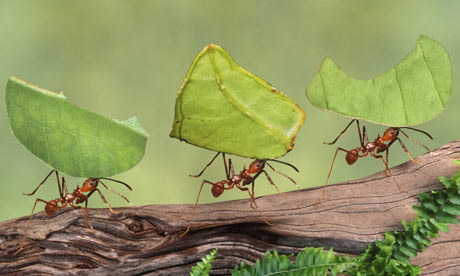
• British Telecom used a biological model based on ant behaviour to overhaul its phone network, avoiding a 10-year multi-£bn exercise.
As exemplified by the innovations described above, biomimicry, in the main, has been applied to product design, manufacturing, green chemistry, structural planning and architecture. However, nature’s wisdom can also inspire and inform organisational transformation. Such emulation of nature’s genius for organisational structures, processes and people behaviour may be better described as ‘bio-inspired’ rather than biomimetic, as it is not limited to scientific extrapolations and copying nature but also metaphorical and behavioural based inspiration, although perhaps still falling within the third part of Benyus’ definition of Biomimicry: ‘nature as mentor’.
Our understanding of nature has evolved over the last few decades, from viewing nature as a battle ground of competition to one of dynamic non-equilibrium, where an order within chaos prevails due to unwritten natural patterns, feedback loops, behavioural qualities, interdependencies and collaboration within and throughout ecosystems. Nature adapts within limits and creates conditions conduce for life. Recent discoveries in microbiology and quantum mechanics uncover the importance of cellular membranes in the adaptation and evolution of organisms. Likewise, the perceptions and beliefs of the individual, organisation and ecosystem can affect their ability to sense, respond, adapt and evolve to volatility in their environment.

The more we grapple with the challenges our businesses now face in these volatile times, the more we realise that nature’s patterns and behaviours can inspire approaches for our own evolutionary success in business and beyond.
The more we build a bridge between business and nature, the more we realise what good business sense really is.
Biomimicry for Creative Innovation (BCI), a collaborative of specialists applying ecological thinking for radical transformation, has developed a set of Business Principles for The Firm of The Future (developed from the Life Principles created by the Biomimicry Institute).
Nature’s Business Principles
Build Resilience
It’s more effective to build resilience than to correct poor risk-based decisions that were made with partial information. A business inspired by nature builds resilience by:
• Using change and disturbance as opportunities rather than fearing them as threats.
• Decentralizing, distributing, and diversifying knowledge, resources, decision-making, and actions.
• Fostering diversity in people, relationships, ideas and approaches.
Optimise
Optimising delivers better results than maximizing or minimizing. A business inspired by nature does this by:
• Creating forms that fit functions, not the other way around
• Embedding multiplicity into both functions and responses
• Creating complexity and diversity using simple components and patterns
Adapt
Being adaptive pays back better than “staying a fixed course”. A business inspired by nature adapts by:
• Creating feedback loops to sense and respond at all levels of the system.
• Anticipating and integrating cyclic processes.
• Being resourceful and opportunistic when resource availability changes.
Integrate Systems
With limited resources and a changing environment, it’s better to be systems-based rather than independent. A business inspired by nature works with whole systems by:
• Fostering synergies within communities.
• Fostering synergies within energy, information and communication networks
• Creating extended systems to continuously recycle wastes into resources.
Navigate by Values
In uncertain times, it’s better to be based on a compass of values than a fixed destination point or set of pre-defined metrics. A business inspired by nature reflects values by:
• Knowing what’s really important to the communities in which it operates, interacts, and impacts.
• Using values as the core driver towards positive outcomes.
• Measuring what is valued rather than valuing what is measured.
Support Life
In the long run, it takes less effort and less resource to support life-building activities than to be damaging or toxic and pick up the cost later. A business inspired by nature supports life-building activity by:
• Leveraging information and innovation rather than energy and materials
• Creating support for individual components that can support the whole ecosystem; supporting the ecosystem so that it can support the individual.
• Making products water-based, renewable, bio-based, and biodegradable.
These Business Principles build on a wide set of existing business theories and are not aimed at providing perfection in organisational design (if such would ever exist). They provide a framework to guide successful transformation towards a Firm of The Future, a business inspired by nature.
To explore ‘business inspired by nature’ further, join the Face Book community here
View a short video clip on business inspired by nature here
Leadership of The Future starts with silence
“At times of great winds, some build bunkers, while others build windmills” goes the ancient Chinese proverb.
We are in the midst of the “great winds” of economic instability, social upheaval and environmental un-sustainability. Will it be bunkers or windmills that we build?
Transformational times of destruction and re-construction inevitably invoke fear. It takes great courage to break rank from business as usual. The challenge with any paradigm shift is that it requires us to both let go of the old, tried-and-tested ways that are ingrained in our collective psyche and embrace novel, as yet unproven ways of being. There is a threshold across which individuals, organizations and communities need to cross. It takes real leadership to transform a business in such volatile times. Incidentally, the root of the word leadership is “leith” which means to go forth and cross the threshold, to die and be reborn.

The ‘new norm’ of dynamic non-equilibrium in business requires a shift in conventional management and leadership styles from over-reliance on top-down, hierarchical, risk-based approaches to managing within complexity. This new style of management juggles and combines varying styles and techniques. It encourages bottom-up ideas and thinking to flourish; establishing an all-pervasive values-led work ethic whilst guiding and coaching.
Complex, adaptive, resilient businesses of the future recognize that change emerges unpredictably, and that over-arching bureaucratic mechanisms no longer assist emergent organizational evolution. The role of leadership is to actively participate in enabling and facilitating local change, by encouraging effective communications with clarity of understanding of how to act and interact. Each and every one of us plays our part in leadership of the future by helping others to co-create towards positive outcomes.

Leaders of the future unleash human potential by instilling trust through authenticity, clarity of purpose and openness to continual learning. Leaders are the learners, the ones who seek ‘personal mastery’ (as Peter Senge puts it) whilst remaining interconnected to the collective whole. Leaders are people who understand who they really are, aspire towards greatness and inspire greatness in others (not egoic greatness but soulful greatness). Leaders become teachers, taking time to assist and empower others to lead themselves. The quest for optimal leadership is about encouraging a creative tension — balancing personal mastery with openness and a deep sense of belonging amongst a diverse community of stakeholders.

Leaders first transform themselves and then guide and coach others, creating a safe passage for the followers to cross the threshold. Here are some tips for leading in transformational times which can be applied by each of us today at no financial cost, but with much benefit:
Tips for Transformation: The Seven S’s
Silence – A quiet mind helps ensure a successful outcome. Be still and allow the mind to quieten as often as possible throughout the day. From silence the mind is more able to identify the right choices for the road ahead. As is profoundly said, ‘the success of the intervention depends upon the state of the intervener’.
Sense – Be in the moment. Learn to really ‘listen’ to yourself and others. The local environment provides vital feedback, ‘feel’ this feedback, tune-in and act/adapt accordingly.
Strategy – Ensure clarity of direction for the meandering path ahead. What are your instincts saying? What really turns you on? What makes your heart sing? Why are you doing what you are doing? Follow your heart with a clear mind. Allow it to navigate your transformation with passion and conviction; this way successful change is made.
Small steps – Each step provides chances to make positive change happen. We need to endeavour to take each step, each interaction and intervention with authentic¬ity.
Stakeholders – Recognise, engage and empower the interested parties. Ten¬sions may be uncomfortable and energy/time-consuming, yet they are inevita¬ble and can help hone right navigation for the path ahead. Through stakeholder engagement, tension can become a constructive force stimulating learning and development.
Systems – Transcend perceived boundaries to see the ‘inbetweenness’; the intercon¬nected systems of relationships and resources within and across our business ecosystems.
Solutions – Problems and challenges abound and the glass can often seem half-empty in challenging times. Explore solutions, the art of the possible; what can be done (rather than what cannot) through solution-creating, collaborating, prototyping and experimenting. Channel energy from fear and worry to the exploration of solutions. This requires courage.
Giles Hutchins is co-founder of BCI: Biomimicry for Creative Innovation and author of The Nature of Business. In The Nature of Business, Giles Hutchins makes a compelling case for applying the same principles of biomimicry to the development of a new business paradigm. He demonstrates clearly how behaviours and organizations found in nature can be applied to help our organizations flourish in chaotic and uncertain times. Watch this short video for more information.
Top Ten Tips for Transformation
Prediction : At least 50% of all organisations around today will be dead or bought-out by the end of this decade.
This is the Decade of Transformation – so how do we ensure our organisations survive and thrive in the transformational times ahead?

Transformation towards the firm of the future requires DEDICATION
D for Diversity:
Diversity is a necessary condition for business to thrive in volatile times: where economies of scale are balanced by economies of scope; where globalisation interweaves with localisation; where embracing individuality goes hand-in-hand with maintaining the integrity of the team, organisation and wider business ecosystem. Differences are not normalised away but celebrated for what they can contribute to a redesigning for resilience. Shift from mono-cultural, singular, mass-orientated approaches to encouraging and incorporating diversity across the business.

E for Emergence:
The ‘new norm’ of turbulence in business requires a shift in conventional management thinking from over-reliance on top-down, hierarchical, risk-based approaches to managing within complexity. Managing within complexity juggles and combines varying styles and techniques. It encourages bottom-up emergence to flourish; establishing an all-pervasive values-led work ethic while guiding and coaching. Emergence has a self-generating quality, where individual parts of an ecosystem interact to provide an emergent order (an unfolding of events that are self-fuelled by the actions and interactions of the parts).
D for Decentralised:
As our linear, hierarchical, reductionist approach to business shifts to more networked, emergent ways of engaging and empowering ourselves and organisations, we find the centralised, stove-pipe, top-down approaches to organisational governance and process design give way to more decentralised, semi-autonomous, interconnected, locally-attuned ways of governing and behaving: less bureaucracy more empowerment.

I for Innovation:
Increased market volatility brings with it the need to create, develop and adapt new products and services under time-pressured conditions. In short, innovation is a critical success factor for the future – organisations able to innovate effectively, time and again shall win out over organisations that struggle to adapt. The firm of the future creates the conditions conducive for creativity by building a culture that facilitates, unlocks and supports people’s creative potential; an organisation that encourages people to overcome fears and inhibitions, where the work dynamic is of constant evolution, where failure is not criticised but embraced for what it is – an opportunity to learn, adapt and evolve.
C for Collaboration:
We are witnessing a shift in mentality and behaviour from the past approach of “dog eat dog” competition between businesses, business units, and employees to the future approach of collaboration across multi-functional teams, departments, organisations and business ecosystems: interconnectedness rather than separateness, collaboration rather than competition. Collaboration encourages the transcending of traditional boundaries and artificial separations in business; it interconnects to encourage sharing, co-creativity, a sense of belonging and an increased willingness to embrace change.

A for Authenticity:
Effective personal and organisational transformation is about being authentic, and true to your values and value; the authentic self and the authentic organisation go hand in hand. Those that learn to follow their true path shall be able to adapt and transform themselves and so the organisations and communities within which they operate. Those that remain incomplete and false (not rising to their true nature) will find it increasingly difficult to get away with benefiting themselves at the expense of others. Re-connecting with our authentic human nature and the natural world around us is one of the most joyous and yet pivotal actions we can undertake on our individual and collective journey towards sustainable living, working, doing and being.
T for Trust:
Being able to trust the people, organisational culture and stakeholder community you operate in becomes an important ingredient for success. The transformation towards a firm of the future requires embracing new ways beyond existing comfort zones while working with others in collaborative and emergent approaches. Courage and co-creation need trust to thrive.

I for Intuition:
The rational mind struggles to cope with the increasing complexity and volatility we find in business often leading to increased stress and reduced performance, but intuition can cope quite effortlessly. Re-connecting with our intuition by creating silence and space for our minds to re-balance both left and right brain hemispheres is fundamental for realising transformational change (in business and beyond). An important part of re-connecting is the need for reflection to continually deepen our intuition, and then using intuition to act with intention (taking responsibility for our choices and actions as well as those of our organisations).
O for Openness:
The more we open up to our environment, the more we tune in to the interconnected nature of business life, sensing and responding in the most optimal way. Likewise, the more we recognise the need for openness in our approaches to ways of operating the more we can positively adapt; shifting from closed-source to open-source approaches, for instance. Sharing knowledge freely is often contrary to our prevalent business mind-set; allowing oneself and organisation to be more open to sharing freely is an important part of the transformational journey.
N for Nature:
A firm of the future is a business inspired by nature. Nature is a deep source of inspiration. Connecting with nature can bring benefits of improved creativity, serenity, centeredness and well-being. Operating in harmony with nature is what true sustainable business is all about – not just seeking to ‘do less bad’ but creating the conditions conducive for life through holistic business value – this is good business sense. The transformational journey is about being inspired by nature, being connected to nature and being in harmony with nature, then by its very nature the organisation and leader has achieved a redesigning for resilience.
View a short video clip on business inspired by nature here
To explore ‘business inspired by nature’ further, join the Face Book community here
The why & how of radical business transformation
 The world is changing (economically, socially and environmental) and many business leaders now realise the imperative for transformational change.
No longer is incremental change of the current business model fit-for-purpose. The change required by businesses to adapt and evolve in these volatile times is radical, dynamic and transformational – fundamentally different business strategy and operations.
First, let us explore the WHY – why do organisations need to radically transform?
Second, we can explore the HOW – how do organisations go about successful radical transformation while meeting the increasingly pressing needs of today (quarterly cost and revenue demands in a challenging business climate).
Why is radical transformation required?
A “perfect storm” of economic, social and environmental factors is making the business landscape increasingly volatile. The pace of change is faster and only set to increase. To succeed, business needs to become more agile, creative, responsive and resilient. Put simply, the command-and-control business management approaches that served us well in more predictable climes are no longer fit for purpose. Dynamic change is the new norm and so strategic and operational approaches must adapt accordingly. Organizations that are able to let go of old mentalities while having the courage to embrace new ways of operating will be the ones able to seek out opportunities in these challenging times. Other organizations, fearfully clinging to practices that are no longer fit for purpose will struggle to cope. Adapt or die.
As Dawn Vance, Global Head of Logistics at NIKE succinctly puts it:
‘Organisations have 3 options:
1) Hit the wall
2) Optimise and delay hitting the wall
3) Redesign for resilience’
It is this redesigning for resilience which is rooted in radical business transformation. No longer is ‘optimizing’ existing business models ‘good enough’ – it is just delaying the inevitable car-crash. Now is the time to be future-proofing our organizations by transforming their business models, their process-flows, their cultural mind-set and their operations from conventional thinking to new ways of thinking is the future for successful businesses.

Already we witness business leaders transforming their business strategies from incremental optimization of existing models (aimed at maximising the short-term return of shareholders) to wisely shifting to new strategies (aimed at benefiting a diverse business ecosystem of stakeholders). This in itself is a great step forward for the evolution of business, with positive repercussions for the economy, society, the individual and the wider environment. The transformation is already upon us and has already started, here are some well-publicised examples:
 NIKE transforming towards having 100% of products and services ‘considered’ (in terms of social and environmental factors) by 2020.
 Kingfisher Group transforming towards net positive economic, social and environmental value.
 Interface transforming towards having zero-waste (of any emissions – gas, liquid, solid) by 2020 across their global operations.
 Unilever transforming towards halving the environmental footprint of their products, to help more than 1 billion people take action to improve their health and well-being, and source 100% of agricultural raw materials sustainably.
Hence, we shift our mind-set from incremental tweaking of our existing business model to fundamentally re-thinking, challenging and innovating our ways of creating value for our stakeholders.
And so to the HOW – what are these new ways of thinking and operating?
The good news is that the answers to the challenges of operating in a volatile world can be found all around us. The HOW to our redesigning for resilience is inspired by nature. Nature has been dealing with dynamic change for over 3.8billion years and the more we look the more we find inspiration for new ways of operating.
Those businesses best able to survive and thrive the volatile times ahead will be businesses inspired by nature: organizations that use ecological thinking for radical transformation to develop new ways of operating across all levels of their business – places (intelligent building), products (biomimicry), processes (cradle-to-cradle), people (authentic, emergent leadership), purpose (in harmony with life). For some immediate inspiration on this see here
The future is bright with creative opportunities for wise business women and men. The challenge is not seeing the future clearly, more it is having the courage, conviction and determination to make the transformative change – individually and organizationally. Many are already making transformative change stick and witnessing the positive virtuous cycles of good business sense prevail.
To explore ‘business inspired by nature’ further, join the Face Book community here
Giles blogs on ‘business inspired by nature’ at www.thenatureofbusiness.org
Buy The Nature of Business hot off the press by pre-ordering it here
The Radical Redesigning of Business for Resilience
Can business be a force for good, restoring society and the environment, providing solutions that genuinely help rather than hurt?
Ought business to be striving for more than just limiting its harm?
I think we intuitively know it can, yet it requires courage to break rank from the mainstream approach to business.

The prevailing business paradigm of maximization, monoculture, self-interest and short-termism is weakening its own resilience, in turn sowing the seeds of its own demise. Our prevalent business concepts, values, perceptions and practices are being disrupted and systemically challenged. This ‘perfect storm’ of crises provides the perfect situation for individuals and organisations to retrench (clinging fearfully to outdated mindsets) or transform (embracing new ways of operating). For those able to adapt in these volatile times, they face nothing less than a shift to a new business paradigm; a way forward that seeks to enhance life on Earth rather than destroy it.
Like the ancient Chinese Proverb:
In times of great winds, some build bunkers others build windmills.

Our prevailing reductionist approach to science, technology and business has encouraged us to see ourselves as separate from nature, and to view the world around us as something to be analysed and over-exploited for our own wants and needs, with scant regard for the consequences. Here lies insight into the root cause of our problems facing us today in business and beyond. The sobering fact of the matter is that our current business approach (and its immense power to fuel problems as well as implement solutions) is neither balanced nor life-encompassing; it is reductionist and anthropocentric in its belief and behaviour. This separated thinking and reductionist view of the world has encouraged an alienation from nature over recent years, leaving us unbalanced in our understanding of the real world – the world not just of stock market trends and commodity prices, but also of soil and sea, of cycles and seasons, and of ecosystems and environments.
As Ray Anderson, former Chairman and CEO of Interface, observed:
We have been, and still are, in the grips of a flawed view of reality – a flawed paradigm, a flawed world view – and it pervades our culture putting us on biological collision course with collapse. It is the paradigm that is reflected in our culture’s infatuation with stuff and our willful ignorance of nature.

Our prevailing view of nature as a battleground of competing species, each fighting to survive, is a narrow view of a more complex picture. When Charles Darwin published his Origin of Species, the phrase ‘survival of the fittest’ was quickly co-opted and distorted by powerful elites to promote the idea that only the biggest, strongest, and most powerful can survive.
In reality, what Darwin found and described in his findings was that those organisms with the greatest ability to adapt to their local environment – the ‘fittest’ in the sense of the best fit – would survive when and where others would fail. He found that sensing, responding, adapting, and aligning with and within the local ecosystem were key to survival. Recent scientific discoveries, coupled with advances in systems thinking and quantum theory, continue to build on these findings, and uncover a more complex and complete view of nature, the workings of the universe, and the evolution of life.
Over the last 3.8 billion years, nature has survived and flourished through times of radical change by dynamically networking and collaborating among species and throughout ecosystems. Diversity, flexibility and collaboration, we find, is core to the interwoven evolutionary journey of life – the driving forces that provide resilience and regeneration within species and ecosystems.
In the words of the business pioneers Michael Braungart and William McDonough:
Popular wisdom holds that the fittest survive, the strongest, leanest, largest, perhaps meanest – whatever beats the competition.
But in healthy, thriving natural systems it is actually the ‘fitting-est’ who thrive. Fitting-est implies an energetic and material engagement with place, and an interdependent relationship to it.
So how does business go about shifting from a prevalent mind-set of reductionism and short term profit maximisation that views the world as a collection of things to be consumed (nature’s capital) to a world-view that has an energetic and material engagement with place and an interdependent relationship with life which is symbiotic not carcinogenic?

In short, how does the prevalent approach of business (and for that matter human society) break its devastating illusion of being a part from nature to realising in reality that we are a part of nature, even with our specialities? This is the sixty-billion dollar question (not whether the USA defaults on its ever-spiralling debt mountain, which is just one of many symptoms we now experience as a result of failing to address the root cause of our social, economic and environmental crises: our carcinogenic relationship with life on Earth).

This question of the moment can be answered through 3 R’s – Re-design, Re-connect, Re-kindle:
1) Re-designing – new ways of operating and innovating beyond ‘less bad’ into ‘doing good’ (shifting from the take/make/waste economic paradigm to a regenerative approach that heals society and the web of life rather that destroying life in the name of short-term gain). An example here is the Kingfisher Group aiming to be a ‘net positive’ force for good in the world.
2) Re-connecting – reconciling our human relationship with life/nature and our own authentic human nature (re-establishing our vital bond with ourselves, our neighbours and the web of life within which we are a part of through education, authentic leadership and eco-psychology). An example here is the co-founder of Natura, Pedro Passo, who instills a business culture that understands our interrelatedness with nature and community.
3) Re-kindling wisdom – working with the grain of nature and operating within the rules of life on Earth (enabling businesses and societies not merely to ‘sustain’ but to thrive in the years ahead by practicing wise approaches to life that draw on, for instance: symbiosis, ecological thinking, permaculture, systems-thinking and systems-being, business inspired by nature, presencing & indigenous wisdom). An example here would be Weleda with its bio-dynamic philosophy and its holistic approach to all aspects of its business.

In these challenging (yet pivotal) times for business and humanity, we must realise that to become truly sustainable, human and business life has to become scientifically inspired, emotionally connected and spiritually entwined with nature and Gaia. Nature and business (as with nature and humanity) must be symbiotic and operate in mutualism for there to be anything resembling a suc-cessful outcome. The sooner business realises the opportunities that come with being connected to and inspired by nature, the better for humanity and the interconnected fabric of life.
To explore ‘business inspired by nature’ further, join the Face Book community here
View a short video clip on business inspired by nature here
Emergent leadership in volatile times
Create the conditions conducive for co-creation and it will naturally flourish.
 Positive virtuous cycles start to unlock as people find the optimal pathways for their own value-creation potential, with the desire to overcome challenges, learn, help and share experiences feeding it. Less energy is siphoned from value-creation activities to management overhead, leaving more available to move forward with the vision of the organisation and innovate. Self-empowerment and collective orientation overcome challenges with opportunities; the leaders refocus their attention from management to empowerment – encouragement through coaching, rather than management through fear.

All biological systems have an emergent quality, as all living structures (including social and organisational) are emergent structures. Emergence has a self-generating quality, where individual parts of an ecosystem interact to provide an emergent order (an unfolding of events that are self-fuelled by the actions and interactions of the parts). Emergence is when an organised, complex and/or cohesive pattern or result arises – often unpredictably – from a series of individually simple component interactions. This is the nature of nature.
Emergent leadership (as referred to by Fritjof Capra) encourages an environment of continual questioning and new approaches to problems. This culture of emergence needs to spread beyond the organisation to the stakeholder community, hence encouraging emergence across the business ecosystem, thus improving resilience of the whole and the parts. 
Increasingly as the organisation is required to become more emergent so leadership is more about empowering, empathising and encouraging interconnections, innovation, local attunement and an active network of feedback. As organisations and business ecosystems become more self-organising and self-empowering, the working environment and culture becomes more emotionally and mentally healthy, where business goals are met without sacrificing personal values and integrity – in fact quite the contrary, where work acts to reinforce personal integrity in providing a rich emergent experience for individual and collective learning and ethical growth.

It is up to us to unlock our creative potential, to evolve and utilise our talents to our best endeavours, and it is also up to us to help others to unlock their creative potential in their time of need, and in so doing helping them help themselves and others. The more we open up to our environment, the more we tune in to the interconnected nature of business life, sensing and responding in the most optimal way.
For more on leadership inspired by nature see Giles Hutchins blogs for The Guardian Sustainable Business or join the facebook community here
The way in which humans engage with, and respond to, the environment has undergone some significant developments in the last century. Major transformations in rapid industrialisation and urbanisation continued to reinforce a sense of separation between society and nature, human and non-human worlds. It is arguably this sense of separation that has enabled society to capitalise on the fruits of science, industry and global economics. Conversely, it is also what underwrites the parallel dysfunction and destruction of our social and ecological systems.
The ecological, social and economic crisis now upon us is as much a crisis of spirit as it is a crisis of resources. Indeed, part of the crisis of spirit is because modern society and industry tends to perceive the Earth as a set of resources, and values it as such. What scope is there for this paradigm to change in order to perceive the Earth as an animate, living system in which humans play a constructive, not destructive, part?
In 2010 The Royal Society of Arts (RSA), a British Enlightenment institution founded in 1754, coined their new strapline: a 21st century enlightenment. Matthew Taylor, the RSA Director, proposes that the core ideals, values and norms that the initial Enlightenment enabled may no longer be adequate or ‘fit for purpose’ for the contemporary challenges society faces. In order to live differently, he argues, we must think differently, and this relates to the way that we see ourselves in the world.
Just as our need to transform business is now becoming apparent, so is our need to transform our engagement with and response to nature. In fact, our sensing and responding to nature holds much learning to help business transform. Understanding the patterns and principles of nature can provide insight into how best to future-proof business for the unpredictability ahead.
All organisations operate within a community – an environment of interconnections – likewise so too do the people within organisations. The age-old adage ‘no man is an island’ is the same for an organisation. In fact, just like an ecosystem in nature, the more diverse the relationships and resources an organisation makes use of, the more resilient it becomes.
In building a bridge from nature to business and business to nature, we start to re-ignite our vital bond with nature.

Organisations of the future are:
Collaborative, innovative, networking, emergent, dynamic organisations more akin to living organisms
There are a plethora of nature’s insights that can be applied to business – all that is lacking is the ability to convert these insights into a business frame, for example:
Mycelium networks provide insight for a responsive and adaptive organisation
Nature (and business) is emergent and interconnected not predictable and linear
Nature does not do waste. Waste of one is food for another.
Natural ecosystems develop niches where each aspect of the material throughput is used.
A Business Inspired By Nature is one that is resilient, optimising, adaptive, systems-based, values-led, and life supporting – these are ‘nature’s business principles’.

These principles do not seek to reduce organisational behaviour to biology, rather, they suggest a set of behaviours and qualities that simply echo the law of the system – Earth – upon which our lives and our businesses depend. They recognise the complexity of human nature and nurture, and are neither a model nor a theory, but rather a philosophy that reminds us that while humans are a special species on Earth, we are still part of nature and subject to its law. If we do not conduct our business within the constraints of the system, we will inevitable go out of business. 
The circular economy, industrial ecology, cradle-to-cradle, the learning organisation and biomimicry all share a common foundation: they take inspiration from nature. Nature has been dealing with dynamic change and complexity for over 3.8bn years, and the more we re-connect with nature, the more we open ourselves up to the wisdom that lies all around us.
What is desperately lacking in today’s framing of sustainable business, and for that matter wider business transformation, is a language and engagement approach for business people to unlock nature’s wisdom and in so doing re-enchanting ourselves with nature – re-establishing our vital bond with our environment.
By framing experiences people have with nature, nurturing them with examples of business inspired by nature, seeding ideas of new ways of operating, we can catalyse the re-connection across the currently broken bridge of business and nature. The re-building of a bridge between business and nature calls on skills and expertise from multi-disciplines: biology, eco-psychology and business change for instance. This fusion of skillsets, with the right vision and mission, can help equip local, national and global business people with the wherewithal they need to adapt, innovate, embrace change and engage in meaningful business transformation towards a sustainable future.

In The Nature of Business, Giles Hutchins makes a compelling case for applying the same principles of biomimicry to the development of a new business paradigm. He demonstrates clearly how behaviours and organizations found in nature can be applied to help our organizations flourish in chaotic and uncertain times. He presents the challenges to the prevailing “business as usual” model, explains the pressing need for transformational change, and reveals the concepts and mind-sets necessary to inspire the businesses of tomorrow.
Giles shows how we can sidestep the Black Swans of breakdown — and ride the Green Swans of breakthrough. John Elkington, Executive Chairman, Volans and author The Zeronauts: Breaking the Sustainability Barrier
This book is bold response to the challenging times we are in. It provides very thought provoking material for anyone considering the sustainability of their operating models. Stephen Howard, Chief Executive, Business in the Community
This book is the most positive, inspiring and practical guide I have seen. Jonathan Gosling, Professor of Leadership Studies, Exeter University Business School
The Nature of Business is a thorough, passionate, driven and inspirational piece of work. Nigel Hughes Co-Founder Green Light Trust and voted in Top 10 Virgin Environmental Entrepreneurs 2008
Watch this short video clip on business inspired by nature here
To explore ‘business inspired by nature’ further, join the Face Book community here
Mushroom Magic – Happy Easter 2013
Happy Easter!
 Easter these days is the most important and oldest festival in the Christian calendar celebrating the resurrection of Christ, and yet it has origins going back way before Christianity. Ancient nature-worshipping Druids celebrated this time of year (the first full moon after the Spring Equinox) as it was seen as the time that the life-nurturing light energy strengthened, bringing an end to winter. Eastre is the old Celtic and Germanic goddess of Spring – a time when life springs forth from the decay and re-configuration of winter time.
With that in mind, here is an ‘Easter special’ blog-post about nature and the cycle of life with a particular focus on an aspect of the natural kingdom often over-looked yet fascinating and a rich source of inspiration for business and beyond – mushroom magic!
A mushroom is the reproductive fruit of mycelium (or fungi) which live underground. Mycelium operate as networks that connect and bring life to the surface of land. The ways of mycelium are still largely unknown to us. It is thought there are far more species of fungi than all the species of the plant and animal kingdoms put together. Fungi exhibit both animal and plant qualities, and have been proven to exhibit intelligence without having a brain. The oldest and largest living species on the planet is, of course, a mushroom mat (found in North America thousands of years old and thousands of acres wide). Let’s take a closer look at what inspiration we can find beneath our feet.
There are more species of fungi, bacteria and protozoa in a handful of soil than there are species of plants and animals in all of Europe. In fact, there are more living organisms living harmoniously together in a handful of soil than there are humans inhabiting our planet.
Soil is a vast repertoire of hidden life – billions of microorganisms are present in just a gram of dirt.
In the span of a year, soil organisms can decompose about 2.5 tonnes of organic matter on a surface about the size of a football field. They are the engine of an endless reincarnation process through which land fertility is maintained.
 After years of deep ploughing, heavy fertiliser use and chemical warfare our soils have deteriorated (as a result of our so called ‘Green Revolution’ anthropocentrically focused on maximising short-term food production for us at the expense of other life forms and also at the expense of our long-term harvest – unwise). Hence, water cannot be soaked up by them so readily – a key reason why run-off and flash flooding is more prevalent – and the reincarnating and nourishment functions provided at the beginning of the food cycle are dangerously undermined. The destruction is profound.
As Carolyn Lebel (Paris-based environmental and social journalist) writes in Resurgence:
‘Soil has come to be looked upon as a mere physical support of crops – a factory floor of sorts.’
In business we often view waste as incidental to our production, rather than realising it is an inherent part of how we view production and how we view life. Waste is perhaps one of the most exciting opportunities facing business on the cusp of this new frontier. I ask you to think for a moment and ask yourself, how much waste do you find in nature?
Mycelium are the builders of soil and the grand recyclers of life – their fine web of cells run through virtually all habitats; unlocking nutrients from one source and in so doing providing food for another. Hence, they steer ecosystems along an evolutionary path, providing resilience and interconnectedness essential for life to burst forth. In fact, mycelium are a ‘key stone’ species, enriching the soils of our lands from which life on Earth is rooted. Without them, all our land ecosystems would fail. As Paul Stamets says in his wonderful book Mycelium Running:
‘With each step in our gardens, we walk upon vast sentient cellular membranes, benefiting our environment far beyond our consumption.’
Having studied mycelium for many years, Paul Stamets believes that mushrooms have an innate wisdom which they use to act as ‘environmental guardians’ benefiting the whole ecosystems within which they live. Perhaps they hold insights for us on our own transformational journey on Earth. Interlacing mosaics of mycelium infuse habitats with information-sharing membranes which are like the ‘neurological networks of nature’. These networks are aware, react to changes in the environment and collectively have the long term health of the host environment in mind. They stay in constant molecular communication with the environment responding to environmental challenges with diverse chemical reactions.
Mushrooms have an interesting history, as originators of life on land. Billions of years ago mycelium came to land from the sea chomping on minerals and rock and in turn providing nutrients for plants to grow and ecosystems to flourish. They formed symbiotic partnerships enabling plants to inhabit land some 700 million years ago. It is thought that animals actually evolved from mushrooms by evolving skins and stomachs about 650 million years ago. After each cataclysmic event (meteor hits) where upon the vast majority of life perished, mycelium were the first to bring back life on land through their ability to encourage the right environment for a rich diversity of life to flourish from the soils they inhabit. They have steered evolution and the path of life on Earth by favouring some species over others and therefore ensuring the success of those species. They are highly attuned continuously sensing and responding to their environment by sharing information across wide, interconnected networks in the soil, ensuring resilience through partnerships with other species, adapting and evolving to ever-changing environments.
Mathematicians have now proven that mycelium networks in soil mirror computer models of dark matter networks in the universe as well as being identical to the nodal structures that make our human-invented internet such a resilient network. It would seem nature designed its own internet in soil many millions of years before us humans. In fact our human brains have the same neurological pathways and class of neurotransmitters that fungi have (humans having inherited them from fungi many millions of years ago). Perhaps there is a consciousness at work here, beneath our feet, which we are currently unaware of? In fact, scientists have now proven through experiments that mycelium do have a collective intelligence (even though they have no brain – at least not one that resembles our human brain). Experiments using food on mazes with moulds have shown how mycelium learn the shortest routes through mazes to the food and then can remember the shortest routes when re-introduced to the mazes. Whilst this form of intelligence may be beyond our minds to comprehend, mycelium are nature’s natural internet and perhaps we would be wise to look beneath our feet for inspiration to our challenges ahead.
Mycelium are the great ‘connectors’ of nature. Just like our internet connects different parts of society, mycelium use their immense network to connect life through soil and roots. This network enables trees and plants to germinate, sprout and grow in conditions that would otherwise be inhospitable for growth, and help ensure a balanced, diverse ecosystem flourishes where each and all benefit from this interplay of life.
Watch a TED Talk given by Paul Stamets on 6 ways mushrooms can save the world HERE
To explore ‘business inspired by nature’ further, join the Face Book community here
The Radical Redesign of Business – leadership and more..
Last week Alan Moore and Giles Hutchins led a weeks course on ‘The Radical Redesign of Business’ for international participants at Schumacher College as part of the three week Enterprising Futures course.
The course explores the rapidly changing world of enterprise forms and models, helping to make sense of the revolution currently sweeping through the ways in which we do business. Information technologies are permitting the emergence of more dispersed, distributed and localized forms of enterprise and facilitating a resurgence in cooperative models. In parallel, many large-scale businesses are explicitly looking to nature as their model and mentor for the development of new technologies and forms of organization. New, dynamic and innovative partnerships are emerging involving multiple stakeholders – large-scale business, social enterprise, charities and the state – in the delivery of goods and services of true social and environmental, as well as economic benefit. The course explores all these trends and provides the tools to would-be social entrepreneurs seeking to create their own initiatives.

Here is Alan Moore’s take on the first week of the course:
I was co-teaching with my good friend Giles Hutchins The Radical Re-Design of Business. A cohort of 20 people from around the world came to explore how we might create enterprises of the future. What they would like, how they might operate and how they might be funded.
Presenting the 6 principles of No Straight Lines and discussing them in some depth with the group was immensely enjoyable. The teaching of transformational business and enterprise and helping the group translate that knowledge into their own world views and perspectives, sometimes with a little fun and creativity was rewarding.

A photo of Dr Stephan Harding teaching on Dartmoor
Tim Crabtree brought a very special way of opening each session, that brought space for our hands, hearts and minds to rest to become open and ready to engage with the days events. The walk on Dartmoor with Dr Stephan Harding, Resident Ecologist and MSc Co-ordinator is something that I will remember and I reflected as I lay on my back on Dartmoor with my eyes closed that this was without doubt a memorable experience.
Giles was a great travelling companion and partner. His work on leadership was thought provoking for us all causing many to stop and reflect mindfully on what leadership truly is.
Robin de Carteret was a wonderful and generous facilitator. I left feeling I had meet 20 strangers, and made 20 friends. Discussing with leaders from Brazil the challenges and opportunities they face excited me with the possibility of returning to Latin America. Chile and Brazil are on my mind. There is no doubt Schumacher has real spiritual energy and connects us deeply to ourselves and the world around us. We need more of what Schumacher has to offer us if we want to live in a more sustainable world.

A photo of some participants discussing leadership at Schumacher
So it was a privilege teaching, and I hope that I get the opportunity to do it again. We need to navigate from our linear world which currently is not serving us as individuals or as a society nor even economically to a non-linear world – a better post-industrial future. That offers new viable alternatives for the ways that, in the past, our societies, economies and organisations were run. These alternative ways produce outcomes that are more humane, regenerative, sustainable, redistributive of wealth, ideas and resources.
Here is some feedback from one of the participants from Brazil:
The first week had Giles Hutchins and Alan Moore as teachers, two generous teachers! Very friendly and kind, simple people with great heart and mind. And to my surprise they talked about things that have been in my mind for quite a long time: purpose, values, communication, language, the meaning of leadership, how to engage people, and so on…
For the first time in my life I caught myself thinking that I could start my own business, not alone of course, but with friends that share the same values and purpose, that are driven by the same desire to change things in a way that is inspired by Nature and Beauty. A business to help others be more open to different ways of learning, different ways of seeing, becoming more connected with their inner self, that are connected with their true sense of purpose.
And then I think I’ve started to understand why so many friends say that I am an ‘entrepreneur’ type of person. For me that word was always related with the idea of ‘being someone good in setting up business and make money’, but after this week with Giles and Alan, I believe it is something different, something more to do with realising my dreams.
My friends also say that I’m a good leader too, and quite a few people say that I’m doing a good job as Senior Volunteer at Schumacher. I must confess that I have a hard time to see it, but if a good leader is ‘someone who has a very clear purpose of what drives him/her’, as someone said during that week, then this is something that I do know I have… I really need to work a lot on my ability to follow as part of leading, as a good leader should also be able to ‘follow’, to ‘be flexible’, and to ‘serve’ .
To finish, I want to share this quote that Giles used to start one of his class:
‘Learn how to see. Realize that everything connects to everything else.’ (Leonardo da Vinci)

What an amazing experience! What and amazing week! New friends, new learning, new ideas, new dreams… What can be better?
To explore ‘business inspired by nature’ further, join the Face Book community here
View a short video clip on business inspired by nature here
Ten Top Tips for Transformation
Prediction : At least 50% of all organisations around today will be dead or bought-out by the end of this decade.
This is the Decade of Transformation – so how do we ensure our organisations survive and thrive in the transformational times ahead?
Transformation towards the firm of the future requires DEDICATION
D for Diversity:
Diversity is a necessary condition for business to thrive in volatile times: where economies of scale are balanced by economies of scope; where globalisation interweaves with localisation; where embracing individuality goes hand-in-hand with maintaining the integrity of the team, organisation and wider business ecosystem. Differences are not normalised away but celebrated for what they can contribute to a redesigning for resilience. Shift from mono-cultural, singular, mass-orientated approaches to encouraging and incorporating diversity across the business.
E for Emergence:
The ‘new norm’ of turbulence in business requires a shift in conventional management thinking from over-reliance on top-down, hierarchical, risk-based approaches to managing within complexity. Managing within complexity juggles and combines varying styles and techniques. It encourages bottom-up emergence to flourish; establishing an all-pervasive values-led work ethic while guiding and coaching. Emergence has a self-generating quality, where individual parts of an ecosystem interact to provide an emergent order (an unfolding of events that are self-fuelled by the actions and interactions of the parts).
D for Decentralised:
As our linear, hierarchical, reductionist approach to business shifts to more networked, emergent ways of engaging and empowering ourselves and organisations, we find the centralised, stove-pipe, top-down approaches to organisational governance and process design give way to more decentralised, semi-autonomous, interconnected, locally-attuned ways of governing and behaving: less bureaucracy more empowerment.
I for Innovation:
Increased market volatility brings with it the need to create, develop and adapt new products and services under time-pressured conditions. In short, innovation is a critical success factor for the future – organisations able to innovate effectively, time and again shall win out over organisations that struggle to adapt. The firm of the future creates the conditions conducive for creativity by building a culture that facilitates, unlocks and supports people’s creative potential; an organisation that encourages people to overcome fears and inhibitions, where the work dynamic is of constant evolution, where failure is not criticised but embraced for what it is – an opportunity to learn, adapt and evolve.
C for Collaboration:
We are witnessing a shift in mentality and behaviour from the past approach of “dog eat dog” competition between businesses, business units, and employees to the future approach of collaboration across multi-functional teams, departments, organisations and business ecosystems: interconnectedness rather than separateness, collaboration rather than competition. Collaboration encourages the transcending of traditional boundaries and artificial separations in business; it interconnects to encourage sharing, co-creativity, a sense of belonging and an increased willingness to embrace change.
A for Authenticity:
Effective personal and organisational transformation is about being authentic, and true to your values and value; the authentic self and the authentic organisation go hand in hand. Those that learn to follow their true path shall be able to adapt and transform themselves and so the organisations and communities within which they operate. Those that remain incomplete and false (not rising to their true nature) will find it increasingly difficult to get away with benefiting themselves at the expense of others. Re-connecting with our authentic human nature and the natural world around us is one of the most joyous and yet pivotal actions we can undertake on our individual and collective journey towards sustainable living, working, doing and being.
T for Trust:
Being able to trust the people, organisational culture and stakeholder community you operate in becomes an important ingredient for success. The transformation towards a firm of the future requires embracing new ways beyond existing comfort zones while working with others in collaborative and emergent approaches. Courage and co-creation need trust to thrive.
I for Intuition:
The rational mind struggles to cope with the increasing complexity and volatility we find in business often leading to increased stress and reduced performance, but intuition can cope quite effortlessly. Re-connecting with our intuition by creating silence and space for our minds to re-balance both left and right brain hemispheres is fundamental for realising transformational change (in business and beyond). An important part of re-connecting is the need for reflection to continually deepen our intuition, and then using intuition to act with intention (taking responsibility for our choices and actions as well as those of our organisations).
O for Openness:
The more we open up to our environment, the more we tune in to the interconnected nature of business life, sensing and responding in the most optimal way. Likewise, the more we recognise the need for openness in our approaches to ways of operating the more we can positively adapt; shifting from closed-source to open-source approaches, for instance. Sharing knowledge freely is often contrary to our prevalent business mind-set; allowing oneself and organisation to be more open to sharing freely is an important part of the transformational journey.
N for Nature:
A firm of the future is a business inspired by nature. Nature is a deep source of inspiration. Connecting with nature can bring benefits of improved creativity, serenity, centeredness and well-being. Operating in harmony with nature is what true sustainable business is all about – not just seeking to ‘do less bad’ but creating the conditions conducive for life through holistic business value – this is good business sense. The transformational journey is about being inspired by nature, being connected to nature and being in harmony with nature, then by its very nature the organisation and leader has achieved a redesigning for resilience.
View a short video clip on business inspired by nature here
To explore ‘business inspired by nature’ further, join the Face Book community here
 The Nature of Business