Ten Top Tips for Transformation
Prediction : At least 50% of all organisations around today will be dead or bought-out by the end of this decade.
This is the Decade of Transformation – so how do we ensure our organisations survive and thrive in the transformational times ahead?

Transformation towards the firm of the future requires DEDICATION
D for Diversity:
Diversity is a necessary condition for business to thrive in volatile times: where economies of scale are balanced by economies of scope; where globalisation interweaves with localisation; where embracing individuality goes hand-in-hand with maintaining the integrity of the team, organisation and wider business ecosystem. Differences are not normalised away but celebrated for what they can contribute to a redesigning for resilience. Shift from mono-cultural, singular, mass-orientated approaches to encouraging and incorporating diversity across the business.
E for Emergence:
The ‘new norm’ of turbulence in business requires a shift in conventional management thinking from over-reliance on top-down, hierarchical, risk-based approaches to managing within complexity. Managing within complexity juggles and combines varying styles and techniques. It encourages bottom-up emergence to flourish; establishing an all-pervasive values-led work ethic while guiding and coaching. Emergence has a self-generating quality, where individual parts of an ecosystem interact to provide an emergent order (an unfolding of events that are self-fuelled by the actions and interactions of the parts).
D for Decentralised:
As our linear, hierarchical, reductionist approach to business shifts to more networked, emergent ways of engaging and empowering ourselves and organisations, we find the centralised, stove-pipe, top-down approaches to organisational governance and process design give way to more decentralised, semi-autonomous, interconnected, locally-attuned ways of governing and behaving: less bureaucracy more empowerment.

I for Innovation:
Increased market volatility brings with it the need to create, develop and adapt new products and services under time-pressured conditions. In short, innovation is a critical success factor for the future – organisations able to innovate effectively, time and again shall win out over organisations that struggle to adapt. The firm of the future creates the conditions conducive for creativity by building a culture that facilitates, unlocks and supports people’s creative potential; an organisation that encourages people to overcome fears and inhibitions, where the work dynamic is of constant evolution, where failure is not criticised but embraced for what it is – an opportunity to learn, adapt and evolve.
C for Collaboration:
We are witnessing a shift in mentality and behaviour from the past approach of “dog eat dog” competition between businesses, business units, and employees to the future approach of collaboration across multi-functional teams, departments, organisations and business ecosystems: interconnectedness rather than separateness, collaboration rather than competition. Collaboration encourages the transcending of traditional boundaries and artificial separations in business; it interconnects to encourage sharing, co-creativity, a sense of belonging and an increased willingness to embrace change.

A for Authenticity:
Effective personal and organisational transformation is about being authentic, and true to your values and value; the authentic self and the authentic organisation go hand in hand. Those that learn to follow their true path shall be able to adapt and transform themselves and so the organisations and communities within which they operate. Those that remain incomplete and false (not rising to their true nature) will find it increasingly difficult to get away with benefiting themselves at the expense of others. Re-connecting with our authentic human nature and the natural world around us is one of the most joyous and yet pivotal actions we can undertake on our individual and collective journey towards sustainable living, working, doing and being.
T for Trust:
Being able to trust the people, organisational culture and stakeholder community you operate in becomes an important ingredient for success. The transformation towards a firm of the future requires embracing new ways beyond existing comfort zones while working with others in collaborative and emergent approaches. Courage and co-creation need trust to thrive.

I for Intuition:
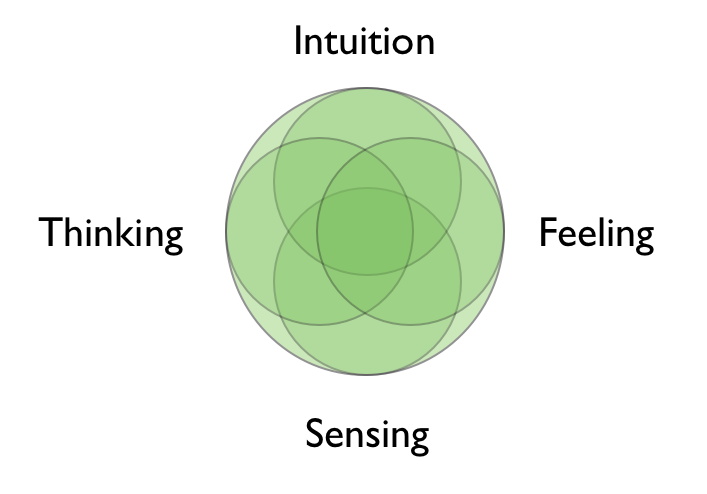
The rational mind struggles to cope with the increasing complexity and volatility we find in business often leading to increased stress and reduced performance, but intuition can cope quite effortlessly. Re-connecting with our intuition by creating silence and space for our minds to re-balance both left and right brain hemispheres is fundamental for realising transformational change (in business and beyond). An important part of re-connecting is the need for reflection to continually deepen our intuition, and then using intuition to act with intention (taking responsibility for our choices and actions as well as those of our organisations).
O for Openness:
The more we open up to our environment, the more we tune in to the interconnected nature of business life, sensing and responding in the most optimal way. Likewise, the more we recognise the need for openness in our approaches to ways of operating the more we can positively adapt; shifting from closed-source to open-source approaches, for instance. Sharing knowledge freely is often contrary to our prevalent business mind-set; allowing oneself and organisation to be more open to sharing freely is an important part of the transformational journey.

N for Nature:
A firm of the future is a business inspired by nature. Nature is a deep source of inspiration. Connecting with nature can bring benefits of improved creativity, serenity, centeredness and well-being. Operating in harmony with nature is what true sustainable business is all about – not just seeking to ‘do less bad’ but creating the conditions conducive for life through holistic business value – this is good business sense. The transformational journey is about being inspired by nature, being connected to nature and being in harmony with nature, then by its very nature the organisation and leader has achieved a redesigning for resilience.
View a short video clip on business inspired by nature here
To explore ‘business inspired by nature’ further, join the Face Book community here
The age of co-operation beyond competition?
Why is ‘competition’ viewed as a key driver in business behaviour? We so often hear business leaders say that they embrace sustainability or new ways of operating because it provides ‘competitive advantage’. Is business life all about competition?

‘Competition’ as a word used to mean ‘striving together’ yet now it seems to refer to working against each other, separation and self-interest. Read more…
Can leadership be inspired by nature?
Shouldn’t it be natural to share the burden of leading a business? While watching geese drafting in V formation, we will observe the flock rotate leaders. Like drafting geese, businesses which rotate leaders will create less resistance for the team. Semco, a multi-billion dollar Brazilian company with over 3000 employees practices leadership rotation flawlessly. They do not have a CEO, rather a group of executives who assume leadership for six months at a time. Semco’s evangelist visionary, Ricardo Semler “believes that by letting go of control, people learn to control themselves and work in a more creative and productive manner” (Zakomurnaya, 2013). Like drafting geese, biomimetic organizations will see leadership as a team responsibility because doing so creates room for reflection, quality control and rejuvenation.
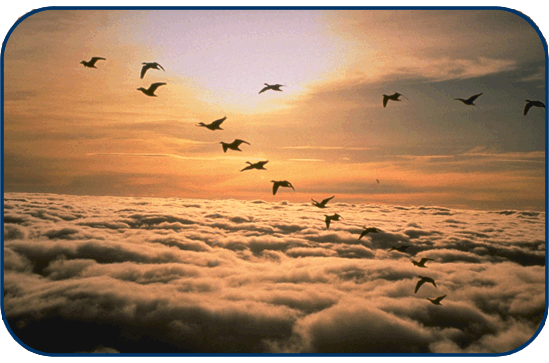 Rotating leaders fosters authentic teamwork by incentivizing us to adopt a participatory and empathic leadership style. In turn, participation and empathy foster cohesive, trustworthy teams which create resourceful and original work. When there is no permanent leader, individuals are more likely to prioritize the team’s well-being over their own. The golden rule phenomenon creates room for reflection and objectivity with regards to decision making and relationship building. Like a regenerating forest, communicating and sharing resources is a hallmark of effective leadership. Because every team member is a small part of the whole, everyone’s opinion and mental state determines the collective energy of the team. Leaders must go out of their way to get to know team members on a personal and professional level. Relationship building and catalyzing objective thought amongst the team depends on the leader’s commitment to personal reflection.

Business leadership inspired by nature begins with knowledge of self. Henry David Thoreau insightfully said “if a plant does not live according to its nature, it dies. And so a man…” Put in a business leadership context this means that unless the leader accepts his own problems and cherishes his own path, he cannot begin to address business challenges and effectively guide his team. The leader’s ability to find balance in his life will determine how even-keeled his team is. Balance fosters an open-minded environment where team members are energized and excited to participate.
Leadership inspired by nature emphasizes perception and cooperation. “Great teamwork happens when individuals strive to be the best person for the team, rather than the best person on the team” (Bo Hanson). Making a conscious effort to pay attention to team dynamics and the morale of the team encourages synergistic behavior. In order to understand team dynamics we must create space for cooperation. For inspiration, let us look to the way soil forms small clumps; it does so to aerate itself and spread nutrients and water deep into the ground. Business teams must also create channels for innovation to permeate. Perhaps employing an anonymous feedback system will encourage your team to enrich the project or improve processes in general.
Lastly leaders can utilize cycles in nature to maximize creativity and productivity in the workplace. It is easy to observe the ill-effects of living opposed to nature. Think of how uncomfortable it is to go a night without sleep or to only eat frozen processed foods for a week. Conversely ‘syncing’ our bodily cycles with the cycles in nature will help us feel energetic and content. This goes beyond getting a good night’s sleep and eating whole, natural foods. Living in accordance with our suprachiasmatic nucleus, commonly referred to as our body clock is a major catalyst for positivity. Let’s look to Traditional Chinese medicine (TCM), rooted in 4000 years of observing how the human body fits into the natural world. TCM shows us that between 7-9am our stomach is most active. Leaders might establish team breakfasts during this time of day to set the tone for a cohesive and lively day ahead. Our kidneys, responsible for maintaining our energy are most active from 5-7pm, so this is a great time to exercise. Biomimetic leadership not only creates harmonized teams it creates harmonized individuals.
In the wise and timeless words of Confucius:
He who is in harmony with nature, hits the mark without effort and apprehends the truth without thinking
To explore ‘business inspired by nature’ further, join the Face Book community here
This is a guest blog written by Daniel Katz of Hult Business School.
Those of us who are members of the BCI network strongly believe that many of the solutions to the problems we are facing today can be found in nature. It is why we talk about ‘business inspired by nature’. When we study ecosystems, we begin to realise how nature has already solved the intricate problems of diversity that we humans seem to struggle so much with, such as creating a global financial system and currencies that are truly sustainable. Simon Robinson of BCI: Biomimicry for Creative Innovation is also editor of Transition Consciousness and a sustainability expert based in Sao Paulo writes a guest blog for The Nature of Business on this here.

In Brazil I consult and teach people in business about complexity and chaos. People are always keen to learn about new business models, and a profound understanding of these business models such as Kyocera’s Amoeba Management System can come from studying complex systems in nature. But there is a hurdle to overcome.
Nature’s systems, the cells, plants, immune systems, DNA and every other organic system do not function in the same way as technology. We cannot use the same mental models we use to build technology for the comprehension of an organic system such as a plant, which not only are dynamic, but which require a complete rethinking of the relationship between the parts and the whole.
Crossing the threshold – 2013: Ready for a new paradigm?
Apparently we change for two fundamental reasons:
1) We have enough information about the situation we want to change
2) We are experiencing so much pain that we have to change
This ‘perfect storm’ of economic, social and environmental factors in our midst is actually a ‘perfect dawn’ for us as it invokes both core drivers for change – we have more than enough information to know we ought change and we are experiencing more than enough pain for us to have to change. The bad news of breakdown leads to the good news of breakthrough.
At times of great winds, some build bunkers, while others build windmills. Ancient Chinese proverb

Many experts now point to an imminent paradigm shift: a transformation in the way we conduct our business, engage with each other and relate to life itself. For instance, Professor Michael Porter stated when addressing a business leaders forum in October 2011 ‘the old models of corporate capitalism are dead…we are witnessing a paradigm shift’. In 2012 John Elkington, in The Phoenix Economy report, notes that ‘the time is ripe for a true paradigm shift to a more sustainable economy.’ So here we are in 2013; there is no time like the present. The paradigm shift is not going to happen five or ten years from now, it is happening as we speak.

The challenge with any paradigm shift is that it requires both a letting go of old, tried-and-tested ways ingrained in our collective psyche and an embracement of novel, as yet unproven ways. There is a threshold across which individuals, organisations and communities need to cross. It is a chasm that can sometimes look like an abyss especially when we are all-to-engrossed in frantically patching up the current way of doing things just to keep the wheels from falling off. There is inherent inertia in crossing the threshold. Our feelings of security in the known and sense of safety in numbers by staying in the herd keeps us fearfully clinging to old ways.
As Morpheus in The Matrix said:

As the saying goes, ‘old habits die hard’. Paradoxically it is through the release of old ways that innovation and new growth comes. The old has to die-off for the new to emerge, just as in nature old trees fall to the ground where-upon fungi and bacteria break it down to release nutrients into the soil for new growth. This ‘back-loop’ of death bringing re-birth is just as vital to the vitality and health of natural systems as the more socially acceptable ‘front-loop’ of innovation, growth and conservation is; ditto for economic and social systems.

Transformational times of impending destruction and creative re-construction inevitably invoke fear. It takes great courage to break rank from business-as-usual amidst a perfect storm. It takes real leadership to transform a business in such volatile times. Incidentally, the root of the word leadership is ‘leith’ which means to go forth and cross the threshold, to die and be re-born.
Dr Otto Sharmer, Senior Lecturer at MIT, in his ‘Theory U’ explores how leadership itself needs to transform in order to be able to lead us across this threshold. Leadership, he finds, is about facilitating the process of letting go of old ways and allowing the new to take root. Leaders first transform themselves and then guide and coach others, creating a safe passage for the followers to cross the threshold. Vital to this leadership is a healthy foundation to ground the transformation in, what Sharma refers to as the soil of the being (the psyche of the self) and the soil of the organisation (the culture of the organisation). It is this soil that allows the old ways to die and yield nutrients for new growth at a personal and organisational level; much like healthy soil breaks down decaying matter in winter to provide vital nutrients for new growth in spring. The soil of us is our inner being, this is where we can start to envision the future on the other side of the abyss and so contemplate crossing the threshold.
This ability to embody the future is what Peter Senge, Otto Sharma and colleagues have referred to as ‘presencing’ and is well articulated in their book Presence. It is the ability to transform our capacity to see and our capacity to create which Senge and others explain as:
‘a new capacity for stillness that no longer fragments who we really are from what’s emerging; and a new capacity for creating alternative realities that no longer fragments the wisdom of the head, heart, and hand.’
This leadership can be found in each of us; we are the leaders of the future. Yes, we may need to sometimes rely on charismatic, courageous people to lead diverse groups of us, yet it is you and me that need to nourish our own inner soil, to allow for the dying of old ways and the re-birth of new realities. This is ‘the nuts and bolts’ or rather ‘the roots and shoots’ of the paradigm shift, not some global flash of light, meteor strike or the second coming, but each of us finding our passion that aligns our inner selves with our outer activities, by envisioning new realities and then taking small steps of change. The good news is we are not alone in having to envision, we can co-create with those in our communities and organisations, as more and more people now get that business-as-usual is broken beyond repair.
Through dialogue and sharing, we help ourselves and others to presence our future. Each interaction facilitates reflection and brings opportunity for further innovation and adaptation. Each day offers us chances to place fresh new steps of change.
As Mother Teresa once profoundly said,
we cannot do great things, only small things with great love.
A healthy and easy first step to take is a stroll in nature, to allow the mind to settle and the heart to be heard. Nature has a magical way of helping us see things clearer. What an important time to be alive; it’s time to cross the threshold and lead ourselves through this paradigm shift in business and beyond.
To explore ‘the new paradigm’ further join the Face Book community here
The Radical Redesign of Business – are you ready?
One could argue our industrial world has reached the edge of its adaptive range.
We are faced with a world that in a very short period of time has gone from seemingly linear (simple) to complex and non-linear (chaotic). Now is the time when we need a way of evaluating how we deal with volatility and unpredictability.
In the words of Prof. Mervyn King, Chairman of the GRI & IIRC:
‘I have little doubt that commentators in 2020 will look back on the decade of 2000 – 2010 and describe it as the decade of stupidity, because generally companies with knowledge of the crises faced by the planet carried on business as usual. They continued to take, make, waste, as if the planet had infinite natural assets and an infinite capacity to absorb waste….The decade of 2010 – 2020, I believe, will be known as the decade of change.’
Transformational times call for transformational change
What is called for is nothing short of a ‘radical redesign of business’. Alan Moore, author of No Straight Lines, and Giles Hutchins, author of The Nature of Business, partner up at Schumacher College to explore this ‘radical redesign of business’.

In redesigning the world, Alan Moore argues that we need human creativity in the sense of the capacity to ‘make’ and we need visionary leadership in the sense of ‘making a positive difference’. In this ‘making’ we need a craftsman’s approach more focused on quality than quantity – we seek the craftsman’s critical eye, steady hand and creative mind.
The call for Craftsmanship
The craftsman’s critical eye and creative mind is vital to evaluating new possibilities; he/she must be open to new ideas, information, tools and materials to make things that enable humanity to flourish in these challenging times. But this requires us to think and act as craftsmen and women and apply our critical thinking to understanding our non-linear world, which is in part shaped by participatory cultures, open, complex and seemingly ambiguous systems that are highly interdependent of each other.
Humanity in harmony with nature
Giles Hutchins notes that we need humanity to flourish in harmony with all of life for there to be anything resembling a successful outcome for business, society and humanity; hence a business paradigm that is both inspired by and in harmony with nature. Seeing the world with different perspectives begs the question of humanity’s purpose and place in life. Is the shift from a mechanistic, linear world to an emergent, non-linear world aided by a changing relationship between humanity and the wider web of life? Can this shift in business and beyond also include a shift from anthropocentric and reductionist thinking to eco-system being?
Systemic failure
Sir Ken Robinson famously said:
‘We educate our children from the waist up, then we focus on their heads, and then we only educate one side of their brain. The whole purpose of education is to produce university professors who live in their heads, their bodies are only there to transport their heads to meetings’.

As Alan Moore says, humanity now ekes out its existence under the industrial tyrannical twins of obsession with numbers and measurement of efficiency in every walk of life, whilst ignoring its fundamental needs. In addition, an unfettered pursuit of material wealth over any other value has come at a terrible cost for society; deeply damaged us spiritually and, ironically for many, materially.
Education was created at a time when the need was to fuel the explosion of industrialisation, yet in its present form, it is becoming a devalued commodity. The current education system educates creativity out of us.
Richard Sennett describes a sense of hopelessness, and isolation that deconstructs our character in the workplace; ’unfettered capitalism’ makes it impossible for us to create coherent ‘character’ with its deadly consequences. Eric Beinhocker points to the failure of neoclassical economics, becoming enslaved to an ideology of neoclassical theory that is in the process of being supplanted by what he calls ‘complexity economics’ – the view that the economy is a complex adaptive system made up of realistically rational people who dynamically interact with each other in an evolutionary system. When people communicate with each other it is not simply a matter of communication, but it is a sharing that takes place in a very real, embodied way. 
We are not atomised, rational people; we are creative, social, intuitive, relational people. As Cacioppo and Patrick point out, brains and bodies are designed to function in a collective and networked fashion, not in isolation. That is, they say, the essence of a social species: ’social connection is not just a lubricant that like motor oil, prevents overheating and wear, social connection is a fundamental part of the human operating and organising system itself.’
The rise of the Human Operating System – the ‘super organism’
As Alan Moore insightfully recognises:
‘We are midwives to a world that’s evolving from the straight lines that were representative of an industrial era, to a world that in its networked beauty is more like nature; more like us. Nature’s default setting is connection.’
Authentic living seeks a different way to work, one that provides greater meaning. This quest is driving a revolution in the structure and methods of business. A radical redesign of business where no corner, no open-plan office, no meeting room is left out. We need a new language and philosophy, an idea of a different type of society, by unfolding and exploring ideas of language and creativity that brings us new ways of describing and comprehending our world. You might call it a new common sense. This human operating system looks beyond materialism to something greater to liberate us from closed systems. In this way, we can become meaningfully re-engaged with the world, understand how we make our way in it, be truly accountable to each other and enjoy the full richness of life.
A transformation to a networked world where people ‘get connected’ is only whole if people also ‘re-connect’ with life, with their sense of purpose and place in life. Richard Sennett tells us that the craftsman constructs authentically. His honesty is communicated through his work, which then holds an inherent eternal truth. And the craftsman represents all of us with a desire to do something well, concretely and for reasons for other than material profit. It’s the unleashing of this deep motivation that we seek.
Alan Moore’s ‘No Straight Lines’ can be found here.
‘Anyone worried about where business is going in today’s chaotic world – and everyone concerned with where it should be going – must read No Straight Lines. Alan Moore has captured what is happening, but more importantly provides prescriptions for what individuals, companies, and society should do about it to create a better world’.
– B Joseph Pine II, Co-author, The Experience Economy and Infinite Possibility
 Giles Hutchins’ ‘Nature of Business’ can be found here and the North American version on Amazon here out soon, it can be pre-ordered now.
‘The Nature of Business’ is not just a very entertaining read, but also a redoubtable sparring partner. A must read for everyone involved in the business of the future…. and aren’t we all?
– Mick Bremans, Chairman, Ecover
To explore the ‘radical redesign of business’ further, join the Face Book community here
The economic, social and environmental volatility now facing business means organizations having to operate in a dynamically transforming landscape.
The nature of change itself is transforming. Organizations are now increasingly exposed to dynamic change: change upon change upon change – while dealing with one change, another affects us, then another, and so on. This dynamic change upsets the traditional mechanistic business paradigm we have been working to over the last few decades.
Paradoxically, inspiration for the current pressing challenges is all around us in nature. Nature has been dealing with dynamic change for over 3.8bn years, and the more we explore nature’s ways the more we find inspiration for operating in a dynamically changing business environment.
Our understanding of nature has evolved over the last few decades, from viewing it as a battleground of competition to one of dynamic non-equilibrium, where an order within chaos prevails due to unwritten natural patterns, feedback loops, behavioral qualities, interdependencies and collaboration within and throughout ecosystems. The more we grapple with the challenges our businesses now face, the more we realize that nature’s patterns and qualities inspire approaches and qualities for our own evolutionary success in business and beyond.
Organizations inspired by nature are resilient, optimizing, adaptive, systems-based, values-based, and life-supporting. Let us explore these principles.
Resilient
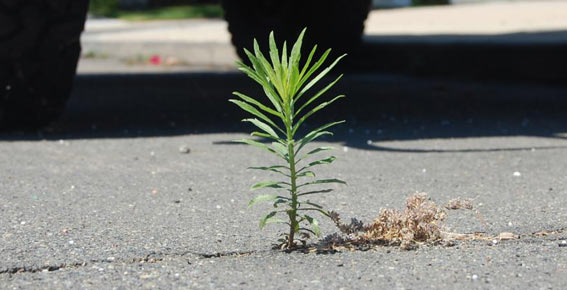
The more resilient an organization is, the more able it is to successfully deal with
disturbances and volatility. Hence, business resilience is fast becoming the Holy Grail for businesses in these volatile times. The more diverse, decentralized and distributed a business ecosystem, the more able it is to seek out opportunities and capitalize upon a changing business landscape.
By way of example, UK brewery Adnams recently shifted their focus from a few product lines and customers to increasing the diversity of products and their customer base. The shift towards a greater variety of products and customers led to investment in adjacent markets. During this business transformation, Adnams also invested in its employees, ensuring they became more empowered to make decisions locally, reducing the need for overly burdensome centralized management. These changes have significantly increased Adnams resilience, leaving them far better equipped to deal with market volatility and seek out new opportunities.
Optimizing
Whilst maximization brings benefit of economies of scale through lower unit cost of production, in nature we find optimization through economies of scope brings different benefits through improved cross-fertilization and species interaction (akin to improved interactivity across traditional department and organizational boundaries). Maximization is driven through homogenizing, scaling up, atomizing, industrializing and reducing complexities within a specific business function, system or process; optimization is driven through enhanced connections, interactivity and interdependencies across different business
functions, systems or processes.
In nature, economies of scope are fundamental for adaptation and survival as it is species that have multiple synergistic interconnections within their ecosystem that co-create resilient ecosystems more able to survive dynamic change.
Adaptive

In the words of Charles Darwin “it is not the strongest species that survive, nor the most intelligent, but the ones most able to adapt to change”.
Unilever is undertaking significant adaptation across its business not just in the way it sources, produces and distributes products but also in the way it engages stakeholders across its entire business ecosystem. It is adapting its approach to business to become fit for purpose for the environment that it operates in.
General Electric is another good example of a company that is adapting and transforming its business strategy towards products and services that enhance the sustainability and long-term value of its customers and wider stakeholder community.
Systems-based
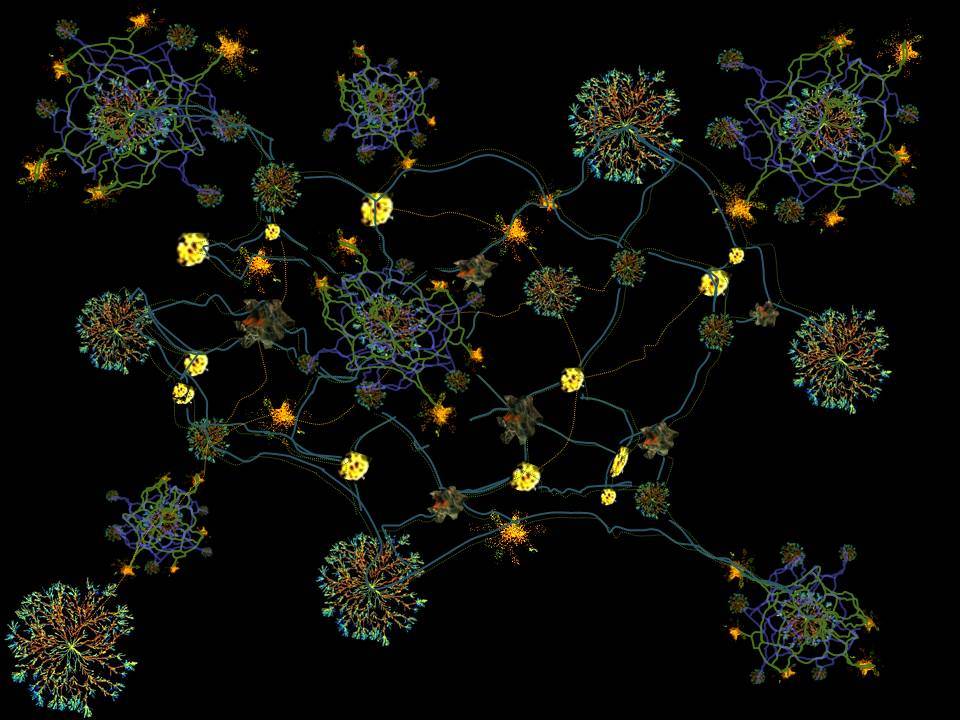
Whilst reducing complex problems, projects or production lines into small, manageable chunks has the advantage of simplifying management and control, it can reduce the interconnections and interdependencies between activities that give rise to synergistic value enhancement.
Business, like nature, is lit up by interconnections and relationships that find success by being both system-focused and self-focused. Whatever the organization (or organism) does to benefit itself should also benefit the system; in benefiting the system it also benefits itself.
Values-based
As the need increases to continuously change, let go of old ways, seek out opportunities and embrace the new, values become the core from which consistent good business behavior is rooted. Hierarchies of management and control slow down the ability for organizations to adapt. Rather than controlling the workforce, a firm of the future empowers the stakeholder community to take decisions locally, based on the core business behaviors set down by the values and culture of the organization. Hence values-based leadership becomes a differentiator for those organizations best able to transform towards a firm of the future.
Life Supporting

Sustainability is fast becoming embedded into business best practice. Life supporting goes beyond traditional sustainability and corporate responsibility – measuring, monitoring and reducing the negative effects of the business. It is about creating the conditions conductive for life; encouraging behaviors, products and services that seek to enhance the wellbeing of those within the business ecosystem. Some organizations are already transforming towards zero emissions (for example, Puma and Interface), yet there is neither rhyme nor reason why business should be limited to that zero goal. Reaching for net positive value creation where business relationships, products and services are mutually beneficial for the stakeholders, society and environment within which they operate is the true ambition for the firm of the future.

Of course that transformation is a journey not a destination. These business principles help shape the direction of the journey, yet there is no ideal business model or perfect way of operating; it is about finding the right way at the right time for the market conditions.
The future is bright for those organizations and individuals bold enough to embark on a journey of dynamic transformation in the face of increasingly perilous market conditions.
To explore ‘business inspired by nature’ further, join the Face Book community here
The Nature of Business – it’s second nature to us!
Evolutionary biologist, writer, Biomimicry 3.8-trained biomimic, and sustainability expert, Dr. Tamsin Woolley-Barker reviews ‘The Nature of Business’.
I recently had the pleasure of coming across Giles Hutchins excellent book, The Nature of Business. Since I’ve been working on a book about organization transformation inspired by nature myself, the title grabbed my attention right away. I am primarily an evolutionary biologist rather than a business person, so my own work, through BioInspired Ink, comes at the topic from a deeply biological perspective. Hutchins’ book is the perfect complement, coming from a broadly informed perspective rooted in extensive personal experience with sustainability and new business strategies. He nudges the corporate reader to consider how complex, highly coordinated, and supremely adaptable biological systems like fungal mycelium, social insects, bird flocks, and fish schools achieve resilience in the face of disturbance, and what businesses can learn from them.
The Nature of Business accomplishes three important tasks. It is, first and foremost, a well-thought out synthesis of a broad swath of thinking on sustainable business practices. It goes beyond this, however, presenting a diverse array of case studies and examples of cutting-edge businesses that are successfully implementing “nature’s business principles” to become more robust, resilient, and responsive in the face of increasing volatility. He focuses on eight of the twelve evolutionary principles that I identify operating in nature’s most resilient systems, and that we can use to transform human systems into the kinds of sustainable structures we see in nature. Last, the book is grouped into a series of nine action-oriented modules, each intended to facilitate practical application of these concepts in the business environment.
Hutchins’ synthesis lays out the idea that the purpose of business today is “to maximize [short-term] shareholder return,” through bottom-line cost reduction and top-line value enhancement. Growth is all-important, and primarily achieved by meeting perceived customer needs and desires. Consumption of goods and services by customers equals growth, and growth equals profit, which equals more employment, higher incomes, and more consumption, which requires the production of ever more goods and services.
Hutchins’ notes that we produce goods primarily by taking raw materials from the Earth (oil, metal, water, and living natural resources), making these substances into products through ‘heat, beat, and treat’ technologies (at significant energy costs, with toxic byproducts), and discarding the final product when it is broken or no longer needed. The problem with this linear production model is that our planet’s resources are finite (“except for solar energy and the odd meteor”), as is its capacity to absorb waste, including carbon emissions.
We treat these ‘natural services’ (resource availability and waste absorption) as if they were largely free. But in reality, consuming the planet’s raw materials, decimating biodiversity, compromising our watersheds, acidifying the oceans, destroying topsoils, and changing the global climate by transferring huge quantities of subterranean carbon into the atmosphere are like taking a zero-interest loan from nature. Borrowing looks cheap now, and we don’t bother factoring these “external” costs into today’s prices. Our lifestyle, however, is saddling us with an increasingly large debt to nature. Sooner or later, this debt will need to be repaid, and there’s no government bail-out coming on this one. As Hutchins says, “living off your assets instead of income is short-sighted.”
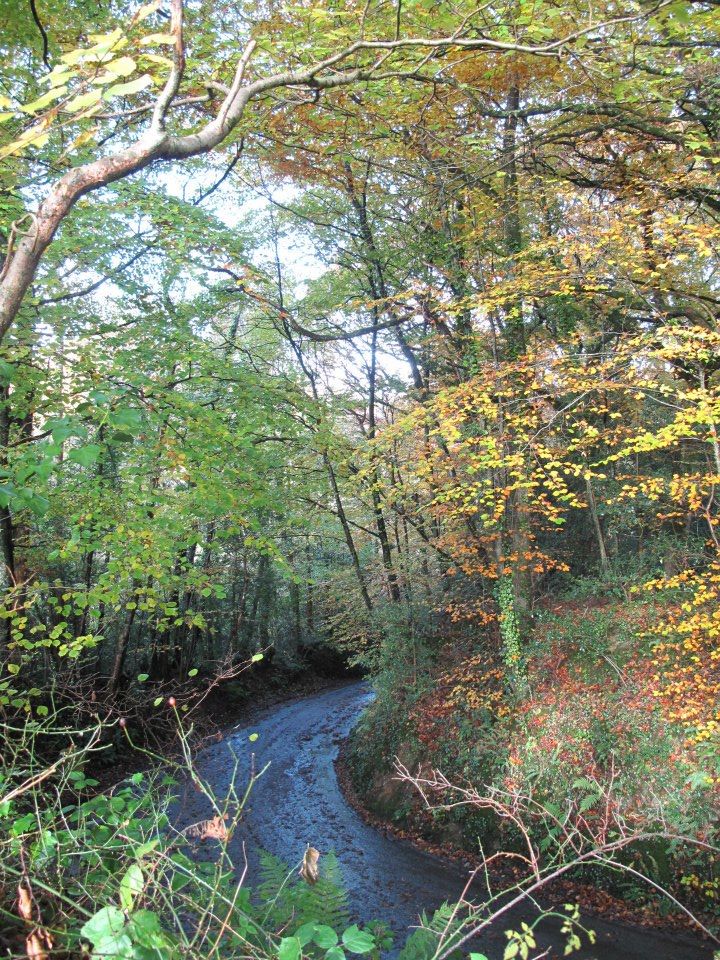
Increasingly, notes Hutchins, these external costs create global volatility and disturbance. Scarcity of natural resources drives up prices and risk in our global supply chains, climate change increases the frequency of extreme natural events, and unexpected (and costly) disruptions occur to natural services we take for granted. Biodiversity declines, and ecologists know that fewer species means decreased ecosystem complexity and resilience, which further weakens the system. All of this threatens social stability, economies, and the businesses we depend on. In short, business as usual is not sustainable. “If we do not conduct our business within the constraints of the system,” says Hutchins, “we will inevitably go out of business.”
The solution to this crisis for any business is to shift away from maximizing short-term profit and the efficiency of each component, and do things the way the rest of nature does them. A ‘subunit efficiency mentality’ yields a suboptimal system, because the whole is actually more than the sum of its parts. Hutchins believes that “good business is about seeking opportunities for value-creation,” defined holistically by the ‘triple bottom line’ of People, Planet, and Profit. When companies realize this, their “values and value reinforce each other, and a values-led culture drives the value-creation potential of the organization.” A long-term, holistic view gives an organization clarity of purpose, which it shares organically with customers and employees, suppliers and distributors. “Only then does the need to manage, monitor, and control stakeholders fall away,” this cumbersome mechanism of hierarchic management to be “replaced by good governance through values and ‘walking the talk’ behaviors.”
Just as in any natural ecosystem, organizational resilience is a function of complexity, diversity, and unity of purpose. And just as in nature, when the values and goals of all stakeholders are aligned, “the chaotic nature of diversity naturally emerges toward delivering shared value-creation, while maintaining flexibility, adaptability, and sense of purpose.” A unified vision promotes buy-in, encourages the intelligent, self-directed response of talented, motivated individuals to changing local conditions, and promotes synergy between partners. Presto! You’ve created a resilient organization, ready to survive and thrive in the face of change, like slime mold absorbing nutrients from a newly fallen tree.
The North American version of the book coming out in a couple of months can be found here. It is already available in Europe and can be shipped globally from here
An evolutionary biologist, writer, Biomimicry 3.8-trained biomimic, and sustainability expert, Dr. Tamsin Woolley-Barker blogs at BioInspired Ink and develops content for the California Association of Museums’ Green Museums Initiative. She is currently at work on BioInspired Inc: 12 Natural Steps for Your Organization to Survive and Thrive, a book about organizational transformation inspired by nature.
For the original post of this review at CSRWire see here
Creative Destruction: Think like a Forest!
The phrase “creative destruction” has become a common one as economies and nations struggle to adjust in the aftermath of the Crash of ’08. It was Joseph Schumpeter who coined the expression to describe the workings of capitalism, and citations of the maverick economist seem to have soared in recent years.
Schumpeter himself has been called a “living contradiction”, oscillating as he did between the twin poles of political economy – history and theory. In the early years of the 20th Century, a great battle was fought between the two. Theory won, leading eventually to the emergence in America of neoclassical economics, with its emphasis on equilibrium and the use of abstract models to study the real economy. Schumpeter refused to reconcile himself to this outcome and all his life he fought against what he called the “Ricardian Vice”, the tendency of neoclassical economists to mistake their models for reality.
Schumpeter never came up with a theoretical framework to support his heterodox views. As a result, there are no Schumpeterian schools of economics. Mainstream economics, with its assumptions of equilibrium, cannot handle even the concept of creative destruction, let alone its dynamics. Where should we turn for insights?
Turn to Nature
In this guest blog the writer David K Hurst explores how creative destruction in business can be inspired by nature.
Nature supplies an answer. Natural ecosystems thrive on processes of continual creation and destruction. Consider an ecosystem like a forest. A typical forest succession looks like this:

It all begins at the extreme left in an “open patch,” a space in the ecosystem that provides equal access to sun and rain. This allows small-scale experimentation without competition—at least at first. The initial colonizers of the open patch are the migrants: weeds and wanderers, like migrant birds, insects, and rodents, who are “funded” by the local seed “bank,” which contains a host of organisms waiting for the right conditions to germinate. These colonists are the entrepreneurs of the ecosystem; they invade the open space, attracted by the ready availability of small-scale resources and the absence of competition. With the easy availability of resources—relative to their requirements—everything grows.
In the forest the migrants and liberated locals thrive and grow in the open patches until they start to bump into each other and to compete for resources. This emerging competition favors the greater efficiencies of larger-scale shrubs and other plants that develop infrastructure—roots to get to the water first, branches and leaves to get to the light first and to shade their competitors. Those who survive have either to dominate or find themselves a niche where they can persist. This process continues, favoring more efficient users of increasingly scarce resources due to the escalating competition, along with more inter-play and collaboration amongst niches. The shrubs are succeeded by trees, which are more efficient still. As the forest grows up, its physical scale increases enormously.
In this idealized forest succession the softwood trees are succeeded by the hardwood trees. The forest has now reached its so-called climax phase; it looks green and gorgeous. It used to be thought that this was an equilibrium condition, but it is not. Indeed, the conditions are ripe for sudden catastrophe brought on by the huge assets stored in a system that has become over-connected. Too many trees are now of the same species and similar age, and they are vulnerable to the same challenges such as fire, wind, disease, and insect attack. Thus, as the forest grows up, the reduction in the variety of organisms in the ecosystem leads inexorably to a lack of resilience in the face of change. A forest needs to create open patches continually to admit variety and renew itself. Destruction precedes renewal.
Destruction and Renewal
The cycle of destruction and renewal is captured in the following diagram:
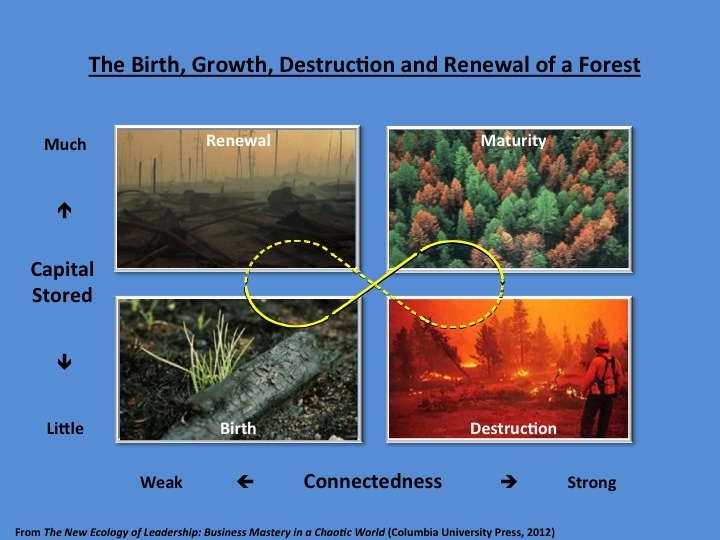
The stylized, infinity-shaped loop contains the familiar lifecycle (solid S-shaped line) that follows the sequence of forest succession from birth to maturity. Joined to this front loop is a back loop or reversed S-shape (dotted line) that tracks the forest as it goes through the process of destruction and renewal. The infinity symbol captures the dynamics of a complex system going through an endless process of birth, growth, destruction and renewal. The growth processes on the front loop are slow, while the destructive dynamics of the back loop are very fast. It is this fundamental asymmetry between the two that makes destruction so disruptive. Fires in a forest do their work quickly, while the processes of recovery take a long time. This is why a resilient forest is a patchwork quilt of many different species in different stages of growth. The immense variety of such a system ensures that it cannot be destroyed by a single event.
Disciplined Analogies
Analogies between ecosystems and human systems, disciplined by theories of complex systems, have the capacity to generate powerful insights into the workings of organizations at many levels. When supplemented by new understandings about human nature, such perspectives suggests that enterprises (including capitalism itself) are conceived in passion, born in communities of trust and practice, grow through the application of reason and mature in power. As they grow, these systems become modular (specialized) and stratified (hierarchical) for the very best of reasons – to preserve a recipe for success. Initially these are enabling bureaucracies, with virtuous habits that are embodied rather than imposed. Over time, however, they become structures of dominance, coercive rather than enabling, and oppressive to all who work in them. The resulting lack of innovation and initiative renders the organization insensitive to what is happening externally. As firms (and institutions) lose their ability to command resources, they become vulnerable to the organizational equivalents of wind and fire, flood and pestilence. The Crash of ’08 provides some prominent examples.
Disciplined ecological analogies are ones that every modern Schumpeterian can embrace.
To explore ‘business inspired by nature’ further, join the Face Book community here
David K. Hurst (david@davidkhurst.com) is a writer and educator. His latest book, on which this blog is based, is The New Ecology of Leadership: Business Mastery in a Chaotic World (Columbia University Press, 2012)
Feedback is essential to how nature and business operate. Feedback relates to two or more interconnected systems sharing information to maintain a two-way, symbiotic relationship. Take the human body which relies on cell feedback to achieve homeostasis and survival. In order to maintain a steady concentration of glucose, the pancreas secretes insulin, directing excess glucose to the liver for storage. By way insulin, the pancreas tells the liver that it’s time to go to work. Feedback occurs over and over in the natural world and also in business.
If businesses took advantage of the experience economy and adopted education as a means to foster deeper, interdependent relationships with their customers, could business drive social evolution? Daniel Katz provides some insight to this important and timely question in this guest blog.

The Archetypes
Neal’s Yard Remedies is a London based purveyor of organic health and beauty products. Upon entering any of Neal’s Yard’s 40 shops in the UK, you will experience the soothing mélange of aromas wafting throughout the store. You’ll find browsing shoppers who sip on free samples of herbal teas and bi-lingual clerks eager to explain the all-natural ingredients found in their products. Neal’s Yard’s success can be largely attributed to delivering a stimulating and holistic, well-being focused experience. Read more…
 The Nature of Business