The Necessary Evolution from Machine to Living-systems L&OD
The L&OD living-systems paradigm is a worldview shift that moves us onward from yesterday’s machine paradigm. A “worldview shift” may sound daunting, especially when many of us experience enough stress, busyness, and volatility in the workplace today. The good news is this worldview shift is a genuine return. It is a revitalization of something innate, a reconnection with the true nature within us and the rhythms and ways of nature all around us. Woven into our human physiology and psychology is the natural capacity to embrace a living-systems worldview. Letting go of old, illusory ways while welcoming in our deeper nature—what could be more invigorating?
When, as leaders, we are able to let go of the outdated mechanistic tendencies and expand our restricted view of the organization, we open ourselves and our teams up to how life inherently operates—in harmony. We learn how to work with natural rhythms and methods that encourage the vitality and adaptability of the organization. We learn to lead by nature.

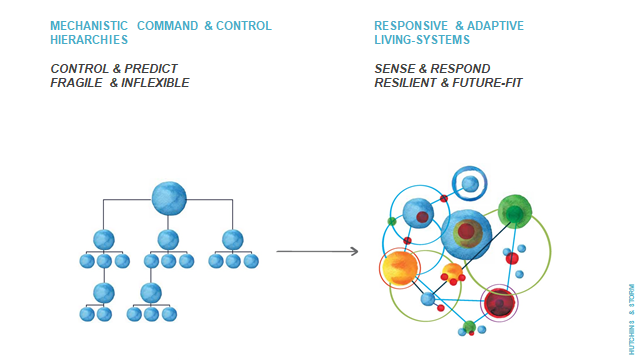
Machine Worldview Living-Systems Worldview
Dominator culture > Partnership culture
Parent-child > Adult-adult
Control-manage > Sense-respond
Disempowering > Empowering
Unnatural > Natural
Life-denying > Life-affirming
Let’s take ourselves out of the busy work environment for a moment and reflect on our everyday life. We successfully go about our daily chores, errands, and affairs without the need for top-down, command-control managers telling us what to do. Whether it’s picking the kids up from school, washing up after Sunday lunch, going to the theatre, catching a train, or organizing a birthday party, we seldom hand over our self-authoring power to managers. We might seek advice from partners and friends or ask experts about certain projects, but when someone starts to tell us what to do in a dictatorial way, our defenses go up, we get wary, and we switch off.
Because being “managed” feels like a form of oppression that undermines our own sovereignty, and so we retract. As we retract, the relationship between ourselves and the other person is subtly inhibited; it no longer flows as naturally, and creative potential is lost. Sure, there will certainly be times when it is wise to exercise authority or assertiveness of one’s view. Leading by Nature is not a namby-pamby way of relating to others in the organization. No, not at all. Leading by Nature is about noticing when we are standing strong in our authentic true nature as opposed to instances when we are either forcing another person or being forced by another whose trying to dominate us. To use psychology lingo, it’s the difference between an adult-adult dynamic and a parent-child dynamic.
A recent global Gallup poll shows that 85% of workers are disengaged, which illustrates the extent to which our mechanistic mindset is crippling organizational effectiveness. It’s a mindset that creates human suffering, psychological distress, and unhealthy interpersonal relations right at the heart of our enterprises, the very place where creativity, passion, purposefulness, and adaptive learning ought to be unlocking our brilliance. Hence, the number one most important thing our leaders need to address is the ability to transcend the old, life-denying organization-as-machine mindset and expand into a leadership consciousness that frees our self-and-system awareness so that we can better sense and respond to the systemic dynamics at play across the organization-as-living-system.
This evolutionary shift in L&OD is a learning-in-action process. First and foremost, it’s an internal shift, an embodied process—rather than a linear tick-box exercise—where one must become self-aware of old habits while patiently practicing new ones. Secondly, it requires enriching the cultural soil of the organization so that each person can draw nourishment from everyday interactions as they learn and adapt.

The good news is that we need look no further than within and all around us to find inspiration for this L&OD shift from a machine into a living-systems worldview.
When we observe a forest or woodland, reductive machine logic sees trees struggling against each other in a competitive battle for survival of the fittest. However, when we sharpen our lens of perception—using a living-systems lens—we start to see the immense, inter-relational venture at play. Different species of trees share nutrients with each other through the soil, and tree roots form intimate relationships with mycelia, bacteria, and microbes. The forest floor is teaming with networks that benefit the vibrancy, resilience, and evolutionary dynamics of the whole ecosystem. In only a handful of healthy soil there’s more living beings working together than there are human beings on the entire planet.
What Charles Darwin originally meant by the phrase “survival of the fittest” was not “dominate or become dominated,” but rather each species adapts to an ever-changing context by “fitting-in” to its niche. It’s not the strongest species that survive nor the most intelligent but the ones most able to adapt to change. This adaptive edge is what our organizations need to foster by welcoming in the living-systems worldview into our L&OD.
Future-Fit Organizations as Living-Systems
There is so much to learn from our trees and soil, let alone nature’s fuller ensemble. In nature’s collectives—ant colonies, beehives, flocks of birds, and shoals of fish—we find the pervasive behavior of sensing-responding. A scientific descriptor for this sensing-responding behavior is stigmergy, where collectives create adaptability, coherence, and resilience without the need for planning, control, direct communication, or top-down dictate. But it’s not just swarms or shoals that display this sensing-responding behavior, it’s a core life behavior that we can observe anywhere, from the forest floors to deep-sea vents, from mountain ranges to prairies. Everywhere there’s life we find sensing-responding behavior.
Adult developmental psychology studies indicate that leaders able to sense and work with the emergent and evolutionary dynamics of life are better equipped to lead 21st century future-fit organizations. (Laloux, 2014) Take developmental psychologist Clare Graves who painstakingly researched levels of consciousness across thousands of adults. What he called Tier 2 consciousness (the next stage of consciousness he witnessed emerging in adults across business and society) is hallmarked by the capacity to sense the systemic inter-relational nature of emergent systems in both natural and human systems. “Know how nature functions and you know how to behave [in Tier 2],” said Graves. (Beck, 2018)
This gives way to the rising trend to learn from nature. Yet, even when seeking to learn from nature, we all too often get caught up in yesterday’s logic, which, as we know, seeks to compartmentalize, categorize, and rationalize. We bring the same old mechanistic lens to our biological explorations that desensitized us to nature’s relationality. While a reductive scientific understanding of nature along with a systematic set of nature’s principles is indeed useful (and certainly something we can draw-upon to inform the new L&OD logic), the challenge and the opportunity lie in shifting our consciousness into a more holistic attentiveness to the nature of life all around and within us. This endeavor is as fresh as it is ancient.
Chinese sages perceived the manifest phenomena of nature as conveying deep insights about how change unfolds in life. It is not the outer forms, functions, and designs of nature but the inner underlying rhythms of transformation which precede the outer natural forms that provide insightful wisdom. My nature-inspired coaching work draws upon the numerous wisdom traditions that understand the importance of the underlying wisdom innate in life—Ayurveda, Buddhism, Shintoism, Daoism, Confucianism and Sufism from the East, Alchemy and Hermeticism from the West, and Tantric and Shamanic traditions found the world-over. This underlying wisdom of life is what I refer to as Nature’s Wisdom.
Nature’s Wisdom
The ability for our sophisticated, digitized, yet stressed-out organizations to attune with Nature’s Wisdom is the next frontier. It means aligning with life itself, nothing more nothing less. All of life—including human society, the organization, and the leader—is immersed in an ever-changing rhythmic and relational dance. When off kilter with the rhythms of this dance, chaos and fragility ensue; when in-tune, all parts find flow and the capacity to flourish. It’s the same for life within the organization as it is for life beyond the organization. Those organizations and leaders who learn to attune with the rhythms and ways of nature are the ones most able to adapt to change.
Through many collaborative initiatives and my own practitioner-based fieldwork, I have spent more than a decade exploring nature’s principles as applied to organizational development. What I now offer here goes deeper than such principles. It’s a universal substratum underpinning how nature and human nature operates. It’s Nature’s Wisdom. We can live in accord with this wisdom through certain practices of learning how to sense and work with life’s subtle ways. It’s a learning journey that involves becoming more intimate with our own true nature (self-awareness) and with the relational behaviors and characteristics of the living-organization (systemic-awareness).
Let’s take a look at three aspects of Nature’s Wisdom:
- Life is ever-changing: Change is happening everywhere all the time. In everything there is both stillness and movement. Movement is pervaded by stillness. Stillness gives rise to movement. The evolution of life spawns from this movement arising from stillness. This dance of life follows the pulsating rhythm of arising and expressing and doing (yang) and falling away and reflecting and being (yin).
- Life is full of tensions: Tension creates the crucible for creativity. There is tension between the yang and yin, which is what impels nature’s creative advance. Sometimes there is a little more yang, sometimes more yin. This yin-yang tension creates opportunities for synergy and “dinergy.” Synergy is where two or more inputs come together and form something new through their tension of complimentary difference. Dinergy is where seemingly opposing perspectives, such as a clash of views, may feel uncomfortable yet if worked through something new can emerge beyond the initial perspectives. Learning to be comfortable with the uncomfortableness these tensions give rise to is an important leadership skill to acquire.
- Life is relational and interconnected: Infusing all life is a universal field of consciousness that informs and interconnects everything. Scientists call it the Quantum Vacuum or Field. Each manifest aspect of nature, along with ourselves and our organizational systems, is distinct in its own right—holding its own boundaries, essence, and purposefulness—yet all are immersed in this Field. Nothing is separate; everything inter-relates in varying degrees. The leadership team is nested within the organizational system, which is nested within its wider stakeholder ecosystem, which is nested within societal and ecological systems. All living systems, including human ones, thrive through reciprocity and give rise to systemic dynamics—pulsations, ripples, repercussions, flows, and potentialities.
While we might be able to intellectually comprehend these aspects, Nature’s Wisdom is revealed only through embodied experience. Future-fit leaders can cultivate this embodied capacity by embarking upon a transformational journey. I have spent over a decade honing a coaching-based practice that guides senior leaders, leadership teams, OD and change catalysts, and organizational cultures through advanced developmental learning journeys. These journeys—whether taken in-person or virtually—are immersive in that they invite leaders to learn-through-practice by going inward into themselves and also into the inner hidden dynamics of the organizational system and wider stakeholder ecosystem in which they operate. These journeys are the lived experience of Leading by Nature.
“Those who flow as life flows know they need no other force.” – Lao Tzu
For more on what comprises a Living-systems approach to L&OD, see my latest book Leading by Nature – The Process of Becoming A Regenerative Leader

Giles Hutchins is author of five books on regenerative leadership and learning from living-systems applied to business. He runs leadership immersions amid ancient woodlands close to London, and also engages in on-line coaching for leaders and practitioners across the globe. His podcast series Leading by Nature can be found here
Feel free to join the Leadership Immersions LinkedIn group here if have not already.
Crossing the Threshold with Nature-based Coaching and Leadership Immersions, by Giles Hutchins
Times they are a’changin. Even the nature of change itself seems to be changing – ceaseless churning change of the catalytic variety concocts this pregnant moment of seismic breakdown and breakthrough. I foresee the next couple of years as simultaneously challenging, transformative and full of potential.
Those of us engaged with transformational leadership work will know that periods of dysfunction and crisis often precede a step-change in evolutionary advancement. Therefore, these are fertile times for an evolutionary shift in leadership consciousness. Let this epochal hour of breakdown-breakthrough not go to waste, but rather spawn a necessary [r]evolution in consciousness. The future of life on Earth depends on it. The future-fitness of our organisations depends on it. So too does the mental health and wellbeing of our colleagues, friends and families.

This article seeks to explain: firstly, why a ‘threshold-crossing’ is an essential part of the evolutionary advancement for leaders; secondly, what the nature of this ‘threshold crossing’ is; and thirdly, how coaching-based immersions in nature provide a powerful way of holding-space for this threshold crossing.
- Crossing the Threshold: To die before you die
The phrase ‘to cross the threshold’ means to undergo a metamorphic process of ‘dying and being reborn’- to endure a shift in ‘inner’ self-orientation and ‘outer’ worldview. It’s a deep psychological renewal that transforms how we relate to our inner-selves and our outer-world, enabling us to become more in harmony with inner and outer nature. The ancient Greeks used the term ‘metanoia’ to describe such a shift, ‘meta’ like in metamorphosis is to ‘shape-shift’ or ‘move beyond’ and ‘noia’ relates to ‘true understanding’: to transform the understanding of our sense of self and how we relate with the world.
Over many year of coaching senior leaders, experience has shown me that for a leader – or for that matter any adult – to undergo a step-change in psychological evolution, one needs to hold-space for both the ‘inner’ and ‘outer’ dimensions of this threshold-crossing: the worldview shift and the inner access to one’s deeper truer nature. All advanced adult developmental models, ancient wisdom traditions, and depth psychology approaches such as Carl Jung’s Individuation Journey and Parker J Palmer’s Journey Towards Wholeness, speak to this inner reorientation to ‘Know Thy Self’. And systemic change specialists, such as Donella Meadows and Peter Senge, know that shifting the worldview of the outer system is a primary leverage point for systemic transformation.
- Shifting from What to What?
In my latest book Leading by Nature I explore the worldview shift unfolding during this time of breakdown-breakthrough, and how it applies to leadership and organisational development. I explore the dominant yet dying Age of Separation and an emerging Age of Regeneration – where humanity remembers its deep connection with self-other-world. You may have started to sense the word ‘regenerative’ entering the emerging zeitgeist. It’s a word that can be applied to all aspects of life, from regenerative agriculture through to regenerative leadership consciousness, and involves an opening up to life’s evolutionary dynamics of relationality, receptivity, responsiveness, rhythm and renewal.
Regenerative Leadership Consciousness, as defined in Leading by Nature, correlates with developmental psychologist Clare Graves’ work on Tier 2 Consciousness (i.e. Teal/Turquoise in Spiral Dynamics) where an embodied cognition of living-systems is activated in our psyche. It also relates to what organisation specialist Frederic Laloux and integral theorist Ken Wilber refer to as Teal-Evolutionary. It is an ecosystemic awareness that draws upon the Logic of Life, an embodied living-systems way of leading and living that seeks harmony with the way life works. This is not new, it’s timeless. For instance, over 2,500 years ago Lao Tzu noted, ‘Those who flow as life flows know they need no other force’ and Confucius noted, ‘Those in harmony with nature hit the mark without effort and apprehend the truth without thinking.’ Yet this is also cutting-edge contemporary thinking confirmed by scientific findings that show how being in nature, and opening up to Nature’s Wisdom, helps us become more compassionate, creative and connected. The explosion of interest in everything from forest bathing to wild swimming speaks to this rising interest in reconnecting to the rapture of real life.
Today our dominant leadership awareness is largely mechanistic and reductive, tuning-out the rhythmic and relational dynamics of how life works. The result being: linear chains of production that create ‘outer’ toxicity and silo’ed hierarchies of management that create ‘inner’ toxicity. The vast majority of people today work in organisational cultures that sap people’s creativity, purposefulness, ingenuity, resilience and empathy. Whilst many organisations pride themselves on being efficient and effective the cold reality is that many of our human interactions, decision-making protocols and meeting conventions are woefully inefficient and ineffective. The root problem here is mechanistic leadership logic. Change the underlying consciousness, and the logic shifts. Shift the logic and the culture can transform in inner and outer ways.
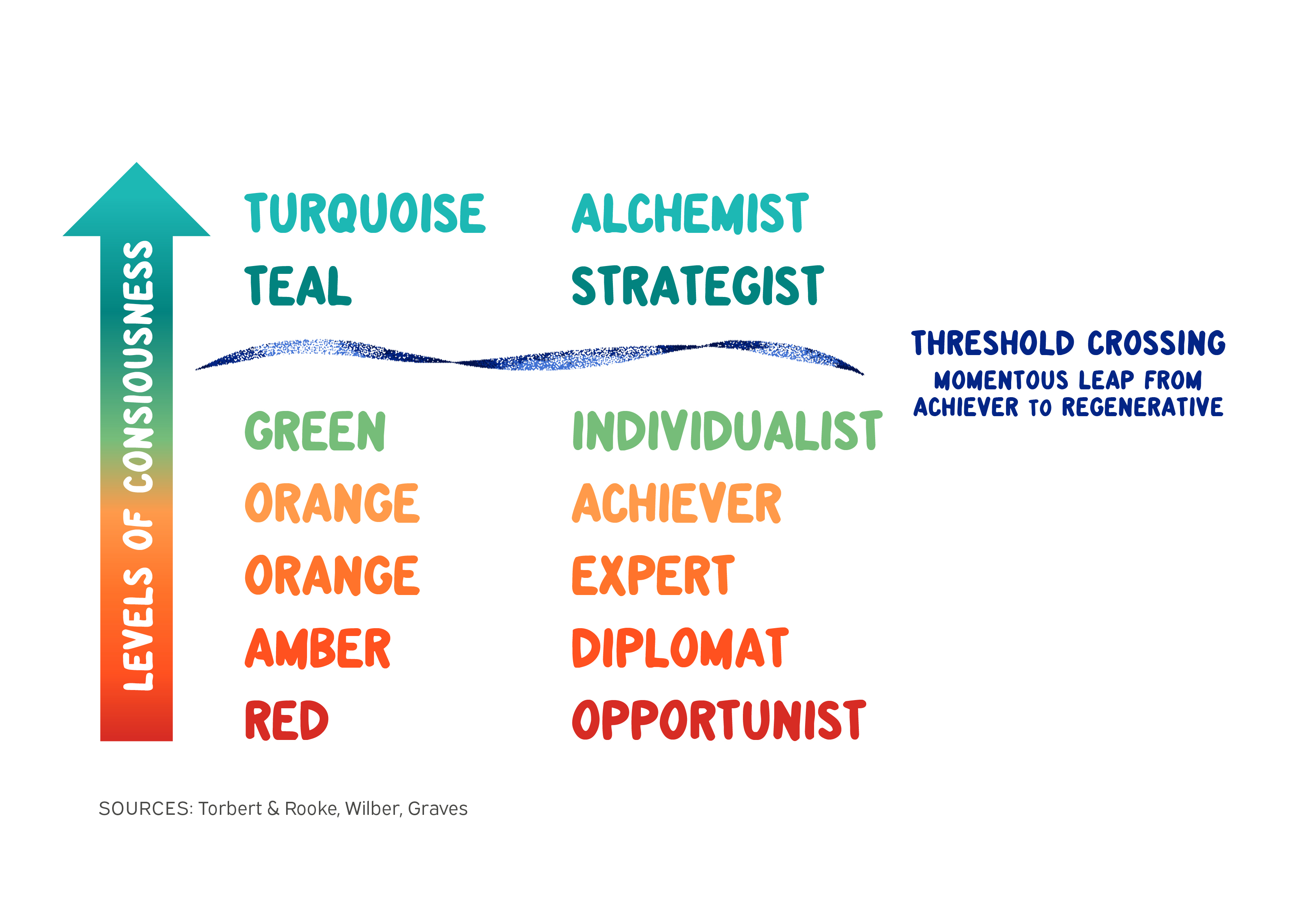
To shift from a worldview of separateness and its mechanistic logic into a worldview of interconnectedness and its Logic of Life, requires a threshold crossing. This allows leaders to sense the organisation as a complex adaptive emergent system rather than seeing it as a top-down hierarchic machine. Our understanding of change, systemic interventions and transformation deepens in recognition of how life works. It also helps us perceive the ecosystemic nature of our own presence as a leader, and the presence of the organisation immersed in a sea of stakeholder relations including the wider social and ecological systems which are all interdependent and interwoven in measurable and immeasurable ways. The other side of all this complexity is a beautiful simplicity, found by crossing the threshold.
In terms of the ‘inner’ dimension, regeneration is a return to our true nature through a journey towards wholeness. This journey is as fresh as it is ancient, and it opens us up to living with more presence and purposefulness; exactly what these times invite of us. Through my coaching working in nature, I blend the shamanic and spiritual with the scientific and sensorial so all of our natural intelligences (rational, emotional, intuitive, and somatic) are enlivened. Then we unlock human potential, touch our true nature, and connect more deeply with the world around us. As Ghandi noted, ‘as one changes their own nature, so does the attitude of the world change towards them.’
- Why Nature Immersions?
There is now a wealth of scientific evidence showing how being in nature significantly improves our empathy, our ability to reason, to deal with change, cope with stress and listen more effectively to others. These are all basic qualities for 21st century leadership. Yet there is much that science is still only scratching the surface of when it comes to the transformative effects of being in nature.
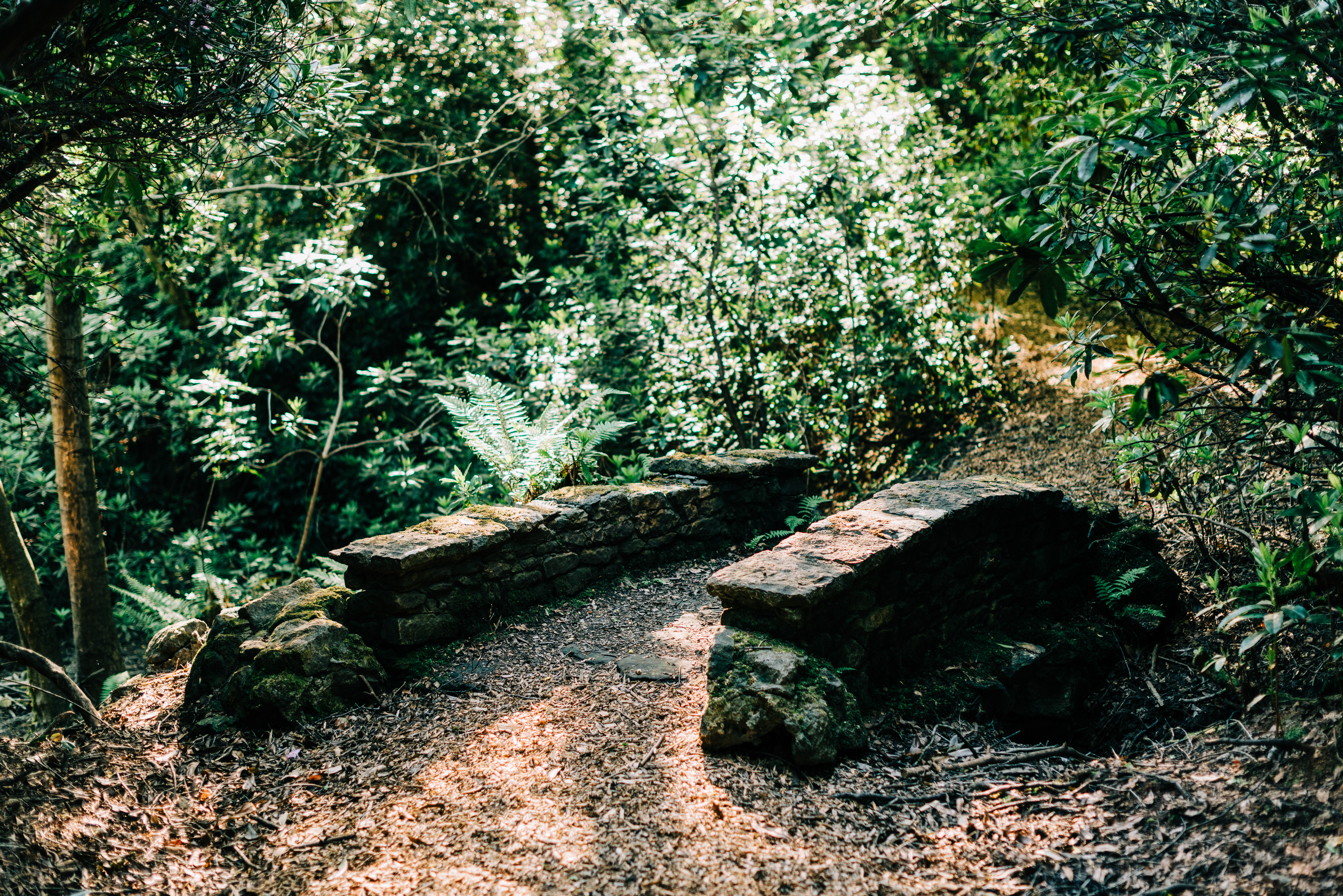
I have taken hundreds of leaders through nature immersions. Immersions can range from half a day in the woods through to multi-day sessions that include overnight solos or even structured vision quests (you can find out more about the practicalities and science of these leadership immersions here).
Many of the senior executives I coach can have strong aversions to anything that might seem hippy-dippy or woo-woo at first glance. Some fear it might involve tree-hugging or Kum Ba Yah moments. Hence, I have learnt to interweave time in nature with science-based insights about how nature works so the intuitive, emotional, somatic and rational aspects of our knowing are engaged adequately, usually starting with the rational as that is the most dominant in many leaders today. For instance, I might explore the interconnected systemic nature of life through microscopes whilst out in the woods, and by describing how trees communicate through the soil and the air, or how bacteria display highly sophisticated communication and adaptation methods. Or I might draw upon how organisational cultures can learn from nature’s 3.8bn years’ worth of tried and tested R&D by explaining about biomimicry, bio-design thinking, chaordic cultures and regenerative leadership. Or I unpack how ecosystems work by visually explain the shift from mechanistic thinking to ecosystemic awareness in a way that satisfies the rational intellect while providing an embodied experience that the coachee can fondly recall many moons after.
Within an hour any hesitation or resistance a client might have to an immersion in nature usually evaporates to reveal receptivity for inner and outer developmental work. Then, around the camp-fire a deep dialogic space for generative listening is held, as ego-masks and psychological armour melt for true nature to be touched. The client does not easily forget these moments of deep presence and purposefulness, and can call upon them when back in the busy work environment. Thus, both horizontal and vertical development takes place in these immersions, as clients gain a wider capacity for everyday resilience (horizontal) and an invitation into up-stretching their inner and outer orientation (vertical).
What happens in just a handful of hours in nature is – in my experience – of an order of magnitude deeper than a coaching session held either in a comfortable armchair or over zoom. And socially distancing in fresh forest-bathing air proven to strengthen the immune system is a COVID-mitigated way to do deep work. Now more than ever people crave time in nature, time that is held in a way that gives them permission to be vulnerable, open-up and let-go of masks, while sensing into blind spots, projections and developmental learnings.
‘Leading by Nature is an essential timely and paradigm-shifting book for 21st Century future-fit business.’
Tomas Bjorkman, Founder of Ekskaret Foundation
Giles Hutchins runs nature-based leadership immersions, facilitates deep-space for coaches and their clients, and provides regenerative leadership training for coaches and advisers both virtually across the globe and in-person amid 60 acres of ancient woodland in an area of outstanding natural beauty with easy connections to London and airports, visit Giles Hutchins. He is also Chair of The Future Fit Leadership Academy. His latest book is Leading by Nature, other books are Regenerative Leadership, Future Fit, The Illusion of Separation and The Nature of Business.
You can find Giles’ latest book Leading by Nature and also the podcast series here
And feel free to join the Leadersip Immersions LinkedIn page here https://www.linkedin.com/groups/13767578/
Living Barefoot – Building a self-managing community at Vivobarefoot (an award-winning B-Corp)
Here at Vivobarefoot we’re evolving into a new way of working. We call it living barefoot.
Living barefoot means more horizontal working, self-management, a focus on listening, inner feelings, openness and embracing tensions. And letting go of hierarchy, parent-child relationships, hyper-masculine stress and competition. As a result, we’ve swapped a vertical hierarchy of rigid teams for a more fluid network of autonomous ‘Circles’ formed around specific business needs.
- Home Circles are where people reside for day-to-day ‘business’ and are looked after in terms of training, development and career progression.
- Project Circles form around cross-functional projects, with a Project Lead (more facilitator than manager) and a small, accountable Active Project Team.
- Yin Circles are where people gather to sense the overall health of the Vivobarefoot ecosystem, and create space for reflection and peer-to-peer coaching.
This approach relies on what we call ‘self-circle-system’ awareness: exploring and communicating how we show up individually, and actively using and respecting these insights in how we self-manage to live Vivobarefoot’s values. We’re swapping ‘control-manage’ for a ‘sense-respond’ ethos prioritising openness, autonomy and authenticity.
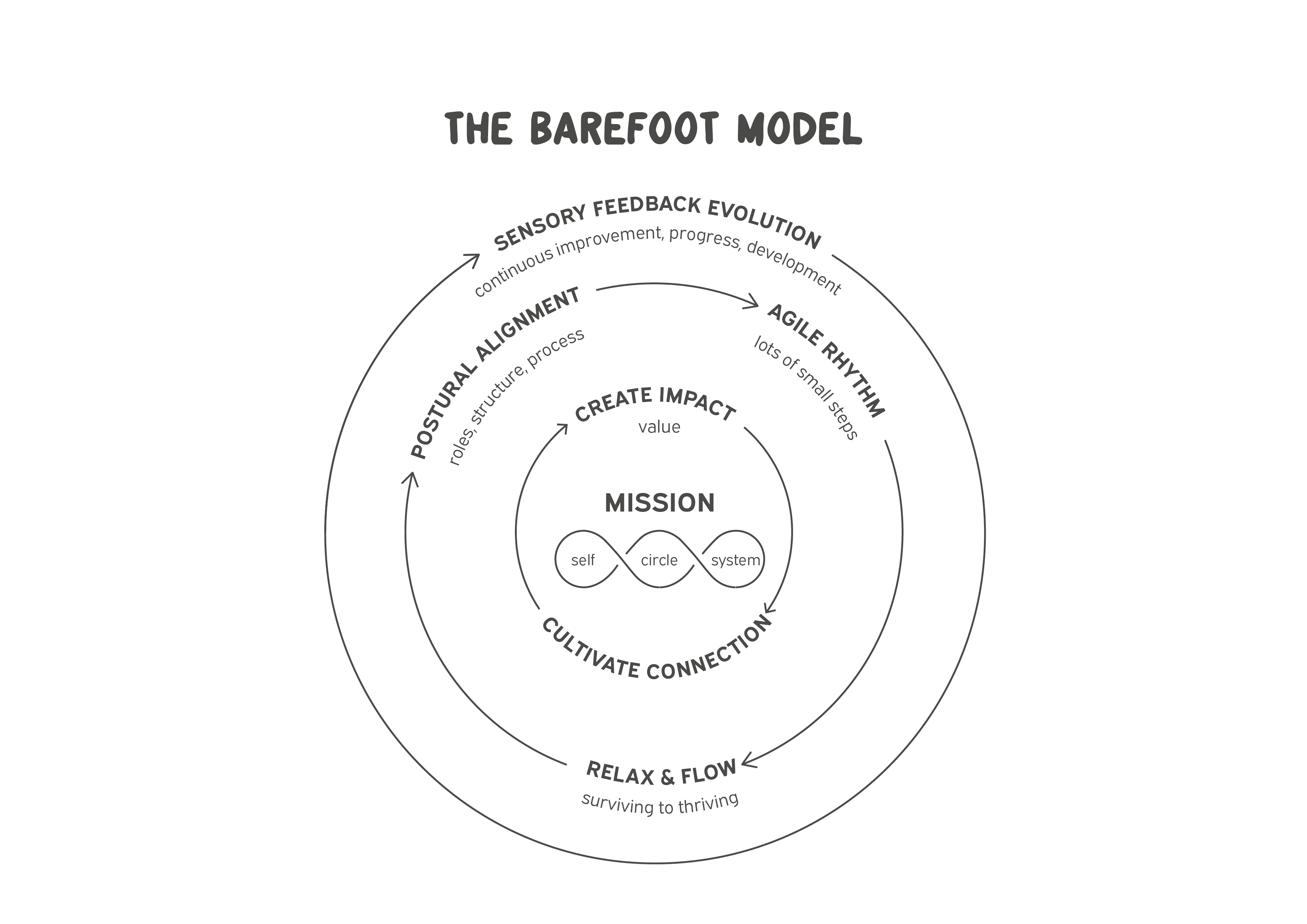
We could yabber about this for hours, but two ingredients have proven especially transformative and challenging: creating the space for teams to self-manage, and learning to communicate openly and authentically to allow self-management to thrive.
This post captures a few of our learnings. Helpful reflection for us, and hopefully useful insight and inspiration for others looking to journey towards becoming a more regenerative culture. For a more comprehensive case study of Vivobarefoot’s journey towards becoming a regenerative business, see Giles Hutchins’ latest book Leading by Nature, which includes a whole chapter dedicated to Vivobarefoot’s business and cultural transformation.
The Power of Autonomy and Honesty
Colleagues of all stripes have found increased autonomy, and the open communication underpinning it, to be really powerful.
More open, adult feedback has been incredibly insightful. For example, one Circle Lead learned that “killing people with kindness” had, in fact, been counterproductive. Most of their team were actually “very grateful for [more open] feedback and have flourished as a result. And then you realise that actually, who were you protecting? Were you protecting them from the difficult feedback, or were you protecting yourself from the difficult conversation?”
Horizontal autonomy also reduces the bureaucratic burden on Circle Leads to make decisions and constantly monitor work (micro manage). For instance, one Lead realised that by taking on extra work to ‘protect’ their team, they had not only been neglecting their personal needs, but also making their team feel guilty and unsure how best to help.
For people used to being ‘managed’, stepping into newfound freedom and trust to take the initiative and make decisions doesn’t necessarily come easy. But when it arrives, it transforms. We’ve heard many stories of people learning loads, growing in confidence and bringing more of themselves to work. Many have even reflected on how the shift from parent-child to adult-adult ways of relating at work is helping them show up more authentically and courageously in their personal lives, too.
Everybody, and Every Circle, is Different
Teething problems and uneven progress are inevitable, of course. Hierarchical management is ingrained into us from early on in life, so reframing it takes work.
The most consistent challenge has been creating appropriate space for people to take responsibility and make decisions in effective ways. Not hand-holding, but also not forgetting to inspire, coach and mentor. And unfortunately there isn’t a ‘how to’ guide for this stuff. At Vivo, we have found creating a ‘coaching culture’ to be helpful – here people listen and explore together by learning to subtly reframe conversations with a more appreciative, constructive and reflective approach. But ultimately everybody is different, so it’s more art than science.
Some of us at Vivobarefoot have sought more reassurance about making decisions and sometimes failing, whereas others have been ducks to water. Generally, we’ve found that pre-existing knowledge and experience helps people adapt more quickly, and have seen many ‘non-managers’ thrive with newfound autonomy.
While exciting for extroverts comfortable speaking up and taking the lead, we’ve also seen that living barefoot can be daunting for introverts, and/or those who do awesome work but are less comfortable leading without hierarchy. Making sure we properly capture and value different ways of contributing is an ongoing challenge.
Likewise, some Circles self-manage more effectively than others. In-person face time, timely feedback and space for reflection all contribute. So does exposure to our Evolution workshops, where we gather around the campfire in the ancient woodlands of Springwood Farm to dive deep into challenges around ways of working and transmuting tensions into learnings. Defined project leadership and responsibility for each member also adds clarity and accountability. And while Covid has made meeting face-to-face challenging, it has accelerated our ability to work independently.
Coaching conversations can help respond to these individual challenges. We have also found that a buddy network, through which people from all areas of Vivobarefoot support each other more freely, offers people more personal support.
Going Beyond the Circle
Living barefoot can be trickier between Circles than within Circles. Uncomfortable conversations are harder with people you don’t know as well or see as often, so reverting to hierarchy becomes more tempting. And because Circles develop at different speeds, expectations can differ across Circle boundaries – a problem we’re trying to address with more cross-functional networks.
There is a similar challenge at the ‘top’ of Vivobarefoot (hierarchical language is hard to eradicate). While Circle Leads (directors) have been really pleased to see senior colleagues relinquishing control, in practice it’s difficult to totally eradicate ‘control-manage’ tendencies, especially when the business experiences shocks like supply-chain ruptures due to conflict, Covid or climate challenges. As one colleague put it, people who “see themselves as bosses” have to work extra hard to “see themselves as servants.”
The reality is, we are likely to experience more and more business volatility on the road ahead, so the sooner we work on transforming ‘control-manage’ tendencies into ‘sense-respond’ across the entire business, the more agile and less bureaucratic we become. And another step towards regenerative business.
Reimagining Leadership
Experiencing these changes and challenges has redefined how we see leadership. Far from requiring less leadership, we now see that living barefoot means more of it, just in different forms.
Although we still have Circle Leads (directors), we’re seeing less ‘leading from the front’ and more leading ‘shoulder to shoulder’ at all levels. As we become better at communicating openly, holding space, embracing discomfort and empowering each other to be autonomous, we’re blossoming into an ecosystem of leaders. It’s been awesome to see. And we are not kidding ourselves, we are still at the early stages of this journey, and we know we have so much more to learn.
Our evolution into living barefoot is still young; many challenges and learnings lie ahead. But our culture is already more entrepreneurial, resilient and engaged. In a word, more ‘barefoot’.
For more on the Vivobarefoot journey towards becoming a regenerative business, see the book Leading by Nature. If you are interested in exploring where your own organisation is on this journey, you can find a Regenerative Organisation Reflective Tool and other useful tools, all free to download, here.
Head of Livebarefoot at Vivobarefoot Ashley Pollock and regenerative leadership coach Giles Hutchins co-authored this article.

You can join the LinkedIn Group Leadership Immersions here
https://www.linkedin.com/groups/13767578/
And find out more about Vivobarefoot’s journey here
The time has come!
We are in the midst of a civilization-wide transformation of the scale never seen before: halving carbon emissions by 2030, reversing natural habitat loss, overhauling social inequality, tackling the mental health and wellbeing pandemic, embracing the digital revolution, and dealing with rising volatility and turbulence across all aspects of society and working-life. No organization is spared.
Now more than ever, organizations need to adapt to disruptive innovations and new ways of working while co-creating life-affirming futures for all. Today’s new-norm of unceasing transformation demands a new-norm in leadership and organizational development. Leading by Nature goes right to the heart of this agile living-systems approach, informed by the regenerative systems in the natural world to inspire practices, tools and techniques that will help us lead organizations capable of transforming and thriving in a fast-emerging future.
“True to form, this latest book of Giles’ is an ambitious, encyclopedic synthesis of many sources of wisdom, all grounded in Giles’ own experience coaching and consulting with executives. Yet just as characteristic, it is a beautifully accessible book, easy to read and hard to put down. It is my fervent hope that many will read it, take its message to heart, and put its guidance into action.”– Michelle Holliday, Principal Consultant of Cambium Consulting & author of The Age of Thriveability
The new-norm in business demands a new-norm in leadership: a leadership consciousness that cultivates organizational cultures able to adapt and evolve during unceasing transformation in ways that create flourishing for all.
This involves a massive call to a life-centric OD and the capacity to model Leading By Nature where we embody, in our being, what OD has historically referred to as ‘the self as instrument of change.’
“Giles has given us yet another timely gift – a detailed and superbly practical guide to the leadership consciousness and practices we so badly need in business, government, education and society at large today. It’s rare to find a ‘teacher of teachers’ that explains and illustrates all aspects of the journey with the clarity and down-to-earth accessibility of this book!” – Dimitar Vlahov, Advisory Board Member of Sustainable Brands & Integrate

You can purchase the book either direct from the publishers Wordzworth or from Amazon and other channels.
You can also listen to the podcast series where Giles Hutchins interviews CEOs of pioneering organizations pushing the envelope toward life-affirming regenerative business, here at Leading by Nature.
Author of four previous books, Giles Hutchins, draws upon over 25 years experience in leadership and organizational development, and over 10 years of executive leadership coaching and regenerative leadership practice to apply an approach to next-stage future-fit business. This is a must-read for leaders interested in leading thriving organizations amid the increasingly volatile times ahead.
“Leading by Nature is a powerful book for people who are serious about regenerative change” – Pamela Mang, co-founder of Regenesis Institute & co-author of Regenerative Development and Design
“Giles’s new book is bang on the money, a really important book.” – Sir Tim Smit, KBE, Founder of The Eden Project
“Giles Hutchins is fast becoming one of the world’s most influential and authentic guides to regenerative leadership.” – Chris Laszlo, author of Quantum Leadership: New Consciousness in Business
join the LinkedIn group if you have not already:

Clearly there is a hell of a lot going on for organisations of any shape and size. Not just volatility across markets, but also immense change within the workplace – hybrid ways of working, the desire for more meaning and purpose through work, the quest for agility, entrepreneurialism and self-management and distributed decision-making.
It’s to this transformative business landscape that The Future Fit Leadership Academy’s founder, Giles Hutchins, and specialist employment law firm Ramsay Paterson’s co-founder, Stephanie Paterson, come together to co-create a practical Reflection Tool aimed at helping leaders engage in reflection, dialogue and exploration for enabling thriving future-fit organizational cultures. The tool is provided as a thought provoker by offering a set of reflective questions that invite contemplation and discussion about where your organisation is on its regenerative journey towards a more agile, developmental and adult-adult culture.
The story of this co-creation between Giles and Stephanie started a few years ago now, when our paths first crossed back in 2016, shortly after Giles published his third book Future Fit, whereupon he was invited to give a keynote about his work on future-fit organizational development at a CIPD conference for about two hundred HR professionals. Stephanie was collaborating with a client to host a workshop on ‘Doing thing differently – can we find another way?’.
We both fondly recall meeting up for coffee in a café in Clifton, Bristol, where we passionately exchanged ideas about the future of business, purposeful and conscious workplaces, developmental cultures and self-managing systems. Back then, there was a real buzz around the ‘new world of work’, what self-management meant for people, teams and organizations, and how digital/hybrid ways of working were challenging the norm.
We shared a flurry of emails after our café meeting, while our respective businesses grew. Then Giles re-located from the south-west to Sussex and set up his international leadership centre at Springwood Farm, to be closer to London and international clients (direct links to Gatwick & Heathrow airport and Kings Cross International station). And COVID hit.
Then a mutual client re-ignited our conversations, and we picked-up our thread earlier this year, and started to spark ideas again, while Giles was finishing off his latest (now fifth) book Leading by Nature. We explored updating the Future-Fit health-check that was in his earlier book Future Fit with a refreshed and reflective style as we felt clients so often need something that helps them pause, reflect and question how their organisations are doing, particularly amid these frantic times. This Reflective Tool we have co-created helps leaders ask the vital question ‘Where are you on your regenerative journey, towards truly thriving as an organisation?’
We envisage this tool being used most usefully in bite-sized chunks, focusing on each section at a time, to enable meaningful and intentional reflection. As a starting point, the tool might be used by the CEO or the Director of HR/People, for individual reflection. We then intend these initial reflections to be further explored through dialogue within one or more small groups, perhaps across the business to get a broader perspective. This in turn will help focus the business on the areas which require attention to ensure vibrancy and future-fitness is embedded into the organization during these ever-changing climes.
The questions provided in the sections below offer a framework for reflection – what we call a ‘Reflection Practice’ that can act as a catalyst for:
1) intentional self-reflection,
2) dialogue with others,
3) planning organisational change.
You might wish to think of this Reflection Practice as a three-step flow: 1st take some time out to pause and reflect on these questions, seeing what comes up for you, 2nd share the Reflection Practice with others and dialogue together, and see what themes emerge, 3rd start to hone-in on areas for potential change that can help your organisation adapt and evolve toward a more regenerative and developmental culture
Section 1 – Organisational Purpose: Often we come to think of profit as a prime-mover, but it’s not. The purpose of the business is its ‘reason for being’. Think of profit as the air we breathe – we need it to exist, yet breathing is not our reason for being. Likewise for the organisation, it has a purpose beyond hitting the numbers, a reason for being that galvanises and coheres the organisation amid volatile fast-moving climates.
Section 2 – Values & Culture: If the purpose is your organisation’s ‘why’, think of its culture & values as the ‘way’ – the way people behave while delivering the purpose. Values and culture guide the organisation and its people as they go about their business day to day.
Section 3 – Decision Making: The day-to-day decision-making processes and protocols greatly influence both the tactical and strategic vitality of the organisation.
Section 4 – Collaboration & Innovation: In this fast-paced ever-changing business environment the ability to innovate and collaborate across teams and also between organisations greatly influences the future-fitness of the organisation.
Section 5 – Interpersonal Relationships & Tension Transformation: The organisation is made up of complex processes of human relating. The capacity to work with tensions and transform mis-understandings or differences into creative potential, helps the organisation continuously learn, adapt and evolve.
Section 6 – Working Environments: Over the last couple of years, hybrid working and the capacity to embrace different working requirements has created a new world of work.
Section 7 – Leadership Mindset: The way we show up as leaders has a great effect on those around us and the overall vitality of the living organisation. Ways of leading that are incongruent with the organisation’s values and ethos can undermine trust and disempower people, greatly affecting organisational future-fitness.
You can download the Reflection Tool here for free – we hope you enjoy using it – and you can find a host of other useful tools and practices related to Giles Hutchins latest book Leading by Nature – The Process of Becoming A Regenerative Leader here: https://gileshutchins.com/content/
Giles Hutchins is a pioneering practitioner, author, speaker and senior adviser at the fore-front of the [r]evolution in organisational and leadership consciousness drawing on regeneration principles.
Stephanie Paterson is an experienced employment lawyer, who takes a human focussed and more holistic approach to employment law advice, working with organisations in a purpose and values driven context.
join the LinkedIn group if you have not already:
Leading by Nature – A radical new handbook for regenerative leadership from business transformation strategist, author, speaker and leadership advisor, Giles Hutchins
“A truly exceptional and timely book that redefines the locus of power in relationship to leadership; leadership that seeks harmony and alignment with nature. Giles reminds us to bring awareness/presence to everything that unfolds. This book is the teacher we all need.” Sue Cheshire, Founder and former CEO of The Global Leaders Academy
Climate change, Covid and conflict have resulted in an increasingly dispersed multi-generational workforce that is crying out for meaning and belonging. The unrelenting pace of these leadership challenges is demanding an evolution in organizational thinking in response.
Giles Hutchins latest book Leading by Nature goes right to the heart of this approach, informed by the regenerative systems in the natural world to inspire practices, tools and techniques that will help us lead organizations capable of transforming and thriving in a fast-emerging future.
“Leading by Nature is THE handbook for regenerative leadership. A must-read for every business leader who genuinely cares about the future of humanity.” Jayn Sterland, CEO of Weleda UK
Rampant inequality, structural racism, the climate emergency, the COVID crisis, and conflicts such as Ukraine, all share an underlying root which, when dealt with, can improve the health of our organisations, society and wider fabric of life on Earth. This underlying common root – the Mother of all our problems – is human consciousness.
The former Prime Minister of the Czech Republic, Vaclav Havel, was spot on when he said in his address to US Congress that, ‘Without a global revolution in the sphere of human consciousness, nothing will change for the better, and the catastrophe towards which this world is headed, whether it be ecological, social or a general breakdown of civilization, will be unavoidable.’
In the same vein, systems scientist Donella Meadows researched system interventions, and observed that the highest leverage point at which to intervene in a system is the mind-set/consciousness/worldview out of which the system arises.
And yet how much of our activities on ESG, circular economics, social inequality, sustainable business, wellbeing at work, and such like actually enable a shift in consciousness?
Unless we address today’s dominant yet out-dated worldview and the leadership logic that flows from it, then all our best endeavours for new ways of working and more sustainable, ethical and inclusive business models will be short-lived.
“Leading by Nature gets to the heart of the shift in leadership that is now required to create a sustainable future for humanity.” – Richard Barrett, Director of the Barrett Academy for the Advancement of Human Values.
Leading by Nature is a fundamental departure from the traditional mechanistic management theory that much of today’s mainstream leadership and organizational development (L&OD) is rooted in. Instead this living-systems approach takes its insight from the way life works, and perceives our organisations as living-systems full of complex processes of human relating. By unlocking self-and-system consciousness within us as leaders, we can better sense and respond to dynamics at play across the organization-as-living-system, enabling future-fitness amid these volatile and metamorphic times.
Machine Worldview Living-Systems Worldview
Dominator culture > Partnership culture
Parent-child > Adult-adult
Control-manage > Sense-respond
Disempowering > Empowering
Unnatural > Natural
Life-denying > Life-affirming
“I love this book and it is one to go back to time and again to full appreciate its inherent wisdom, directing us into Leading By Nature not as a destination but as a path well-travelled. Drawing its insights from many fields, including Appreciative Inquiry, Adult Development, Systemic and cutting-edge Organizational thinking, Jung and his collective unconscious along with Eastern philosophies – it challenges us to move from a constraining, mechanistic approach. How exciting and thank goodness!” – Eve Turner, Chair, APECS, co-founder Climate Coaching Alliance, author Ecological and Climate-Conscious Coaching – A Companion Guide to Evolving Coaching Practice.
“Leading by Nature is a powerful book for people who are serious about regenerative change, people who recognize that outer transformations grow from inner transformations, and understand that adopting techniques without understanding their scientific and philosophical foundations is a trap. Giles lays out a pathway that both guides and educates in what Ursula Le Guinn called the critical work of relearning our being in the world.” – Pamela Mang, co-founder of Regenesis Institute & co-author of Regenerative Development and Design
The time has come to get radical and deal with the root problem, the very way in which we engage with reality.
Author of four previous books, Giles Hutchins, draws upon over 25 years experience in leadership and organizational development, and over 10 years of executive leadership coaching and regenerative leadership practice to apply an approach to next-stage future-fit business. This is a must-read for leaders interested in leading thriving organizations amid the increasingly volatile times ahead.
You can purchase the book either direct from the publishers Wordzworth or from Amazon and other channels.
You can also listen to the podcast series where Giles Hutchins interviews CEOs of pioneering organizations pushing the envelope toward life-affirming regenerative business, here at Leading by Nature.

Giles Hutchins is an author, speaker, business transformation leader and CEO coach. He has written 5 books on regenerative leadership and how organisations can learn from nature to become more resilient and future-fit. He is a senior advisor for a number of leading organisations and business schools on the future of business, and has worked in organisational change for over 25 years. His international practice is anchored at Springwood Farm amid ancient woodland in Sussex, UK. His latest book is Leading by Nature.
Feel free to join the LinkedIn group Leadership Immersions if you have not already:
It’s a fascinating yet challenging time to be a leader. We are in the midst of an old system dying and a new one being born, all amid unceasing transformation – change upon change upon change is the new-norm. Yet as the genius Einstein knew, when we look deep in to nature we understand everything better; we see with new eyes and bring a different quality of consciousness to the solutions than that which created the problems in the first place.
Through over a decade of working on regenerative leadership and nature-based coaching, I have developed a range of practices, coaching-frames and processes that aid the journey of becoming a next-stage future-fit leader.
On 17th June, I will host a special nature-based leadership immersion providing an embodied experience of what it means to become a Regenerative Leader and the magical Springwood Farm, West Sussex, – direct trains from London to Three Bridges station.
The Immersion – Logistics:
9.30am Arrivals – refreshments upon arrival. Workshop commences at 9.45am
4.15pm Departures
By Car – RH17 6HQ .
By Train – Come to Three Bridges station for no later than 9.15am, a cab will meet you there.
Cost: £400 – To confirm your place email giles@ffla.co
Pre-reading or preparation: Once you have paid, you will be sent some preparatory material and guidance. Another email will also be sent near the immersion with further information.
What can you hope to gain from the experience: You will form part of a small group of like-minded yet diverse leaders and practitioners, and will be facilitated by Giles Hutchins for the entire day. Here are some of the things you can hope to experience:
- An embodied experience of regenerative leadership
- Tools, processes and techniques to aid the journey toward regenerative leadership
- Consciousness-raising practices and modalities
- Peer-sharing and facilitated group dialogue sessions
- Pre-reading material and guidance before the workshop
- A signed copy of Giles Hutchins yet-to-be-released Leading by Nature book
- Organic lunch and refreshments throughout the day
Some quotes from previous open-day immersion workshops at Springwood with Giles:
‘The nature immersion workshop with Giles exceeded all expectations. This is real space to develop strategies fit for the 21st century.’ – Stephen Passmore, CEO, Resilience Alliance
‘What an inspiring day in the woods Giles, a great balance of talking, contemplation, meditation, being in nature – Thank you so very much!’ –Participant, CEO of non-profit organization
“In these challenging times, Giles offers those of us in the ‘business as usual’ world both hope and the opportunity for deep connection with nature, spirit and ourselves. I highly recommend joining Giles for one of his immersion journeys of reconnection for a beautiful perspective on how we might do business differently and better.” – Will Adeney, Management Consultant & Nature Connection Mentor
‘Your immersion into nature opened our minds, opened our souls, to deeply connect with our place and purpose in life. With love and deep appreciation for your inspiration.’ – Sue Cheshire, Founder of the Global Leaders Academy
‘Feel I’ve had a day with a real master. What beautiful profound lessons’. – Simon Milton, CEO of Pulse Brands
After 14 months of lockdown, I joined Giles and others on a day-long ‘Leadership Immersion’ at Giles’ magical and awe-inspiring 60 acre ancient woodland in West Sussex. Having read his last book – Regenerative Leadership, I had high expectations. They were surpassed, magnificently.
Giles took us on a journey that saw complete strangers enter into a state of connection, high trust and intimacy – in a matter of hours. We emerged nourished, energised, connected, centred and better equipped to deal with the challenges of life in the early ‘20s. For those seeking answers around their personal and professional development – I can’t recommend Giles and his work highly enough. – Richard Tyre, CEO of Good People
About Springwood Farm: a mix of semi-ancient and ancient woodland with wildflower meadows, 60 acres in total, private and secluded specially designed for advanced leadership coaching work, see some pictures here: https://www.leadershipimmersions.com/gallery

About Giles Hutchins:
Giles Hutchins is a pioneering practitioner and senior adviser at the fore-front of the [r]evolution in organizational and leadership consciousness and developmental approaches that enhance personal, organizational and systemic agility and vitality. He is author and co-author of several leadership and organizational development papers, and the books The Nature of Business (2012), The Illusion of Separation (2014), Future Fit (2016) and Regenerative Leadership (2019). Chair of The Future Fit Leadership Academy and Founder of Leadership Immersions, co-founder of Biomimicry for Creative Innovation and Regenerators, he runs a 60 acre leadership center at Springwood Farm, an area of outstanding natural beauty near London, UK. Previously held corporate roles – Head of Transformation Practice for KPMG, Global Director and Head of Sustainability for Atos (150,000 employees, over 40 countries). He provides coaching at individual and organizational levels for those seeking to transform their personal and/or work lives. He is also a keynote speaker on the future of business and regenerative leadership, and guest lectures at international business schools. He blogs at www.thenatureofbusiness.org
The 17th June is a one-off open programme for 2022, and places are limited. Email giles@ffla.co if you wish to book a place.
In to the Woods
As the Spring Equinox beckons in longer days and winter falls away for another year, I thought I’d share this lovely article written by writer Mark Hooper who came to explore and write about my leadership immersions at Springwood Farm, for Hole & Corner magazine’s 2022 edition, and in partnership with the natural lifestyle and barefoot living brand Vivobarefoot
From his own Sussex wood, Giles Hutchins is using nature to show businesses a more regenerative way to flourish and grow…

Following nature’s lead, suggests Hutchins, allows us to develop more responsive ecosystems within business, and allows companies to evolve, adapt and flourish
Hutchins is respected author, executive coach, keynote speaker, and TED-talker who has developed a consciousness-shifting coaching-based concept of ‘regenerative leadership’. Formerly a Director with KPMG Consulting, as well as Global Head of Sustainability Solutions for the multinational company Atos Origin, he has developed a radical approach to business by offering on-site and virtual leadership coaching experiences that are immersive in the truest sense.
Hole & Corner heard about his work through Galahad Clark, co-founder and CEO of the footwear brand, Vivobarefoot. Clark mentioned that he was working with Hutchins to help grow the roots of his brand and to deepen the connections of his team to nature, and to the wider world. Clark was so impressed by Hutchins’ ideas around transforming business models to make them more in tune with nature and the planet and less motivated simply by profit and growth that they have started working together.
‘The only excuse for creating more stuff in the world is if products help us connect more closely with nature, help us be more healthy and ‘human’ and or help address important ethical or environmental issues,’ said Clark. ‘But by 2019 while we were making great progress in the way we made shoes, something didn’t feel right in the hierarchy of the organisation. So, as we came out of the woods in business terms, we went back into the woods with our people.’ Over 100 members of the Vivo team have spent time in Springwood in the past year. Intrigued, we arranged a walk in the woods with Hutchins to find out more.
Having bought Springwood Farm near Haywards Health, just before the Covid pandemic struck, Hutchins has tapped into something that all of us discovered in some degree during the global lockdown: the restorative power of nature.
Walking through the woods, there is an overwhelming sense of serenity, solitude and calm. At one point, as we step into an atrium like space under the shade of a canopy of trees, the temperature noticeably drops, producing a physical chill that literally sends a shiver down the spine. Hutchins grins as he spots my reaction. It’s a deliberate, dramatic demonstration of the power of nature – and of our connection to it.
Hutchins uses the trees themselves to explain his theories – sometimes through metaphor, but often going deeper than that, showing how we are a part of the nature that surrounds us, bound by the same laws and processes. As companies are beginning to finally understand and fully take on board the need for sustainability, so he is trying to help them to realise that any meaningful change has to be internal as well as outward-facing.
‘To start off, I was quite selective and only wanted to work with companies that I felt were already on this journey,’ he says. ‘But now I realise you have to work with everyone. It’s about changing our mindset by deepening our consciousness.’
Key to Hutchins’ theory is that companies tend to adopt what he describes as a ‘mechanistic’ approach – an unwieldy, top-down structure that compartmentalises individuals and activities in silos. This hierarchical system makes things easier to control, but it comes with a massive downside.
‘It objectifies things and splits us off,’ he explains. ‘Often when companies talk about “purpose”, it’s some brand mission statement.’ It has the effect of de-humanising the people the company relies on – treating them as mere ‘resources’, when in fact they should all be seen as vital – and equally important – parts of a greater ecosystem. ‘It’s quite fragile, it’s not very creative, it’s disempowering, and you can’t adapt. It should be about asking, how are people showing up in the workplace?’
This is where the woodland metaphor takes root. Studies have shown how a complex system of mycelium in the soil helps trees to share resources – a symbiotic relationship that allows different organisms to thrive rather than working in competition. Similarly, Hutchins suggests we need to develop more responsive ecosystems within business organisations, allowing the individuals and the company as a whole to evolve, adapt and ultimately flourish.
All of which is great in terms of theory – but Hutchins’ mission is to demonstrate these ideas by helping us get back to nature in the purest sense. It’s often an emotional experience and one that resonates deeply. He talks of CEOs with tears in their eyes. And in explaining how businesses can be run better, the focus often shifts to how we can become better people.
At another clearing, Hutchins takes me to a length of rope coiled into a simple figure-of-eight shape, and encourages me to walk along it, thinking about anything – work, relationships, life – as he explains how it mirrors the natural cycle of the seasons. As we follow a curve representing spring turning into summer, he suggests that we have become too hung up on thinking that the paths of our lives, as well as business, should always be about following an upward trajectory – chasing a need for everything to constantly improve, always wanting more. But this isn’t how nature works. Instead, the curve leads us back downwards, as nature and then winter take hold. Typically, these are seen as negative stages in business or personal growth: a time shrinking, where we are less productive or efficient; and consequently something to be avoided.

But trees don’t avoid winter. It’s just another stage in the process – where leaves are shed, providing nourishment for the soil, helping new shoots to form during the rebirth of spring. Equally, this can be a daunting time, where we face new challenges in terms of growth.
Hutchins lets me walk the route at my own pace in silence, and it’s a genuinely moving experience – the realisation that the process of letting go (‘letting your leaves fall’) is an important step for all of us.
The setting helps of course. As the pathways and clearings lead us through subtly different environments, we are frequently confronted with deer, stags, muntjacs and other woodland creatures – who stand momentarily startled, before crashing back through the undergrowth. ‘I don’t want to talk too much about the auspiciousness of different species, because it can sound too shamanic,’ says Hutchins, ‘But often interesting things happen while we’re walking. Just this morning, a gentleman was sitting by the lake, sharing something quite insightful that he was just beginning to reveal, when a kingfisher flew straight past. That felt really special.’

I get a sense from Hutchins that the actual process of path making was a restorative one for him – sometimes finding and expanding natural holloways and clearings, other times finding the path of least resistance.
As we walk, Hutchins points out the surface underfoot – a raised, chipped wood carpet (created from the trees cut to create the path), often laid over a base of wooden stakes – and you get a sense of the sheer effort that has been put into Springwood.

He stops and grabs a handful of soil, and says, ‘There are more organisms in that than there are human beings on the entire planet. So it’s about making people aware that they are in life: and that life is continuously interrelated.’
He elucidates this thought by talking about the ‘inner’ and ‘outer’ aspect of our lives. For any organisation, there is an ‘inner’ culture – its way of being and values – a well as an ‘outer’ strategy, which can by anything from the supply-chain to customer and stakeholder relationships. The key, he suggests, is to create a balance or coherence between these two aspects. ‘It’s not just external – the way the company is showing itself to the external world, through its products or its relationships. It’s also internal. We work with a lot of people who have a great sense of purpose, but they need to change the culture.’

This equally applies to the individual, and much of Hutchins’ coaching centres around helping leaders to understand their ‘inner’ nature, giving them greater authenticity and purpose, and their ‘outer’ relationship with the environment, helping their personnel to trust each other and thrive.
‘I take them on a bit of a journey around regenerative leadership,’ he says. ‘Asking them what does wellbeing mean to them, and helping them to move to an adult-adult ecosystem rather than a parent-child one.’
For example, his ongoing work with Vivobarefoot. ‘I’ve worked with Galahad Clark, coaching him one-on-one,’ explains Hutchins. ‘But then we’ve also had the leadership team coming here, having meetings, sleeping overnight, and then we had the whole organisation coming through in these pods, where people from different parts of the organisation come together and have a connection. We’ve also had webinars with them, talking through the book, Regenerative Leadership. It’s all about using that as a text to help them to become a more regenerative culture. So that’s been more inward, but I’ve also touched on how we can help them in terms of educating people, so it’s not just about the product, it’s about creating communities around wellbeing.’
For Clark, the work is only just beginning, but already he has noticed a significant change in the way his business is organised, a shift, he says, ‘to networked communities that collaborate across the system, foster entrepreneurialism and nurture the barefoot/regenerative culture’.
Hutchins is the best advert for all of this: he has an air about him of quiet satisfaction: a man who has found his calling, hewn from these beautiful woods. If you build it, they will come.

Thank you to Galahad Clark, Vivobarefoot, Mark Hooper and Hole & Corner for this lovely article that has managed to capture some of the essence of the nature-inspired regenerative leadership coaching I take leaders on both in-person at Springwood and also on-line through bespoke programs of leadership and organizational transformation.
Hole& Corner magazine is published biannually, dedicated to stories of craft, beauty, passion and skill. It is distributed internationally, with stockists including Do You Read Me ?! in Berlin, Athenaeum Niewscentrum in Amsterdam and 300 Barnes & Noble stores in the US.
I love Hole & Corner – there is a tranquility to all the subjects it specialises in that is very much needed.
– Sir Paul Smith
If interested in attending an immersion, there is a special one-off open programme immersion at Springwood Farm on Friday 17th June this summer. Places are limited – you can email Giles at giles@ffla.co or through the Leadership Immersions website
For more on Giles Hutchins’ work, visit his website here
Leading By Nature
Earlier in October, before we launched our new communications agency Wilful, the leadership team went for a walk in the woods with author and regenerative leadership business coach, Giles Hutchins. Just before the pandemic took hold, Giles moved his family and his practice to Springwood, 60 acres of ancient woodland in Sussex. Despite the challenges of launching a venture in the midst of COVID, hundreds of people have already experienced the inspiring and restorative power of time spent reflecting on leading regeneratively whilst walking in Springwood’s glorious setting.
Giles uses the serenity of the woods, focusing parts of the walk on specific trees to help people let go of their day-to-day work stresses to reflect on the way nature organises and manages things. We talked about how trees can sense when we are there through vibrations in the ground; how they share resources with other species through mycelium in the soil and how nature has evolved symbiotic relationships that create conditions for different organisms to thrive simultaneously by working with, rather than against each other.
Reaching a clearing, and sitting around an open air fire, we were asked to think about how the old mind-set of leadership and organisational development is no longer serving us well. It’s mechanistic, top down, silo’ed approach compartmentalises activities and relationships in an effort to make things easier to control. Organisations are treated like machines, Giles contends, with people classified as ‘human resources’ alongside other inputs like capital and energy.
In this way of thinking, value and success have been measured narrowly on growth and profit which can lead to poor decision making when it comes to externalities like the environment and fairness. This mind-set has contributed to the stress we face today in the workplace where there are still too many inflexible, unsustainable and ultimately fragile organisations.
Giles proposes instead that we adopt the logic of life, a timeless ethos which takes its inspiration from nature. By recognising that our organisations are complex, relational systems (rather than machines) we can start to create conditions for the ecosystem to flourish, adapt and evolve. Organisations need to balance the needs of stakeholders rather than species, but the goal remains resilient, sustainable living systems.
Nature is regenerative, we need our organisations and systems to learn from the natural world because we only have the resources of one planet. What do we mean by ‘regenerative’? To work the way life works, creating conditions that allow life (and all stakeholders) to thrive. Giles has called this approach to regenerative leadership, Leading by Nature and explains that it has two dimensions:
For the leader – the ‘inner’ is connecting to our true nature within; tapping into our essence so we lead with authenticity, coherence and purposefulness. The ‘outer’ is about harmony with nature, creating generative spaces where trust, responsiveness and developmental learning thrive. This inner-outer coherence allows us to create regenerative potential in others.
For the organisation – the ‘inner’ is the culture, values, meeting conventions and decision-making protocols that pervade the organisation’s way of being. Creating a more agile, adult-adult, diverse and inclusive way of working unlocks potential. The ‘outer’ is the strategy, customer value propositions, supply-chain and wider stakeholder relationships that drive how the organisation shows-up in the world. Reaching beyond ‘sustainability’ into ‘regenerative business’ we help stakeholders (including society and the environment) flourish through the products, services, experiences and communities the organisation facilitates.
To summarise: Leading by Nature taps into nature’s wisdom by shifting from a mechanistic mind-set into a regenerative mind-set that enables individuals, teams, organisations and our stakeholders to flow, adapt and evolve in these volatile times. Interested? You can read more about Giles’ thinking Here.
This article was written by Narda Shirley Co-CEO of Wilful.
About Wilful
Wilful is a new kind of communications agency that works at the intersection of innovation and sustainability to amplify the ideas solving the world’s biggest problems. The Wilful team is on a mission to help clients in the transition to a low carbon, regenerative economy.
Wilful’s task force approach blends disciplines to deliver an agile and adaptable client service drawing on the expertise of two well established agencies with a complementary focus: Cherish with its track record of working with mass market digital disruptors and Gong with its focus on corporate and B2B, often in sustainable development.
Headquartered in London, Wilful has a global network of partners: in Africa it is anchored by Gong’s business in Kenya and in Europe and the US it is represented by Over There, the group of independent agencies that Cherish co-founded.
To find out more, visit www.thewilful.com
For more on Giles’s Leadership Immersions in Nature, visit https://www.leadershipimmersions.com/
You can listen to a recent podcast by the World of Wisdom with Giles Hutchins
If you wish, you can also join the LinkedIn Community Leadership Immersions
Why Regenerative Leadership has to be the new norm in business? by Giles Hutchins & Laura Storm
There is no doubt. We are living in a time marked by great upheaval and change, where the breakdown of global systems has become impossible to ignore. Leaders – both political and business – are being forced to cope with rising challenges: pandemics; resource scarcity; high levels of stress in the work place; unpredictable, frequent and disruptive innovations; rampant social inequality; constant competition for top talent; increasing volatility and changing stakeholder expectations; rapid digitization and globalization; mass migrations and refugee populations; fragile supply chains; mounting social tensions; political extremism…The list goes on but you get the picture.
On top of all this, the climate of our planet is changing faster than expected, putting additional critical pressure on all our systems. Our biosphere is collapsing with up to 1000 species going extinct every day.
We have created production systems that are based on a linear, take-make-waste approach focused on immediacy and dehumanization. We have created financial systems based on short-term profit maximization that ignore life and debase human integrity. Our organizational systems are dominated by hyper-competition, power-and-control hierarchies, and rising stress. In our current environment, the few benefit at the expense of the many.
The old systems and structures of a post-industrial hyper-consumerist culture are slowly breaking down. The old ways cannot go on, and through this breakdown, we are witnessing pioneers all over the world birthing the conditions for a new way. These pioneers believe there is a better way – to live and do business. They are rebuilding systems and structures and instilling new business practices that actually contribute to life on Earth rather than destroying it.
For years we have been studying these pioneers, worked with them and witnessed how they impressively through every little action are carving out news ways of doing business, of leading and of living. A new paradigm, not only for business but for life on Earth, is being born these years. What these pioneers have in common is how they focus on ensuring their organisations have both an ‘inner’ and ‘outer’ regenerative approach. The ‘inner’ being culture – everything from meetings, feedback, conversations, decision-making, self-managing approaches, adult-adult relations, diversity and inclusion and wellbeing. The ‘outer’ being value propositions – everything from products, services, stakeholder-relations, product design, supply chain, etc. For a business to be on the regenerative journey it ought be attending to both the ‘inner’ and ‘outer’ dimensions so that all aspects of its business seek life-affirming futures that enable the employees, the stakeholders and wider society and the environment to thrive.
What does regenerative mean? Is it the same as sustainability?
We were running Regenerative Leadership retreats and workshops many years ago when seldom folk had even heard of ‘regenerative business’. Now, a few years on, and there is a rising zeitgeist around ‘regenerative’. The term is getting more and more attention and major corporations such as Walmart, Danone, Unilever, General Mills and PepsiCo have started to use the term to communicate aspects of their strategic vision.
But what does the term ‘regenerative’ actually mean, and what about ‘regenerative business’ and ‘regenerative leadership’? Regenerative means to renew, replenish, heal, revitalize. Which, in practice, means to understand and work with the living-system dynamics of the organization and its wider ecosystem; to work in ways that allow the business to become life-affirming. Essentially, ‘regenerative’ is to attune with the way nature works. And ‘regenerative business’ enriches all stakeholders including wider society and the environment; a business that is committed to becoming life-affirming in all its facets, both inner-and-outer: culture, operations, strategy and ecosystem. ‘Regenerative leadership’ is a way of leading that cultivates life-affirming conditions. It is a shift in consciousness from a reductive/mechanistic way of leading into a systemic/living-systems way of leading. We engage in this shift by working with the Logic of Life (which we shall explore in a moment). This is a fundamentally different mind-set from traditional linear mechanistic management theory that much of today’s mainstream leadership approaches are still rooted in. And this is not the same as sustainability. Sustainability, as stated by the Brundtland commission in 1987 means “meeting our own needs without compromising the ability of future generations to meet their own needs.” While ‘sustainability’ is an important aspiration, with the systemic challenges our organisations now face, we need to go further than ‘sustaining’, into working with life, and creating the conditions for life to flourish and creatively adapt both within the culture of the organization and throughout the organization’s relationships and value propositions with its wider stakeholder ecosystem (which includes wider society and the natural ecosystems upon which life depends).
Hence, a regenerative approach works with a living-systems worldview, a quality of leadership consciousness that understands how life works.

This might sound like fanciful utopia to some. Surely business is about the bottom-line? For sure, regenerative businesses need to survive in today’s world, and there is good evidence that shows clear financial benefits in becoming regenerative (see The Global Lamp Index for instance, showing companies that mimic life consistently outperform their mechanistic counter-parts). We have spent many years coaching leaders on the ‘business case for regenerative’ to help meet the scepticism it invokes in many of us, and in the book Regenerative Leadership we provide tools to help in this regard. This is not just about survival, it’s also about thrival – to attract and retain high-quality talent, to innovation, out-perform, adapt and evolve in increasingly volatile times. This is simply good business sense, especially amid a societal shift that seeks a deeper sense of meaning, purpose, engagement and creativity in the workplace.
It is only natural, that as ‘regenerative’ becomes more popular, there can be some confusion or misunderstanding around what ‘regenerative’ actually means in practice, when applied to leadership and organizational development. Hence the reason for the book Regenerative Leadership which spells out in detail the complete regenerative DNA model required for regenerative leadership and regenerative business. In summary, there are 3 levels of learning from living-systems: 1) Living Systems Design; 2) Living Systems Culture; 3) Living Systems Being
In brief:
Living Systems Design: upon sensing in to how living systems work, we find certain life dynamics, patterns and principles. We can apply these principles and patterns to how we design our products, services, processes, places and economic models. This is the exciting, and revolutionary, space of biomimicry, industrial ecology, circular economics, regenerative design, cradle-to-cradle, biophilic design, bio-innovation, doughnut economics, regenerative economics, and more.
Living Systems Culture: as well as applying living-systems insights and systemic-leadership to the design of our processes, products and places, we can explore a shift in our organizational cultures from organization-as-machine to organization-as-living-system. This is the space of complex adaptive systems applied to organizational development, adult developmental psychology, systemic leadership and systemic coaching, self-managing team dynamics, purpose-driven business, adult-adult coaching culture, shifting power-dynamics, and more.
Living Systems Being: this shift from reductive to systemic ways of leading and operating, involves a shift in our consciousness, a shift in our ‘being’. The very practice of being-in-nature is scientifically proven to help us become more systemic, empathic, integrated and balanced. Through various practices we can learn to more deeply attune with life, by opening up into our deeper truer nature, while opening into more of how life really is. This is a life-long journey towards wholeness, and is the nutritious soil from which regenerative leadership grows.

Apply all three levels of living-systems and you have embarked on the Regenerative Leadership Journey.
Those already on this journey know that this is first-and-foremost about a shift in consciousness, which can be neatly articulated as a shift from separateness to interconnectedness, and yet there is nothing neat-and-tidy about this journey of a lifetime which requires us to open into our deeper truer nature, individually and collectively, while opening into how life works.
The 7 key principles of the logic of life
So let’s explore how we can take learning from living systems to help our organizations become more regenerative, through 7 principles we call the Logic of Life. These 7 principles are informed by science (from a range of scientific disciplines such as biomimicry, facilitation ecology, evolutionary biology, complexity theory, living systems theory, regenerative design, complex adaptive systems thinking, ecological psychology, quantum physics, and more), and are also inspired by indigenous wisdom and other ancient wisdom traditions.
In brief, these 7 principles of the Logic of Life are:
- Life is life-affirming. This is the over-arching principle. Life creates conditions conducive to life. The Regenerative Leader seeks only life-affirming activities and outcomes, being watchful for anything that could be toxic, life-denying, degenerative.
- Life is ever-changing and responsive. Change is an inevitable aspect of life we can embrace for the opportunity and leverage it offers us for learning, adaptation, resilience and evolution. Life learns and adapts through emergent, developmental and evolutionary dynamics. When we tune-in to life we can discern these dynamics and apply them to our living-organizations.
- Life is relational and collaborative. Everything in life consists of inter-relating, interconnected systems nested within each other. Understanding these interconnections frees our perception from seeing and thinking in silos and instead into systems. Life is full of relationships; systems nested within systems. From the cells in our body, to our neighbourhood, organization, society and economy, relationships abound. Sensing the relational nature of our organizations helps us notice stuckness, flow and nodal points for leveraging emergent change.
- Life is synergistic and diverse. Life thrives on diversity – there wouldn’t be life without diversity! Monocultures of sameness or group-think undermine creativity, innovation, adaptability and resilience. Likewise tensions of difference act as crucibles for learning and development.
- Life is cyclic and seasonal. Life unfolds through ebbs and flows of cycles and seasons. We are all cyclical beings in need of the processes that all seasons bring: The emergence of spring, the intensity of summer, the letting go in autumn, and the deep restoration and reflection of winter.
- Life is flows of Energy & Matter. Life depends on innate ecosystem flows and cycles that enable recycling, reuse and renewal. There are innate ecosystem processes that life depends upon, and as such everything flows in a cyclic interconnected way. Designing and operating with this understanding of energy flows enables us to recycle, reuse and renew in ways that do not undermine life’s ecosystems.
- Life is pervaded by a Living Systems Field. Both shamanic and scientific evidence points to an all-pervasive field, a ground-of-all-being that informs all form. We have been brought up in an age where the understanding of this field is largely absent from how we see the world. As we step-change into Regenerative Leadership Consciousness, we sense the interconnectedness of all life and recognize this field of interconnection.
In our workshops and learning journeys with leaders and organizations we apply this living-systems lens to all aspects of the business, from business transformation, strategy development, customer journey design, culture change, branding, team performance, organizational renewal, and agile ways of working, so the organization can become a thriving living-system that works with life, while unlocking the brilliance of its people.
One such business we’ve been working with is Vivobarefoot, which helps people connect with nature through providing high-performance minimalist shoes and nature-connection experiences. Vivobarefoot has been on a regenerative business journey with us for a year now, and its great to see the organization shift from a top-down silo’ed traditionally structured business into a vibrant living-system which embodies ‘regenerative’ both within its culture (by helping people connect more with their own inner-selves and with others through regenerative practices and self-managing methods) and wider throughout its diverse business ecosystem (by helping its stakeholder community engage on this regenerative journey).
Where do I start?
We know it can feel overwhelming to embark on a regenerative journey and therefore we’ve tried to make it easier for you by creating the Regenerative Business DNA framework.
This Regenerative DNA assessment model embraces both the inner and outer technologies, tools, and consciousness that are required for the new regenerative business paradigm to unfold. It’s a unifying framework that integrates vast bodies of research, different domains, and specialist methodologies – connecting the dots instead of creating yet another silo-approach.
We have tested this DNA model of Regenerative Leadership in our coaching and consulting work with leaders from myriad organizations (from small social enterprises through to massive corporations). We have showcased it at international conferences, seminars and workshops. And we have introduced it into our many conversations with practitioners and seasoned specialists working in this emergent field of living-systems applied to leadership. It is clear: There’s a readiness for a holistic model that equally addresses the inner and outer aspects of how to lead and thrive in this next stage of human civilization.
Two questions have guided our work on this framework for next-stage Regenerative Leadership:
How can we be truly life-affirming in our collective way of doing business?
How do we reclaim nature within us and around us in our modern-day urbanized lives?
The DNA framework consists of 3 main elements of learning from living systems we mentioned earlier: 1) Living Systems Design; 2) Living Systems Culture; 3) Living Systems Being – and provides inquiry questions for each section for you to assess where there are areas you ought to start to focus on during your regenerative journey.

Activate your Super-Nature for your continued journey
Those already on this regenerative journey will know that this is first-and-foremost about a shift in consciousness, which can be neatly articulated as a shift from separateness to interconnectedness, and yet there is nothing neat-and-tidy about the journey. It’s an organizational journey as well as a personal journey. On an individual journey you need to activate your Super-Nature to be able to hear, see, feel and analyse everything around you. You need to dare move beyond analysing the progress or health of your organization in excel sheets and instead tap into a greater wisdom.
As a culture, we no longer feel a deep empathic connection with life and the ecological systems that sustains all life on this planet. Instead we primarily focus on outer forms of technological innovation and material progress, while deprioritizing inner wellbeing and consciousness.
The separation of inner (mind) and outer (matter) creates a wounding duality that divorces us from the immense richness of knowledge and wisdom we can only tap into when our inner-outer ways of knowing are integrated and we dare tap into what we call our Super-Nature. Even in this century, many of us don’t know what it means to have a strong inner connection, or how we feel in our own body about certain situations. Do you? Do you know how it feels to be strongly anchored within; at peace and grounded in yourself?
Many leaders today deem bodily reactions and insights as irrational and unreasonable. Our relationship with nature’s innate wisdom may often be seen as hippy-dippy and not to be taken seriously. Intuition is something that is not really understood, and viewed as questionable. Any such irrational thinking we might mock as second-rate or woo-woo. In any given situation, many of us go immediately to our brains, to analyze the situation, while disregarding any intuitive insight or gut-feeling. We react (one might say ‘habitually re-act’) instead of taking a pause, breathing deep, and addressing a challenging situation wisely.
We have unwittingly removed ourselves from ourselves and out of our natural reality! Just look at the way we approach living. Have you ever looked to outside comfort – a new gadget, shopping spree, special food, a weekend getaway, an extreme sport experience, maybe even a date or an affair – when feeling confused or troubled inside? Have you ever put in more hours at work in an attempt to feel (temporarily) good or worthy? While we busy ourselves with outer ‘doing’ we are numbing our inner ‘being’.
Activating our super-nature is about tapping in to our full potential by drawing on our whole-body intelligence, beyond the rational, analytical and mechanistic tendencies we have been trained in. It’s about opening up to a greater wisdom than the rational and analytical left-hemisphere of our brain allows.

The famous psychologist Carl Jung was fascinated by the notion of tapping in to our whole-body intelligence and extensively studied our different ways of knowing: intuitive, rational, emotional, and somatic. Essentially, crossing the threshold from separateness (mechanistic logic) to interconnectedness (living-systems logic), involves an integration of these four natural intelligences to activate our super nature.
When we allow these four ways of knowing (intuitive, emotional, somatic, and rational) to cohere within us, and thereby get access to a deeper kind of wisdom and intelligence. We become wiser humans and wiser leaders.
It may be easier to continue doing what you’ve always done, and it may seem sensible amid all this uncertainty and volatility to stick with what you are comfortable with. But in the long run it eats you up inside, weakens you and undermines your organization’s vitality and its stakeholder ecosystem.
In the book Regenerative Leadership, we explore 4 imbalances within us that we can allow to reconnect and find flow with life, as so become regenerative in ourselves and in our systems. These 4 areas are:
- Inner-outer: these days, due to stress and busyness, we have increasingly focused on the ‘outer’ aspects of life, and impoverished the inner. We have deprioritised the imaginal, intuitive inner-being and prioritised the tangible outer-doing. This creates an imbalance inside ourselves and also in the way we perceive reality. Reality has become a collection of separate objects and subjects, names and categories. The spacious ‘field’ that interconnects all life has been all-but forgotten or ridiculed as a flight-of-fancy. As the great mythologist Joseph Campbell notes, ‘separation of matter and spirit, has really castrated nature. And the Western mind, the Western life, has been, as it were, emasculated by this separation”. The Journey of Regeneration allows us to start to integrate this inner-outer dynamic of life once again.
- Masculine-Feminine: We each have masculine and feminine psychic-energies, characteristics, emotions and behaviours within us. Today’s society favours the masculine, competitive, assertive, controlling, doing aspects of our psyche and impoverishes the feminine, metamorphic, empathic, listening, receptive, intuitive aspects. Learning to integrate these masculine-feminine aspects within our psyche is a vital part of the Journey of Regeneration.
- Left-right brain hemisphere: Neuroscientist Iain McGilchrist has extensively explored left-brain hemisphere dominance in our Western culture. The left-hemisphere of the brain, according to McGilchrist’s and other neuroscientists’ findings, focuses on the parts of the problem by decontextualizing, narrowing down, and abstracting the problem in a closed system. This of course, helps us analyse and find neat solutions and metrics to the problem at hand. However, only a solution in the context of an isolated closed system, not in a living, emergent, complex system – like a business environment with ecosystem challenges. By the same theory, the right-hemisphere of the brain focuses on the whole of the problem by broadening perspective, forming connections, and viewing the problem within an open system; we seek context, think creatively (out of the box) and develop greater understanding. It is both the knowledge of the parts (left-hemisphere) and wisdom of the whole (right-hemisphere) that we need to solve today’s problems. Learning to integrate both left-hemisphere (analysing) and right-hemisphere (expansive) attention and also engage in practices that encourage simultaneous integration of both hemispheres at the same time (like playing a musical instrument, active-seeing, dancing, or being in-flow during a creative yet analytical endeavour) is an important aspect of the Journey of Regeneration.
- Human-nature connection: The mini Ice-Age/Climate Change around the 16th century in Europe witnessed a rising sense of separateness and increasing desire to control nature, hand-in-hand with banishing any sense of the sacredness of nature. This sense of separateness from nature begun much earlier with the advent of civilisation, and yet it was alongside the 16th Century Scientific Revolution, the Witch Hunts and the increasing rationalistic portrayal of nature as a resource to be plundered for human betterment that drove a hard stake of separateness into the Western mind. Over the centuries that followed, the Western mind has become increasingly separate from nature, and with it deep psychic atrophy has set in. As the leading biologist Edward O. Wilson explored, our need to relate to nature is an integral part of human development. He called this ‘biophilia’ (which comes from the Greek bios ‘life’ and philia ‘love’ – ‘the love for life’) which he saw as an innate tendency we have as humans. This ‘love of life’ or nature-connection is foundational to our physiological and psychological wellbeing and development. A sense of separateness from nature creates physiological and psychological problems (increasing fear, competitiveness, anxiety, stress, greed, etc.). These are the very root problems of the systemic challenges ourselves as leaders and our human societies face today.
As we cultivate integration within ourselves across these 4 areas, we Journey towards Wholeness and Reconnection. In-so-doing we open up into our deeper truer nature and open up into a deeper truer reality. We become more human, more conscious, more purposeful, more in harmony with life. This is a process of ‘becoming’, not a one-off hit or neat-and-tidy change-management plan or 10-step process; it’s a messy, full of eddies and undercurrents, trip-wires and shadowy cul-de-sacs. It’s a challenging learning journey which is well-worth enduring. It’s a labyrinth that liberates us into who we truly are.
What we have spent years working on is bringing an approach to business that meets busy executives where they are at and enables themselves, their teams and their organisations and ecosystems to embark on a Journey of Regeneration, which enables them to come alive and their organizations to thrive amid increasingly volatility. This regenerative leadership journey results in more resilient, innovative, purposeful, agile organizations that attract and retain high quality talent and deliver truly meaningful products and services into society. This is the future of business, and it glowing brighter and strong by the day now. Organizations such as Vivobarefoot, Houdini, Patagonia, Pukka Herbs, North Star Housing and many more that we case study in the book are forming part of a new way (see this recent article for more on these cases just mentioned). This new way is a regenerative way that celebrate and works with life. This is the future we all know in our hearts is not only possible, but the only viable pathway ahead if we are to overcome the systemic challenges we have created through working systematically against the rhythm and logic of life.
We hope you will join us among regenerative pioneers sooner rather than later.
Giles Hutchins & Laura Storm are co-authors of Regenerative Leadership
“This is the must read book of the year! I couldn’t put it down. The clarity, inspiration, synergy and wisdom of this book is breath-taking” Dr Lynne Sedgmore CBE, former Chief Executive of 157 Group, Centre for Excellence in Leadership
“The world is changing fast and organizations are not keeping up with the pace of transformation. This book invites leaders to catalyze the necessary regeneration to not just catch up, but to lead the world into the 21st century.” Christiana Figueres, Executive Secretary UNFCCC 2010-2016

“Giles and Laura bring their vast experience and deep wisdom to create an evolutionary blueprint for a sustainable future for business, people and the planet” Richard Barrett, President of the Barrett Academy for the Advancement of Human Values
“This book is full of wisdom and determination! It will inspire leaders to succeed in the 21st Century.” Tim Flannery, award-winning scientist
“Storm and Hutchins confront the challenge of redesigning the world to deliver a sustainable future with vision, energy, and creativity.” Dan Esty, environmental Lawyer & Policymaker, author of best-selling Green to Gold
“Seeking inspiration in the natural world, the principles in Regenerative Leadership provide a framework for a more inspired path forward in business and life.” Ryan Gellert, CEO EMEA Patagonia
“Hutchins’ and Storm’s Regenerative Leadership shines a bright light on one of the most critical, and least understood capacities required of anyone and any institution seeking to work regeneratively – understanding and living into the three-fold dynamics of what the book calls the DNA of regenerative leadership.” Pamela Mang, co-founder of Regenesis and co-author of Regenerative Development and Design.
‘Hutchins and Storm demonstrate that they are clearly at the forefront of a new leadership paradigm that maps an emerging model for sustainable organization in any institution that wishes to thrive. Regenerative Leadership is built upon developing awareness of self and system that embraces the wisdom of Nature alongside creative human consciousness.” Kingsley L. Dennis, The Sacred Revival – Magic, Mind & Meaning in a Technological Age
“This book succinctly brings together the importance business leaders have in redefining and supporting their organisations and communities to do more good.” Nigel Stansfield, President of Interface EAAA
 The Nature of Business