The ability to listen is an essential human quality; it catalyses our ability to be wise, is foundational to the quality of our relationships, and is core to how we manifest our Purpose in the world.
And yet listening is often overlooked in our rush to achieve more purposeful lives or more purposeful organisations.

Let’s explore four levels of listening (encompassing aspects of Scharmer’s Theory U, Deep Listening, Way of Council speaking and listening from the heart, non-violent communication, Bohm’s Dialogue, transformative listening, active & empathic listening, systemic and dialectic listening):
- Downloading (we are listening to information largely to confirm what we already know and in a factual way that is largely devoid of contextual relations e.g. train announcement, or someone speaking to us about day-to-day humdrum while we are half doing something else)
- Factual Listening (we are listening more attentively as there is specific information we sense as relevant to us e.g. train announcement specifically relating to a change to our schedule – our ears prick up and we listen more attentively, or a colleague is speaking to us about day-to-day stuff yet with new insights or updates that catch our attention.)
- Empathic listening (we are sensing into what is being communicated, the person is not speaking ‘to’ us, but ‘with’, as we are sensing how it feels for them as they ‘share’. We shift our perspective – if only momentarily – beyond our own judgements, habituations and framing because of our sensing into how the other person feels. We have opened ourselves up to listening beyond our ‘small self’ and started to relationally connect beyond ourselves. The other person senses this either consciously or unconsciously and the quality of communication is enriched as a result. It may still be about the day-to-day stuff, but we have intentionally chosen to enhance the quality of our listening through the depth of attention we are offering the ‘other’.)
- Generative Listening (we are conscious of our small ‘self’ judgements, personalities, habitual perspectives, emotional baggage, etc. and we allow ourselves to deepen our awareness, our presence, beyond this small ‘self’ as we open up to our deeper Self and the larger relational context or field we are in, by connecting with our hearts, guts, soma and intuition while opening up to the field/source/nature that our self-and-other relationship is immersed in. We sense the wider social, ecological and quantum field between us and beyond us. We give space and time for that which we sense is emerging within the generative field we are co-participating in. As we converse in this way, we open up more deeply to the wider relational context within and all around us – we presence life in an active and alive yet relaxed and patient way.)
‘When you operate from Listening 1 (downloading), the conversation reconfirms what you already knew. You reconfirm your habits of thought: “There he goes again!” When you operate from Listening 2 (factual listening), you disconfirm what you already know and notice what is new out there: “Boy, this looks so different today!” When you operate from Listening 3 (empathic listening), your perspective is redirected to seeing the situation through the eyes of another: “Boy, yes, now I really understand how you feel about it. I can sense it now too.” And finally, when you operate from Listening 4 (generative listening), you have gone through a subtle but profound change that has connected you to a deeper source of knowing, including the knowledge of your best future possibility and self.’ Otto Scharmer, leadership specialist
In learning to become more authentic, purposeful and soulful leaders, we become more self-aware of the different levels of listening we are applying throughout our daily discourse. It feels subtly different when we are engaged in generative listening; a ‘flow’ can be sensed in us and in the other people we relate with. We allow subtle synchronicities to come into our perceptual horizon, making wiser decisions as a result.
‘Attention is a moral act: it creates, brings aspects of things into being, in doing so makes others recede. What a thing is depends on who is attending to it and in what way.’ Iain McGilchrist, neuroscientist
Fundamentally it all boils down to our intention and the quality of our attention we are able to sustain during what can be stressful, fast-moving and distracting day-to-day environments.
Deep listening is a simple yet profound practice that helps us become more self-aware of the quality of our listening and speaking.
‘So when you are listening to somebody, completely, attentively, then you are listening not only to the words, but also to the feeling of what is being conveyed, to the whole of it, not part of it.’ Jiddu Krishnamurti, mystic
Deep Listening happens when we give our full attention to the moment, listening to what is being spoken without thinking what we are going to say in reply, giving our full attention uncluttered by judgement or opinions or distractions – presencing through listening – an attentive state of being that is open, alert, calm, and receptive.

We catch ourselves when we sense we are starting to get caught up in thoughts of past or future, or judgements about what the person is saying, or how it makes me feels. We move beyond empathic listening in that regard, as we go deeper than empathising with what the other is saying, into a deeper awareness of allowing ourselves to be clear, un-entangled by any feelings or thoughts that may spawn within us because of what is being said or the way it is being said, we notice how we feel and what is spawned in us, but then we bring ourselves back to the present moment, back to listening with our full attentiveness – undistracted and resonant within our hearts.
A simple practice of deep listening can be undertaken when one person speaks for 4 minutes and the other person listens generatively/deeply/fully, with no interruptions or verbal or bodily cues from the listener. The listener remains still yet attentive, maintaining warm gentle eye contact throughout. Then after four minutes, we swap and the other person speaks while the first person listens attentively.

Some general guidelines for undertaking this exercise of speaking and listening from the heart:
- Try not to come too much from the head or over-analysing what you are saying, just speak openly and naturally. Let go of rehearsing what you will say. Trust that would arises from within us is what is meant to be said.
- Speak in the first person – only ‘I’ – ‘my’ own experience, what ‘I’ and feeling. Avoid using ‘you’ or ‘they’ or projecting opinions/judgements on others.
- Be self-aware, notice if you are rambling, and notice how coherent you are feeling while speaking and listening – be aware of the sense in your heart and gut.
- Listen without judgement and opinions – be self-aware of when judging or forming opinions and learn to let go, so you can be fully present. If your attention wonders, gently bring it back to focusing on the person you are listening to, while maintaining warm eye contact, without any verbal or non-verbal cues or body gestures. Remain still, relaxed, present and fully attentive. Enjoy.
To explore ‘the new paradigm’ further, join the Face Book community here
To see more about Giles Hutchins’ latest book, Future Fit , see
What is life?? Let’s take a closer look shall we…
Once upon a time, not too long ago, I had the great pleasure of spending time with Dr Alan Rayner, a first rate scientist and former President of the British Mycological Society. Alan kindly contributed many insights to my book The Illusion of Separation, about how nature really works once we see beyond our acculturation.
This blog post is a guest post jointly written by Alan Rayner (author of NaturesScope) and Doug Marman (author of Lenses of Perception)
In March 2016, a group of biologists led by Craig Venter announced the creation of ‘independently’ living cells with the smallest genome. Their announcement was hailed as a milestone. The big lesson learned by the biologists is that no one can explain why almost one-third of the genes are needed for survival. However, hidden in the subtext of this study, we believe, is an even more important lesson: The most essential ingredient of life may not actually be genes or a substance of any kind, but rather a relationship.
In the experiment, the biologists started with bacteria that had the smallest genomes they could find. They then began deactivating genes one at a time, to see which ones were needed for survival. If the bacteria lived and kept reproducing, those genes weren’t necessary and were removed. After years of work, the genome was reduced to half its original size. Every remaining gene has been tested. None can be eliminated. Their goal is now to identify the role of the mystery genes. They hope this will give them a blueprint of what is needed for living cells to survive as independent entities.
But there’s more to the story. It turns out that many of the “unnecessary” genes could only be deleted after supplying the petri dish with key nutrients and eliminating potential dangers. As a result, the new cells can no longer survive in the wild because they’ve lost the ability to hunt for food and avoid threats.

Image by: Tom Deerinck and Mark Ellisman of the National Center for Imaging and Microscopy Research at the University of California at San Diego.
Is it fair to say that these are independently living cells? Don’t they need the biologists to feed them and remove their wastes? This is where the story gets interesting.
You see, the genomes of these cells may be tiny compared to other single-celled organisms, but they are still 200 times larger than the genomes of simple viruses. So they aren’t even close to the littlest genomes.
Viruses, however, are not considered independent life forms because they can’t survive outside a host cell. They need a host in which to live, and they need the genome of the host to reproduce. That’s why the biologists wanted to study organisms that live on their own. But do they? Is true independent living even possible?
All organisms depend on their environment for energy, carbon, and mineral nutrients to grow and reproduce. No plant, animal, or microbe can survive without this supply. Cutting them off leaves them as inactive as a car without fuel. All biologists know this. But if we consider the implications of this deeply, it frames the question of life in a new way and it opens the door to a new explanation for how biological life may have emerged.
For example, it shows that treating organisms as if they are self-contained entities, isolated from their neighborhood, is a profound mistake because life doesn’t belong to individuals alone. Life is a relationship between creatures and their environment.
If this is right, then finding which genes are necessary for survival will not in itself explain how life works, because genes aren’t the cause.
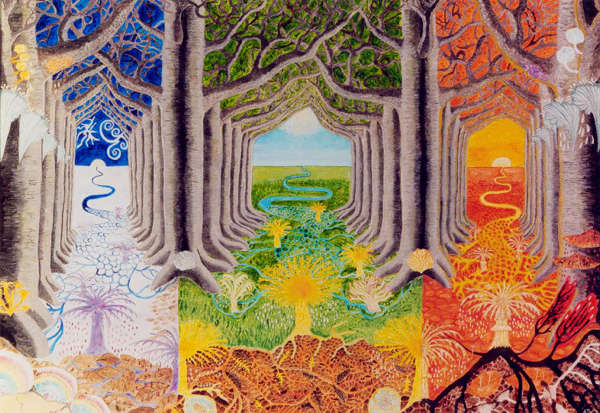
Trees create habitats that team with life. Painting by Alan Rayner, from Mycological Research, 102, 1441-1449.
Meditations on Purpose
‘One must be something, in order to do something.’ – Johann Wolfgang von Goethe
‘Purpose is a function of character, and character is something we mostly notice by its absence. The news these days is filled with stories about the absence of character… the entrepreneur who cuts corners or who is aggressive due to his desire to get the job done…I believe that Purpose – not money, not status – is what people most want from work. Make no mistake. They want compensation; some want an ego-affirming title. Even more, though, they want their lives to mean something beyond the superficial…Not just accomplishing day-to-day results but actually making a better world, by making companies more effective and more fully realized in their Purpose…To make better companies, one must start with developing better leaders that stand for something.’ – Nikos Mourkogiannis, leadership specialist
A sense of Purpose is a deeply felt sense of awareness of our Self, our truest nature, our soul-calling – the Work that the world is calling us to do, that calls upon everything we are, everything we experience, everything we believe in.

This requires us to learn how to listen to the sound of our Soul, which is in-tune with the World Soul (anima mundi) of Nature/Cosmos. It is this ability to truly listen, to tune-in to our Selves, which enables our deeper Purpose to come out of our depths and inform our daily conscious awareness.
This quality of listening into our Selves transforms our ability to listen to others. It enables us to listen with our full attention, while quietening our distractions. And when we listen to others with our full attention, the other person senses this quality of attentiveness and (consciously or unconsciously) begins to open up and share in a more authentic and responsive, less defensive and reactive, way. Our conversing and communing as human beings opens up to a richer ground. It is from this essential quality of listening to our Selves and to others that we fertilise a nutritious ground from which authentic purposeful communication and relationships spawn; this is the essential (yet often over-looked) foundation for purposeful business.
Real leadership galvanises diverse people through a deep sense of Purpose that speaks to their souls. This kind of leadership facilitates the forming of working environments that consciously develop the values that enable the authentic execution of that Purpose in the world. The Purpose provides certainty, confidence, conscious intent and unity-within-diversity. It informs the work-space for adaptive, self-organising, empowered teams of people to bring more of themselves to work, in-so-doing enabling the teams, organisation and business ecosystem of relations to not just survive in volatile challenging times, but to thrive.

Once the Purpose within our leaders is clear, and starting to be embodied by the organisational culture, it also needs to be conveyed authentically in the strategy of the organisation. In practice, this is an on-going process, not a static set of documents, but a continual listening to ourselves, to the field of the community, to the relational intention of others. It requires being sensitive to other’s moral imperative, and also understanding the commercial opportunities/dangers of pursuing certain approaches and relationships with other parties who may not resonate with the same Purpose or ethical intention.
The Purpose is lived day-to-day. It illuminates the ‘way’ we go about things, and acts as a powerful differentiator from our competitors, and can allow for superior profits enduring advantage by reducing risk aversion and fear, while improving creativity, innovation and the formation of synergistic relations.
This Purpose is a conscious intent we daily hold dear. It helps guide us in these volatile times, and helps reduce the temptations and distractions of our ego-machinations – fame, greed, jealousy, and material success for success’s sake. It prevents us from being diverted from our Truth by the allure of other people’s praise/criticism, judgements and differing political, commercial or ethical perspectives. Purpose roots us while allowing us to be open and flexible to the Dance of Life – it provides the convergence within the divergence of vibrant living systems.

Recent findings in quantum physics, sociology, neurobiology and psychology point to our bodies being embedded and embodied in a rich milieu of relationships – physical, chemical, psychological, energetic and quantum relations, with our human and more-than-human world. We now know that our minds do not reside in our brains, but a complex inter-relational gestalt of brain, heart and gut neural networks, our hormonal and lymphatic systems, and our energetic and quantum relations within and beyond our bodies. Candice Pert refers to our mind as the ‘bodymind’, as it is our entire selves immersed within this rich milieu of relations that make up our mind. And there is now scientific evidence that our conscious intention – and the quality of our attention – influences the coherence of our bodymind i.e. our ability to shift from a dis-eased incoherent state to one of purposeful authentic behaviour that improves our wellbeing and the synergy of our relationships.
It seems from scientific research that when we commit to life-affirming compassionate choices with clear purposeful conscious intention, there is a shift in the quality of our attention, notable beneficial changes in the protein behaviour within our cells, the neuroplasticity of our neural networks, and greater overall coherence of our bodymind (for instance, the attunement of our sympathetic and parasympathetic nervous system, and also attunement of our left and right brain hemispheres, as well as entrainment of our brainwaves with the waves of our heart and gut regions). This coherence has a notable beneficial effects on others within our organizational community (both locally and non-locally within our emotional field).
There is also scientific evidence emerging that once a threshold of more than 10% of the people within an organisation or community of people shift their conscious intent, the social field of the whole group shifts making transformation quicker, easier, and longer lasting. In other words, it is cheaper and more effective to transform our social systems through purposeful conscious intent than it is through the traditional carrot-and-stick extrinsic factors of conventional organisational development approaches.
This has profound implications for leaders seeking rapid and lasting transformation amid these fast-moving climes. The ability for our leaders to be coherent, clear and true in their sense of purpose, while framing their interventions with conscious authentic intention, greatly enhances the efficiency and effectiveness of organisational transformation.
‘There is a pressing need for leaders to participate consciously, intentionally, and in harmony with life’s processes, channelling our wilful collective action toward the conditions life needs to thrive… How can I serve this unfolding, either by intervening, by planting a seed, by cultivating a freshly sprouted initiative, or by compassionately hospicing something that needs to die?’ Michelle Holliday, organisational specialist
We are essentially flowing as a process of becoming through our ‘being-in-the-world’, as the philosopher Martin Heidegger would say. Perceiver and perceived are co-participating, with the quality of our intention and attention helping the pulsation of flow in our local (and non-local) neighbourhood within this sentient ocean of interconnected life. How we attend to each moment, the quality of our attention and the purposefulness of our intent, is what governs the quality of our co-participatory relationship with the field within and all around us.
‘The success of the intervention depends upon the state of the intervener.’ Bill O’Brien, former CEO of Hanover Insurance
Bach wrote at the bottom of his compositions, SDG – Soli deo Gloria, ‘to God alone the glory.’ In the composer’s view he was simply being a conduit, a messenger, in service of something flowing through him into his Work. This was his duty, his purpose, to be in service of this Great Work. Yet we don’t have to be religious or believe in God to have this sense of deeper purpose, all we have to do is see beyond the meaninglessness of today’s mindless culture and begin to open ourselves up to a deeper way of being, a more mindful, more present, more authentic state of awareness that informs our being-in-the-world. In-so-doing our world conspires to help us, and we sense subtly lit streams of synchronicity; we flow with our receptivity and responsiveness, rather than fire-fighting with energy-draining reactiveness. Instead of the daily challenges sapping our life-force, our day can nourish and enrich our learning of becoming more of who we were truly born to be. As we open up to our deeper Purpose, we become stewards of Life, in service of this awesome Dance of Life within and all around us.
‘The greatest voyage of our lifetimes, is not in the seeking of new landscapes but in the seeing with new eyes.’ Marcel Proust, philosopher
The medieval word artificer or ‘maker of art’ is where the concept of ‘artisan’ as a creative maker of art comes from. In this artful service of life, the artisan – or craftsman as referred to by social philosopher Richard Sennett, or tradesman as referred to by philosopher and mechanic Matthew Crawford – gains meaningful engagement through the act of creating and delivering something of quality and value to self and society. Sennett views the creative potential for craftsmanship as innate within all of us. The act of doing something well unleashes a deep motivation and sense of wellbeing within the artisan. Through the creative act, the artisan ensures work flows with creative energy and so is a conduit for realising creative potential. Charles Eisenstein in his Sacred Economics talks of ‘the one who bows into service’, recognising the sacred nature of work delivered with loving attention. The work of the artisan is authentic and beautiful, consisting of an intrinsic richness emanating from a co-creative unfolding process of worker and work which necessarily involves an active engagement of heart, mind, body and soul. It is this transforming nature of wholehearted work that brings coherence and fulfilment, birthing a sense of meaning from which happiness and a rightful sense of place and purpose in society derive.
‘The only ones among you who will be really happy are those who have sought and found how to serve’ Albert Schweitzer, Nobel prize winner
The leader enables a diverse group of people to unlock their individual creativity in ways that inform the unifying Purpose of this diverse multiplicity of people. The leader conveys this Purpose, and also embodies this Purpose through conscious intention and quality of attention, enabling a coherent field to evolve in a co-participatory way for individuality to thrive within community.
In this regard, it may be seen that to be a conscious Leader with authentic Purpose in today’s mindless culture cut adrift from soul and meaning, is THE vital Work of our lifetime.
To explore ‘the new paradigm’ further, join the Face Book community here
Natural Business for A World That’s Waking up
Albert Einstein threw down the gauntlet for our human evolution when he said,
“A human being is a part of the whole, called by us ‘universe’, a part limited in time and space. He experiences himself, his thoughts and feelings, as something separated from the rest, a kind of optical delusion of his consciousness. This delusion is a kind of prison for us, restricting us to our personal desires and to affection for a few persons nearest us. Our task must be to free ourselves from this prison by widening our circle of compassion to embrace all living creatures and the whole of nature in its beauty.”
A task not for the faint-hearted, as it requires great courage to widen our circle of compassion amid increasing tension, fear and uncertainty. Not least it requires a fundamental shift in worldview, in how we perceive our sense of self, our relationship with others, and our sense of place and purpose within this world.

Whether it’s the disciplines of quantum physics, psychology, ecology, organisational development or evolutionary theory, it is now dawning on our contemporary consciousness that life is not simply a mechanistic construct of push-pull factors and selfish genes, where separate organisms compete with each other in the struggle for survival. Rather, we are now recognising that life is an inter-relational network of inter-being, where everything is in dynamic relation with its environment, continuously communicating and collaborating within an ocean of being. The ‘self’ is not the ‘separate self’ of individualism but the ‘differentiating self’ immersed within a rich milieu of relations. It is the diversity and reciprocity of these relations which provides for the organism’s resilience and in-turn the resilience of the wider ecosystem. As the world-renowned biologist Lynn Margulis succinctly puts it,
“Life did not take over the globe by combat but by networking.”
This living-systems view of life is beginning to permeate our corridors of power. There is an increasing recognition that business-as-usual thinking is not going to get us very far. To become future-fit we need to embrace a new way of operating and organising. That new way just so happens to be the way life really works – not the control-based dominate-or-be-dominated mechanistic logic of yesterday, but the real logic of life perceived beyond the illusion of separation: emergence, receptivity, reciprocity, local-attunement, power-with, eco-systemic thinking.
In practice, this means emancipating ourselves from many of the structures inhibiting our natural aliveness today by embracing collaborative soulful practices, such as Way of Council, deep listening, mindfulness-in-motion, foresight planning, prototyping, multi-stakeholder dialogue sessions, scenario planning, white space technologies and the art of hosting tools, as well as direct inspiration from living systems such as eco-literacy, biomimicry, industrial ecology, circular economics, regenerative and adaptive cycle approaches.
There are a multitude of simple yet courageous undertakings each of us can take to help nurture a more soulful, living-systems approach to work. For instance, how about starting each and every meeting with a minute’s silence, to help centre ourselves and tune-in to more of our natural ways of knowing (intuitive, somatic, emotional and rational) allowing for more than a glimpse of what lies beyond the busyness of our masturbating monkey-minds. How about checking in with our teams at the end of the day to share in a heartfelt way, where we practice meditation-in-motion by listening and speaking from the heart. How about having a quick round-robin at the beginning of each day for people to share what they feel grateful for at the present time, perhaps sharing who we might like to thank for helping us out in small yet loving ways, and so celebrating the good qualities of ourselves and our community. How about creating a two hour space in our schedules every Friday morning for our team to sit together in a circle, having the permission to explore and envision new ways of operating that embrace and serve life. How about creating space for a half-day workshop every four weeks with other stakeholders – such as pressure groups, think tanks, customers, suppliers, investors – giving permission for us all to explore together and share perspectives of how to do things better. How about creating a ‘children’s fire’ in our boardroom, so that all key strategic and operational decisions consider the potential impact they have on the next generation, our children. All of these are very real business practices being applied by a range of organisations today. This is not some futurist utopian vision, it’s becoming mainstream.

The number one most important thing facing our leaders, managers and change agents today is this shift in logic from an essentially mechanistic, reductive, competitive, control-based, power-over logic rooted in the story-of-separation, towards the logic-of-life, and with it the realisation that our organisations are living systems immersed within the living systems of society which are immersed within the living systems of our more-than-human world. This is why my latest book Future Fit explores – indeed activates – the qualities required for future-fit business by exploring the practical tools and techniques for this necessary shift in logic from machine to living. In this way, we deal not just with downstream effects (climate change, biodiversity degradation, endemic social inequality, racism, and so forth) we also deal with the root cause – our very relationship with life, and our sense of place and purpose as human beings in our more-than-human world.
To explore ‘the new paradigm’ further, join the Face Book community here
Cultivating Our Leadership of the Future
Over the last few weeks I have had the pleasure of engaging with a great variety of senior business leaders from a range of organisations, and I have been struck by the consistency of the challenge facing them regardless of their sector and company size.
Today’s leaders are holding an increasing tension. This tension is, on the one hand, caught in the reality of today, with the pressing need to quickly react to increasing volatility, disruptive innovations, changing expectations, system shocks, and more. It’s a challenge just to keep our heads above water in these business climes, and yet on the other hand, this tension is also about tomorrow’s reality – not some distant future but in 3-5 years from now – with an increasing recognition that the ‘new norm’ of our future is unceasing transformation and increasingly volatility. And so today’s leadership challenge is framed by the inquiry, ‘How do we keep our head above water today while we begin to radically redesigning for resilience, so that we don’t just survive but actually thrive in the times ahead?’

This new set of business challenges requires a new set of leadership skills, as well as an overhaul of our approaches to organisational learning and development. To not just survive but thrive in this new norm of business requires our leaders to deepen their personal and organizational capacity to sense into the emerging field of future possibilities and attune to the synchronicities amid these complexities. Those organizations and leaders that hold-on ever-tighter to out-dated managerial mind-sets rooted in separation, control and power-based hierarchy will be yesterday’s news.
So how do our leaders equip themselves appropriately amid this increasingly challenging landscape?

The good news is, the insights we need for our pressing challenges, lie all around and with us if we so choose to look. In opening up to more of who we naturally are, and also in opening up to how life really is (beyond the habituations, acculturations and control-based frames of yesterday’s logic) we allow a deeper perspective to form within us. We learn how to reframe our meeting conventions, our strategic intent and our day-to-day interactions from a linear, control-based, mechanistic frame to a regenerative living-systems approach that embraces our humanity and our sense of place and purpose within this more-than-human world.
There is more good news: we now have ample scientific evidence-based studies, methods, case studies and approaches to help guide us in this transformation of leadership mind-set. For instance, Joseph Jaworski’s wonderful work around synchronicity and flow in leadership, Otto Scharmer’s Theory U tool-set, Peter Senge’s work at Society for Organizational Learning, Bill Torbert’s work on action inquiry and global leadership frameworks, Frederick Laloux’s work on self-organising Evolutionary/Teal organisations, to name a few.
All of this boils down to our ability to tap into our deeper personal and organizational learning, by reframing our mental models.
In my latest book, Future Fit (2016), I explicitly explore how we enable our leaders, teams, organizations and stakeholder relations to become more regenerative – not just inspired by the logic of living systems, but tending toward harmony with life.
‘The greatest voyage of our lifetimes is not in the seeking of new landscapes but in the seeing with new eyes.’ Marcel Proust
Put simply, our leaders of today and tomorrow need to become more human and in-so-doing, inspiring, facilitating and catalysing our teams to become more human within our firms of the future.
By opening up to more of who we truly are, through cultivating our natural ways of knowing – what Carl Jung referred to as our 4 ways of knowing: our intuitive, rational, emotional and somatic; and what Donah Zohar and others at Oxford University refer to as our IQ/EQ/SQ – we allow our deeper Self to come through us. We fertilize our daily ego-awareness with a more soul-infused awareness, which enriches the quality of our attention and the quality of our inter-relations, i.e. enhancing the ability to really listen, to engage in generative conversations, and to sense the flow of what is emerging rather than attempting to control it or polarize it in to me-versus-you thinking. This is a subtle shift in awareness yet it has profound consequences for how we be-and-do in our organizations. It allows us to bring more of our selves to work, so we can draw on more of our creative potential and innate collaborative intelligence, enabling our organizations to become vibrant and resilient living systems.
Otto Scharmer, and others, have referred to this quality of attention as ‘presencing’, as we are both fully present to what is in the moment now, as well as sensing into what is emerging. It is a spontaneous yet compassionate attention, heightened yet relaxed, receptive yet responsive. This is our opening up to the flow of life and to the intentionality of our deeper Self (our soul promptings). It is a crossing of a threshold from an awareness dominated by the ego-self to an awareness that is infused by our soulful-Self, with the ego as faithful assistant to what arises rather than controller, judger and manipulator of what it wants to arise based on its narrow-minded perspective of self-as-separate-from-and-in-competition-with-the-world. It is what Otto Scharmer refers to as a ‘letting-go to let come’, which is a surrendering process, a self-emptying so that we can be more receptive to what is emerging rather than beholden to our habituated ego-responses.
This subtle yet profound shift in awareness is the root of true leadership and essential for the times we are now in. The origins of the word leadership find their root in the old European word ‘leith’ which means to cross the threshold, to let go of old ways and embrace the new.
Whilst still inured in our hurry-up-and-get-on-with-it managerial mind we may seek cook-book solutions to our pressing challenges, yet unwittingly applying the very logic to our solutions that created the problems in the first place. For instance, I am coming across more and more organizations wishing to move toward self-organizing adaptive approaches of operating, yet by seeking to force-fit a holacratic approach through top-down operating models and processes while overlooking the need for a deeper shift in mind-set in terms of how we show up to work. In other words, we provide another mechanistic approach (albeit more inspired by living systems than conventional power-based structures) in our quest for regenerative outcomes. This is why many organizations are really struggling with top-down approaches to self-organization. We need to turn this logic inside-out; we need to first work with ourselves as leaders, so that we can start to create the conditions conducive for regenerative living systems to flourish within our teams.
To summarise, the fundamental challenge for today’s leaders is to improve the quality of attention amid increasing tension. There are myriad case studies, tools, techniques and liberating structures we can apply to do just this. This is what Future Fit is aimed at dealing directly with, equipping our leaders and our organizations to deeply connect with our humanity in-so-doing enabling us to become fit for our emerging future.
For more on Future Fit visit www.futurefitbook.com .
To explore ‘the new paradigm’ further, join the Face Book community here
Living with Nature
‘Those who take for their standard anyone but nature – the mistress of all masters – weary themselves in vain’ – Leonardo Da Vinci.
The Royal Society of Arts is pleased to have Giles Hutchins & Andres Roberts for the “Living with Nature” session on 14 September at The Rainmaking Loft, St Katherine’s Dock.
The world is getting faster and more complex, and the status quo doesn’t seem fit-for-purpose anymore. While we accelerate in speed and industrial growth, our wellbeing, equality, and social and ecological balance are at ever greater risk.
We seem to be living in a time of unprecedented separation – from ourselves, each other and the wider world we are part of. And yet there are signs of our waking-up to the innate inter-dependence of life.

Scientists and researchers across the disciplines of neurology, ecology, sociology, organisational development and anthropology are now uncovering the vital importance of our relationship with nature (and by nature we do not mean something out there, we mean what is within and all around us, what social ecologist Gregory Bateson referred to as the Mind of Nature).
Ancient wisdom traditions the world over have long known the importance of being rooted within nature. And pioneering contemporary psychologists are increasingly recognising that our sense of separation from nature underpins the profound socio-economic problems we face today, from consumerism to climate change.
Living with Nature goes right to the heart of matter by exploring our sense of place and purpose within our more-than-human world.

Clearly this is an immensely rich and deep topic to attempt to do justice to in a two hour evening session after a long day in the office. What is in store for those who attend is a window of opportunity to embody, reflect and explore our personal and collective relationship with nature.
About the speakers
Giles Hutchins is a speaker, writer and adviser on ways in which our human systems can find harmony with nature. His latest book – Future Fit – explores regenerative business; business that creates the conditions conducive for life to flourish.
Andres Roberts, co-founder of Way of Nature UK, is a guide, facilitator and leadership and change advisor dedicated to wholeness, purpose and balance. He has dedicated much of his life and work to helping positive change happen through art, play and nature.
Places are free of charge but please do book here. We look forward to seeing you there!
Location: Rainmaking Loft, International House, 1 St Katharine’s Way, London, E1W 1UN
Designing Flourishing Future Fit Firms for 2020 & Beyond
We are witnessing a sea-change of epic proportions; an evolution of humanity’s consciousness no less with positive repercussions now evident in business and beyond.
And this is just the beginning. Tectonic shifts in our socio-economic models, strategic and operational management and leadership development are metamorphosing our prevalent paradigm into something as different in look and feel as a butterfly is from a caterpillar.
In the early stages of a pupa’s metamorphosis, cells quite different from the caterpillar organise into groups. These ‘imaginal cells’ run up against the opposition of the old caterpillar’s immune system which perceives them as a threat to the caterpillar’s existence. Over time, as the system of the caterpillar begins to breakdown, these new formations spawn forth the structures, processes and logic of the butterfly; ditto for the metamorphosis in our midst.
‘Proposals for transformational change will be derided and, when they gain traction, resisted at every turn. It is true but too easy to say that the resistance will come from entrenched interests. It will come from ourselves.’ James Gustave Speth, Economist for US Congress
Amid the stresses and strains of the every-day we may not always sense this seismic transformation or be aware of how much is actually shifting within and all around us. And such times of change inevitably invoke fear and denial. Clinging to the tried-and-tested safety of the status quo is a quite natural reaction, yet it only delays the inevitable, in fact it creates greater turbulence ahead as eddies and undercurrents of these transforming seas build up around us as we hold-on rather than learn to sail the stormy seas.
Beneath the surface of this sea change in our ways of doing things is a deeper shift in our worldview – both its mythos (the cultural narrative that shapes how we perceive the world and our relations within it) and logos (the systemic, relational and organisational logic that underpins how we go about things). Deep and complex influences within our own psyche, our collective consciousness and in the structures pervading organisations are transforming.

Our out-dated, soon-to-expire cultural story is based on separation. This story allowed us to define ourselves as independent, autonomous, free-thinking rationalists in moving on from the constraints of the mythic-religious era of medieval times. The Scientific Revolution and its Age of Reason helped clarify aspects of the world around us, yet in-so-doing over-accentuated a left-brained, narrowed-down, reductive, ‘positivist’ perspective. This positivist objectification of the world around us (often referred to as ‘rationalism’) provides a sense of separation, an abstraction of the ‘I’ sense from the deeper inter-relational participatory nature of life: the Cartesian mind-divorced-form-matter materialism of modernity. This perspective – if allowed to crowd out other ways of knowing – ends up reducing the world to little more than a collection of bits and bites, stripping our universe and humanity of meaning and undermining our deeper sense of place and purpose within the world.
‘The dominant epistemology of our times fundamentally reduces learning and knowing to exercises of a disembodied intellect. This way of knowing is at the heart of the huge crises humanity is facing right now. A deep and lasting transformational learning requires in each of us a shift in the dynamic coherence of our linguistic, emotional and somatic being’ Julio Olalla, international coach and consultant
It’s Time to Become Future Fit Today
In times of turmoil, the danger lies not in the turmoil but in facing it with yesterday’s logic
- Increasing volatility, complexity and uncertainty is the new norm, hence our organizations need to be able to not just survive but thrive amidst unceasing transformation.
- Too many of today’s organizations are locked in to hierarchic, KPI-obsessed, siloed, control-based, defensive, reactionary and fire-fighting mind-sets strangling the ability to adapt and evolve amid volatility.
- Isolated initiatives such as wellbeing-at-work, purposeful business, mindfulness, and corporate social responsibility, often leave the underlying logic, culture and ethos of the organization unchecked.
- Only a fundamental overhaul of the underlying logic will enable our firms of the future to flourish amid these transformational times.
As well as all this, there are complex shifts affecting each of us at deep and partly unconscious levels, challenging how we perceive ourselves, each other and the world around us.
At once it is an immensely exciting, liberating, testing and unpredictable time to be involved in the future of business.
The ancient Greeks called such a time Kairos – a supreme moment of indeterminable time which, if not adequately engaged and acted upon, may pass us by.
This crucial time bears witness to a profound window opening between two worldviews, that of the out-dated yet still prevalent logic of yesterday (with its hallmark models, mind-sets and metrics) and the dawn of our emerging future whereupon the perceptions and practices of yesterday melt amid the heat of the moment, alchemically reconfiguring new pathways, perspectives, principles and behaviors.
As Bob Dylan would say, ‘times they are a changing!’
Re-inventing the organisation
This is a story of how the ‘nice to have’ human aspects of the business are really the ‘need to have’. It’s a story of how a company (edge talents aka ‘edge’) was re-invented into a deliberately developmental/evolutionary organisation by applying a blend of art of hosting methods, Holacracy and organisational development methods. This is a guest blog from Graham Boyd of Dojo4Life and Nikyta an employee of edge.
Nikyta: This is also my story. As a recent graduate, about how I went from needing safety and stability in titles, benefits and fixed job descriptions so that I could be productive, to getting all I needed from deeply open communication, participation, and personal growth at the workspace.
Graham: And it is also my story. As a P&G manager I was constantly thinking: “How can one of the oldest and best companies in the world waste so much of their human capital? Why are so many alienated, and at their most productive after hours doing their hobbies? How can we invest more successfully in business growth? There must be better, easier ways. Ways that enable far more output and develop human well-being without compromising either.” Leading the transformation of edge, I put into practice all I have learnt and developed over the past decade about how to re-invent an organisation. Especially what I have learnt about the strengths and shortcomings of different new ways of organising and working.
Nikyta: I joined edge in September 2013 was an international grant receiving foundation that provided talent to Social Businesses. Come December, it was all about to change. There was a need to transform the foundation that I joined, into a for-profit, whose products were capable of tackling all the unaddressed ‘HR’ problems of a start-up ecosystem.
Graham: I had been coaching the leadership for a year by then. Now came a mandate from the investor to transform to for-profit with me as ‘transformation CEO’. So time to dive deeper in as strategy and transformation consultant … The first step was to dive back into our markets, and engage with as many stakeholders as possible. We gathered data from 180 + businesses, investors and start-up talent, across 5 countries
Radical Creativity – The Way Nature Intended
Traditionally, creative thinking has been seen as the province of artists and other ‘creatives’. Yet, we are all born with minds-bodies-souls capable of enormous creativity. As the Sri Lankan art historian Ananda Coomaraswami noted, ‘An artist is not a special kind of person but every person is a special kind of artist.’ Each of us has immense creative potential, though there seems to be little room for creativity within today’s hectic schedule.
John Cleese, the famous ‘creative’, regards creativity as the ability to play, be childlike, explore ideas and be curious. We have two states of mind, he says, one that is ‘open’ and one that is ‘closed’:
Closed State: Active, impatient, pensive, very purposeful, not much humour, can get stressed – not creative but action-orientated.
Open State: Less purposeful, more inclined to humour, more playful, curiosity for its own sake, not under time pressure to get a specific thing done – more creative.
To be effective, we need to switch between a state of mind that is ‘open’ and creative and ‘closed’ and focused. All too often, Cleese finds, in today’s busyness we rush to the closed state of ‘doing’ and so trample over the creativity in our midst, ending up with poorer solutions than if we had stayed in the open state for longer.

Tapping into our creative potential becomes an unveiling process we allow to happen by opening up to all that is within and around us, unfettered by our ‘closed’ state – which the neuroscientist Iain McGilchrist would say is that of our left-brain hemisphere, and anthropologist Steve Taylor would say is that of the ego-self. The narrow-mindedness of this ‘closed’, ‘left-brained’ or ‘egoic’ state is an important aspect of how we humans attend to life; it enables us to categorise and package up aspects of reality while defining our sense of ‘self’ from ‘other’. Yet, when this way of attending dominates, we overly extract our conscious awareness from the innate and primal creativity of life; a vicious cycle of anxiety, defensiveness, competition and alienation ensues. It leads to what Albert Einstein referred to as an optical illusion of consciousness, where we get caught up in our own abstraction, like a hall of mirrors, entrapped and deluded by our own illusion of separation. Enter the contagion of consumerism in our midst.
 The Nature of Business