Business Inspired By And In Harmony With Nature
“Look deep into nature and you shall find the answers.” (Albert Einstein)
It has become patently clear to many that business is undergoing a metamorphosis. Due to a perfect storm of social, economic and environmental factors, organisations have little option other than to seek out opportunities in these volatile times, adapt and evolve to what the book The Nature of Business refers to as ‘firms of the future’ – businesses more akin to living organisms than mechanistic monoliths designed for the Industrial Era. Nature offers helpful lessons to support the firms of the future in multiple ways.
- People: Nature influences positively how we engage, empower and encourage our people to build resilience within their diverse stakeholder group. Eco-psychology and natural leadership are emergent approaches to help people deal with complexity and unpredictability.
- Places: Nature inspires intelligent buildings that sense and respond to their internal and external environments, making them effective, vibrant and healthy places to work.
- Processes: Nature shapes business processes such as industrial ecology and symbiosis, business ecosystem mapping, systems thinking, eco-literacy, circular processes, closed-loop economics and cradle-to-cradle.
- Products: The imitation of nature – biomimicry – is a well-established practice in assisting the designing of sustainable products.
- Purpose: Nature teaches businesses that being sustainable means creating the conditions conducive for life, rather than merely reducing the harm inflicted. Therefore, instead of focusing on the reduction of negative social and environmental impact, forward-thinking businesses move toward ‘reaching beyond-zero impact’ and strive to become restorative and net-positive.
 As Professor Michael Porter stated when addressing business leaders in New York in 2012, “we are witnessing a paradigm shift in business from hurting to helping”. Forward-thinking businesses look to nature for inspiration. Collaborative, innovative, networking, emergent, dynamic firms of the future are more akin to living organisms, hence gain great inspiration from how nature has been dealing with dynamic change for over 3.8bn years. Take a few points by way of illustration of what business can possibly learn from nature:
- Successful species and ecosystems in nature are resilient, whereby living beings collaborate, forming niches within diversity.
- Whilst the strongest man-made material is Kevlar – made at around 1000C in a complex chemical and energy intensive process – spiders make webs stronger than Kevlar at room temperature with no pollution.
- Nature does not have waste and pollution: what is waste for one part of the ecosystem becomes food for another.
 How do we shift the prevalent understanding of business – and of human society too – from the illusion of being apart from nature to the realisation that we are a part of nature? The answer comes from the three R’s: re-design, re-connect, and re-kindle.
- Re-design: Developing new ways of operating and innovating that ‘do good’, i.e. shifting from the ‘take-make-waste’ economic paradigm to a regenerative approach that heals society and creates life, rather than destroying both in the name of short-term gains. A good example is the Kingfisher Group aiming to be a ‘net positive’ force for good in the world.
- Re-connect: Reconciling our relationships with ourselves, with others and with nature through education, authentic leadership and eco-psychology. A great example is the Co-Founder of Natura, Pedro Passos, who encourages a business culture that understands our interrelatedness with our community and nature.
- Re-kindle: Working with the grain of nature and operating following the rules of life on Earth, i.e. enabling businesses and societies to thrive in the future by practicing the wisdom offered by life, such as symbiosis, ecological thinking, permaculture, business inspired by nature, indigenous knowledge, etc. An inspiring example is Weleda, which applies bio-dynamic and holistic approaches to all aspects of its business.
 In these challenging – yet pivotal – times for business and humanity, we must realise that to become truly sustainable, human and business life has to become scientifically inspired, emotionally connected and spiritually entwined with nature and Gaia. Nature and business (as with nature and humanity) must be symbiotic and operate in mutualism to achieve successful outcomes. The sooner business realises the opportunities that come with being connected to and inspired by nature, the better for humanity and the interconnected fabric of life.
For more on this see kindle or the book ‘The Nature of Business’. This was a guest blog written by Giles Hutchins for Akasha Innovation
No answer required….
‘When light falls upon the leaves, it falls in many ways. It dapples, streaks, shimmers, blotches, discovers, reveals what lies beneath. In just this way in the heart of the forest the light fell upon the leaves and upon what lay beneath them. It fell upon the speckled bird elucidating his mysterious presence. And it fell upon the ground beneath the tree wherein the bird was perching. There on the ground, on the carpet of forest plants that the light dappled and shimmered. And thus the toad was revealed. There he sat, blinking his prehistoric eyelids, wrinkled and warted, and looked at the speckling bird in the branches above his head. And he too was speckled. He blinked again and the light was speckled.
‘In this place,’ he considered, ‘the admixture of darkness with light is particularly pleasing. Here everything is wonderfully warted, wonderfully variegated.’
He gazed up towards the branch where sat the bird. He gulped, and stretched out his three-toed hand in salutation.
‘Greetings, O bird.’
‘Greetings, O toad,’ the bird replied.
There was silence. No more was said. The toad had come there with a purpose. He had come there with a question. ‘What’ he thought ‘is my purpose? What is my question?’
As he sat there blinking it was as if he could not remember. Perhaps his question and his purpose had been left behind in those other places on the way. Or had they melted away into the dappled shadow and light of the place? The toad had come thinking that he wanted an answer to something or other, but in the place where he now was no answer seemed to be needed. His protuberant eyes mirrored the eyes of the bird.
‘This is unquestionable‘, he nodded to himself.
‘Greetings, O bird,’ he said again.
‘Greetings, O toad, ‘ the bird replied.
Again the eyes of each mirrored the eyes of the other.
(ref: Thetis Blacker, the Place, extract. Cited p67-8 Temenos vol 13 )
The New Paradigm is Inspired by Nature
The economic, social and environmental volatility in our midst means organisations have to operate in a dynamically transforming landscape. Here is a repost of a guest blog I wrote for Akasha Innovation that can be found here

The nature of change itself is transforming. Organisations are now increasingly exposed to dynamic change: change upon change upon change – while dealing with one change, another affects us, then another, and so on. This dynamic change upsets the traditional mechanistic business paradigm we have been working to over the last few decades.
Paradoxically, inspiration for the current pressing challenges is all around us in nature. Nature has been dealing with dynamic change for over 3.8bn years, and the more we explore nature’s ways the more we find inspiration for operating in a dynamically changing business environment.
Our understanding of nature has evolved over the last few decades, from viewing it as a battleground of competition to one of dynamic non-equilibrium, where an order within chaos prevails due to unwritten natural patterns, feedback loops, behavioural qualities, interdependencies and collaboration within and throughout ecosystems. The more we grapple with the challenges our businesses now face, the more we realize that nature’s patterns and qualities inspire approaches and qualities for our own evolutionary success in business and beyond.

Organisations inspired by nature are resilient, optimising, adaptive, systems-based, values-based, and life-supporting.
The ‘New Paradigm’ is actually ancient, yet flowing with fresh spontaneity; whether it be sustainable business inspired by nature, organisational transformation inspired by nature, societal evolution inspired by nature or ‘human nature’ inspired by and in harmony with nature through an awakened heart-felt empathetic relation with life.
While there are many noble endeavours to transform within as well as revolutionise beyond our collective paradigm, many of today’s ‘solutions’ largely overlook the root cause: our human-nature relation. Any vision that overlooks the root cause of our multiple crises will be doomed from the get-go.
It is time to transform, and that transformation is within, through and all around us: to see more clearly the way of nature, remembering our destiny as conscious co-creating participants – a community of subjects. As Hunter Lovins says, look to nature, and the deeper we look the more we realise far from nature being about dog-eat-dog competition or individualistic selfish genes, it is much richer, more relational and diverse, it is transformation itself. We are beginning to realise the wave is very much part of the ocean, and the ocean is Nature.
For more on this visit the Facebook page of ‘The Nature of Business’.
The space between and through the notes allows them to dance – the co-creative unfolding
The quietness between soundings; the preparation for what is to come from what has already been; the out-breath dies into still, receptive presence before the energetic in-breath impregnates.

The word poetry derives from the ancient Greek word ‘poiesis’ which means an unfurling, creative revealing, bringing forth or presencing of reality.
‘All poetry is a matter of giving sensory form to ideas and finding the images that take us unhindered into the heart of things.’ Roger Scruton
‘The great works of art have about them the quality of a reminder. They fix that which is fugitive: the cooling shadow of an oak on a windless, hot summer afternoon; the golden-brown tint of leaves in the early days of autumn; the stoical sadness of a bare tree glimpsed from a train, outlined against a heavy grey sky. At the same time, it is forgotten aspects of our own psyches to which paintings can seem mysteriously conjoined. It can be our unspoken longings that surprise us in the trees, and our adolescent selves that we recognise in the hazy tint of a summer day.’ Alain De Botton

‘There are two aspects of things – the outward and the inward…. The outward has no meaning except in so far as it helps the inward. All true Art is thus an expression of the soul. The outward forms have value only in so far as they are the expression of the inner spirit of man…To a true artist only that face is beautiful which, quite apart from its exterior, shines with the truth within the soul. There is no beauty apart from Truth… Truly beautiful creations come when right perception is at work.’ Ghandi

True poems I call fingerprints
That show upon their grain of skin
Those delicate labyrinths within
Which are the essential her or him.
Yet poems are like footprints too,
Precise across a field of dew
To lead us on some echoing trail
To where that hidden trove, the secret source
Of resonance, can be hailed:
A frozen gleam, a buried seal of gold,
This unseen watermark upon the page.
(ref: Jack Herbert, extract from ‘A Scroll of Fern’)

To see a world in a grain of sand,
And a heaven in a wild flower,
Hold infinity in the palm of your hand,
And eternity in an hour.
William Blake – Auguries of Innocence
‘Silence is an ocean. Speech is a river.’ Rumi
‘The river is within us; the sea is all about us’ TS Eliot
“The minute I heard my first love story
I started looking for you, not knowing how blind that was
Lovers don’t finally meet somewhere
They are in each other all along” Jalal ad-Din Rumi
Wishing you a very merry festive celebrations and happy new year 2014.
With love, Giles.
Where’s the vision for the future…what’s the new paradigm?
There is a lively discussion here on GSB about how the sustainability movement will fail without a compelling vision of the future. I have been prompted by Anna Pollock on the Facebook page of ‘The Nature of Business’ to write a comment, for which I am thankful. Here is my comment below, I welcome your views:
The ‘New Paradigm’ is actually ancient, yet flowing with fresh spontaneity; whether it be sustainable business inspired by nature, organisational transformation inspired by nature, societal evolution inspired by nature or ‘human nature’ inspired by and in harmony with nature through an awakened heart-felt empathetic relation with life.

The answers to our pressing challenges are all around and within us, what is lacking is the will to go deep. Essentially we are struggling to over-come the shallowness of our dominant ego-consciousness (techno-fixes for symptoms, short-term profiteering through private ownership of ideas, tentative policies that tweak rather than transform, etc.). Our collective paradigm is dominated by our ego-consciousness – capitalism, materialism, rationalism, individualism, patriarchy, and so on.
While there are many noble endeavours to transform within as well as revolutionise beyond our collective paradigm, many of today’s ‘solutions’ largely overlook the root cause: our own heart-felt empathetic relation with life: ourselves, each other and Nature. The reality is that life is so much greater, deeper and more profound than anything our rational ego-minds can fathom, yet we continue to attempt to solve problems with the same mind-set that created them – unwise.
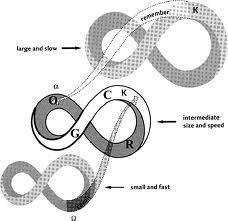 By example, the discussion of growth and its polarised opposite ‘no growth’ can over-look the deeper insight we find in nature. Growth is part and parcel of life: innovation, growth, conservation, re-configuration, rebirth, innovation, growth and so on through spirals of nested ‘panarchies’. Growth is an important attribute of what makes us who we are, yet to focus on one part of life (whether it be ‘growth’ or ‘conservation’ for instance) while blinkering ourselves to the deeper spiralling vortexes of life is akin to a childish teenager not yet able to see beyond its own ego ‘I’ reflection. Nature beyond the tidy yet artificial confines of our rationalistic ego-consciousness embraces death and rebirth, embraces change and transformation and embraces the co-creative wildness within, through and all around us.
Any vision that overlooks the root cause of our multiple crises will be doomed from the get-go. So let us get back to basics, back to nature, back to our oceanic presence flowing through every moment beyond the narrow blinkers of our rationalistic ego-mind. This is something all wise people throughout the ages agree on and it is more relevant now than ever. Then we can begin: masculine and feminine, yin and yang, rational and intuitive, science and sacred, human nature and more-than-human nature. Yes this requires courage (from the root word ‘coeur’ meaning heart) as the solution is deeply within and through our relations with each other and all of life. We can all en-courage ourselves and each other through our ways of being and doing.
Biomimicry, ecopsychology, indigenous wisdom, regenerative and circular economics, and so forth all take inspiration from nature, yet to envision without this deeper presence is to miss the mark. It is time to transform, and that transformation is within, through and all around us: to see more clearly the way of Nature, re-membering our destiny as conscious co-creating participants – a community of subjects. As Hunter Lovins says in her comment above, look to nature, and the deeper we look the more we realise far from nature being about dog-eat-dog competition or individualistic selfish genes, it is much richer, more relational and diverse, it is transformation itself. We are beginning to realise the wave is very much part of the ocean, and the ocean is Nature.
The Guardian and GSB provide a great space for such to be discussed and shared – this is so very important. A big thank you to Jo and the team, with love, Giles
To explore ‘the new paradigm’ further, join the Face Book community here
View a short video clip on business inspired by nature here
View a presentation on ‘A Radical Review of Reality’ here
Authentic Leadership for Radical Transformation
Radical transformation is heart work; transforming how we perceive, attend to and engage with our inner and outer worlds – the ever-changing context we find ourselves in whether it be personal, family, organisational, community, societal.
‘The salvation of this human world lies nowhere else than in the human heart’ Vaclav Havel

To breathe life through the eye of the heart is to transform through our own becoming. Being authentic within the moment is being and becoming through our hearts. It is where our soul attunes through its participatory relationship with life. Here is where our authentic Self (our true Self beyond the ego) opens up and co-creates with the world around us. This is the sea of synchronicity full of eddies, under-currents, storms and summer breezes. Accepting the present moment with our full presence – this is leading with heart, with courage (its root ‘coeur’ meaning heart), beyond fear, beyond control. It’s not for the faint-hearted, nor the ones desiring an easy path through life.
It is worth noting that the root word of ‘leadership’ is ‘leith’ which means to cross the threshold, to let go of the old in order to embrace the new – so fundamental to any transformation. Deeply ingrained within our current paradigm is a ‘rationalistic abstraction’ which seeks to polarise the creative tensions inherent within life. Rather than seeing continua to dance through, our rational mind accentuates and then polarises life into binary dualities: good-evil; black-white; rich-poor; human-nature; subject-object; self-other, conscious-unconscious, space-matter, and so on. The boundless and spontaneous wildness of reality is dissected, atomised and fenced-off; resulting in the fragmenting of our self-other-Nature reality in turn fracturing our inner self from our outer self, our conscious mind from our unconscious mind, ourselves from each other and from our other-than-human kinship; hence the separation, scarcity and status anxiety rife in our Western culture. This abstract polarisation may help us define things and box them up into neat and tidy arrangements of control, yet it ends up extracting us from the lived-in flow of reality. It is the root source of our collective inauthenticity; a fearful way of attending to life that is inherently unsustainable.
‘Fearing weakness I strive to control…If there is present awareness, fear is seen clearly as an abstraction…a future anxiety born from memory’s blueprint…investing in an illusory concept about right or wrong in order to avoid that which is absolutely beyond both…In separation, no matter what happens I feel separate. In presence, the self is no more and there is simply that which is.’ Tony Parsons
 As leaders, we not only open ourselves up to our full becoming through ‘presencing’, but we also help others open up to too. Authentic leadership is giving others the space, time and courage, through en-couragement, to find their inner Self, their true voice and resonance (or tune). In this way, leading can be seen not as orchestrating or conducting but rather as facilitating the ability of others to tune themselves. Leading helps facilitate the co-creative journey of becoming our true selves while honouring the mystery beyond pre-defined outcomes. As Parker J Palmer insightfully points out through his important work, leaders serve as midwives to a birth of consciousness that can only come from within. Hence, the emergence of the new paradigm in our midst requires authentic leadership. Our collective and individual shift in consciousness requires space, time and courage, through en-couragement, to take root and grow, ever-transforming, ceaseless unfolding.
The art of presencing has been applied to organisational transformation and business leadership through the great work of Peter Senge and Otto Scharmer. Their work at MIT and SoL in partnership with businesses around the globe, highlights the need for leaders in organisations of all shapes and sizes to intimately connect with their evolving authentic Self. Presencing is relevant for all transformative situations we find ourselves in.

Authentic leadership, therefore, is courageous leadership rooted in the heart. It is less about the theory of an idealised leadership model and more about the practical ability to navigate a journey of authenticity, inspiration and love; energising and equipping oneself and others to make the right choices for the situation at hand. Each and every one of us plays our part by helping others to co-create through love.
Love is…
‘Love is the only emotion that expands intelligence.’ Humberto
Love is what enables us to give to ourselves and others. Love is mutually beneficial and always creates conditions conducive for life – love feeds on and grows from love. It breeds positive virtuous cycles. Leadership and organisations of the future are more about love than profit – now here is a new business paradigm in the making, and one that does not need an ‘ism’.
Much has been written about the importance of love in leadership. Sadly, love is not a word we hear much of in business circles these days. It has become a much misunderstood and misappropriated word in our Western consumerist culture of fast paced pleasure.
As Tim ‘Mac’ Macartney, Founder of Embercombe in his beautiful book ‘Finding Earth Finding Soul’ notes:
‘Love inspires leadership…It is the finding of love that will bring forth the leaders we need. It is with each one of us and we only need to let go of our fear and she will be known to us.’
In the words of Gerald May:
‘Love cannot be a means to any end…Love is an end in itself a beginning in itself. Love exists only for love…The real commandment of love is an invitation born in our own yearning, not an externally imposed ‘should’….the invitation of love is to be consciously, energetically alive, and involved in love. This is the real meaning of invitation: living into, being alive within.’
Take a walk on the wild side…through the wisdom of the heart
 An important aspect of becoming an authentic leader is learning to love ourselves whole-heartedly, which means embracing our shadow and our wildness – that which our cultural conditioning has taught us to suppress. We need to let all of ourselves come out and play. “Everyone carries a shadow,” Carl Jung wrote, “and the less it is embodied in the individual’s conscious life, the blacker and denser it is.” Our over-active ego attempts to control our inner and outer worlds, often suppressing much of our psyche into our unconscious ‘shadow’. Whilst the ego is an important and valuable assistant for the trials and tribulations of any transformation, it is the heart where the real transformative potential lies.
Much research has been undertaken into the heart as a physical organ of perception and knowing. Stephen Harrod Buhner, in his book ‘The Secret Teaching of Plants’ explores the wisdom gained through the heart. He points out that ‘between 60 and 65% of the cells in the heart are neural cells’ which are wired into the nervous system and brain. The heart is the body’s most powerful electromagnetic sensor and transmitter, continually decoding the vast array of electromagnetic signals radiating from our lived-in environment. It would seem the intuitive mind is very much in the heart. It is through the heart (and then subsequently our brain and nervous system) in conjunction with our sensory perception that we find ourselves living in continual and participatory dialogue with the world around us.
Out of Control – Beyond Boundaries
‘If consciousness can abandon its mad, quixotic quest to control reality, a radical lessening of anxiety follows…our domestication becomes rebalanced with our wildness. This is an enormous and life-changing relief.’ Nick Totton
 Through the embodiment of our inner and outer worlds (intellectual, emotional and spiritual), we begin to realise that life does not need to be controlled. When it boils down to it, it’s all about relationships – how we relate with our selves (ego-Self) with each other (self-other) and with our wider kinship (human-nature). In business and nature, everything works through flows of relationships. Trust is the soil from which healthy vibrant relationships take root. Control is the opposite of trust and relationships struggle to survive without trust. Trust requires mutual respect and understanding, a reaching out beyond oneself that allows for a flow of sharing through relations; a reciprocation. Trust is what allows a relationship to unfold unbounded by the narrow constrains of what we think things ought to be for some pre-defined outcome.
To be spontaneous while co-creating with others is to have innate trust in the relationships while letting go of control. In this way, trust allows an opening up to the present moment – a ‘presencing’ where upon we en-courage an aliveness to flow through all we are co-creating. Authenticity and spontaneity are dancing partners in transformation.
The wonderful dynamism of our participatory co-creative engagement – our cosmic dance – with life is magic in itself, and its flow is laced with its own balancing and self-righting abilities if only we learn to let go and let love, only then we will gain confidence and trust in how things really are, beyond the tidy yet artificial confines of control. From here, within this moment of authentic presence, we live beyond contradiction, beyond separation, beyond scarcity, we transform, we metamorphose. Just as it seems inconceivable for the caterpillar to contemplate dancing upon the wind, so it seems inconceivable in today’s short-term output focused, quantity obsessed organisations to lead without control. The transformation to a new paradigm, first-and-foremost, asks us to let go of our pre-conceived notions, our cultural conditions, our rigid mental maps and tidy definitions in order to cross the threshold.
An easy way to experience life beyond contradiction is by dancing with another. When both dancing partners relax into the dance, when the ‘leader’ has let go of control and is attuned with the ‘follower’, then true co-creative tango flows, with an ease and magic far beyond the realms of control or rationality. ‘I’ll see you all at the Dance said she’.
To explore ‘the new paradigm’ further, join the Face Book community here
The nature of Nature : Natural co-creation through natural inclusion
A story of Being and Becoming (extracts with permission from Alan Rayner’s paper on Natural Co-creation )
In the becoming was the void. And the void was good. She said, ‘let there be light!’ And there was light. And the void included the light and the light included the void. They loved one another as they danced life into exuberantly flowing form, inspiring and expiring as an ever-transforming array of whirls within whirls within and around the creatures of the Earth.
 But One light-embodied form of darkness arose, which became self-conscious of its own image. It grew alarmed by the painful prospect of its own expiration and sought the security of sovereignty over all others whilst taking the liberty of doing as it pleased by claiming its own internal purpose and drive. It formed the word that fortified itself against the void by calling her bad names and rallying armies to deny her nurturing presence. It gave names to all the other forms, fixing them too within hard lines of definition that severed their communion with the void. And so the void was exiled from her offspring and made to suffer in the background of all that she had danced with her partner to life. Love became divided between loyalties, each denying the other in vicious circles. Light hated darkness and darkness hated light in a sharp dichotomy between black and white, to no good purpose. Pain stalked the Earth and no one knew what to do about it.
Into this place of grief there came many men of substance, who took it upon themselves to give instruction concerning the ways of the world. And they called the Places where they stood solidly on the basis of their Authority by great names: School, Academy, Church, Cathedral, University, Parliament, Senate, to name but a few. But all they could do was repeat themselves in ever more expert ways. They converted the creative spirits of unadulterated minds into uniformed reproductions of themselves by caging them in cubical cubicles of standard curricula and wielding stick and carrot to keep them on track. Above All they worshiped the One great outsider and insider that could multiply by dividing into many, adding to sum and taking away from mothers. And they called this One infinite and infinitesimal, whilst leaving aside the void that they loved to avoid suspended in vacuum, somewhere ineffable. Nature is square they had to declare, even if only as an approximation. It must be so, for, to be sure, in a world with no corners, where on Earth can we fix its centre?
The newly self-conscious forms soon grew weary of wandering around, hunting and gathering whatever the Earth provided for their sustenance, ever refreshing herself as they moved on in preparation for their return. They yearned to settle in One Place where they could make themselves comfortable, self-contained and protected from the vicissitudes of their natural neighbourhood. Helped by those regarded as wise, they learned to build walls and fences to keep what they desired most in and what they desired least out. They became expert at removing resident wildlife and replacing it with whatever individual kind of form they selected and bred to suit their consuming interests. One thought to be wise even proclaimed, with deeply furrowed brow, this to be the way Life Itself evolved, by discarding her own variety in favour of whoever competed best in the struggle for her selective attention. So the vast forests and moorlands and marshlands and grasslands were converted to fields and farmyards and factory housing, each ever more densely and uniformly stocked with plants and animals whose only purpose was to grow and reproduce as fast as possible, so that ever more could feed ever more. Eventually, the self-conscious began to treat themselves in the same way as their stocks, to be managed as commodities by departments of human resources. And when at last the stocks began to flag under pressure of disease and stress, unable to supply the growing demand, the demand did not lessen but sought instead to replace the genes from which they’d been bred, with something better.

Having settled for this penned in, staked out world the scene was set for claims of sovereignty over each fragmented plot. The size of plot depended not, as in other creatures’ natural territories, upon what was needed to sustain the life within its dynamic local within non-local boundaries, like a river’s banks within its watershed. Rather it relied on some estimate of enforced power, measured out in square units that ignored the lie of the land. And so the adverse square Law became the right to rule by might; an overarching pyramid of numbers called the State – in honour of its permanent fixture – with One at the Top. Yet each State in its concrete setting sold itself short of what lay out of reach beyond its self-imposed walls, in States nearby and far away. Interstate Highways became imperative to allow transactions between the imperial powers. But on these roads betwixt fixed abodes, there was always the danger of meeting a stranger who dealt unevenly in monetary cubicles of divided loyalty, creating mistrust to disrupt the exchange and open the way for invasive force.
As the struggle for power grew more intense, so too did the desire to forge more and more from what could be mined from the Earth’s natural resources. Coal, oil and forest provided heat and flux to serve the fabrication of dazzling inventions that raced ever faster across the globe. But in the wake of labour-saving, pain-freeing device, raced also the spread of exhausted spirit, of lives serving time in office and factory, and rising residues of burnt fossil fuel.
With hard lines drawn betwixt and over all, the view of the self-conscious became stifling. No-one beyond the boundaries of self-definition could possibly be trusted, so all became threatening opposition, the epitome of all that one stood against by dint of what one stood for. Ideology, above and beyond the care of natural resources, became the ground for endless dispute whose only final solution lay in the elimination of the opposition, by fair means or foul. War became the chief way of rallying power to one’s own side, a game in which the gathering, ever more inventive, killing forces of science and technology became willing or unwilling collaborators, coerced by punishment and rewarded financially. Common sense whimpered on the sidelines, barred from intervention, desperate for a hearing in some silent space beyond the din.
Can our rational pursuit; Serve any better purpose; Than to chase what we seek; Further; And further; and further; Away? If we were only to loosen; Those unforgiving means and ends; The hardline limits of denial; By which we close down on our prey; We could release the life that loves; Our child’s play; That pools us all together; In the recreative communion; Of our natural neighbourhood.
Seven S’s for Leadership In Transformational Times
The Seven S’s of leadership in these transformational times:

- Silence – A quiet mind helps ensure a successful outcome. Be still and allow the mind to quieten as often as possible throughout the day. From silence the mind is more able to identify the right choices for the road ahead.
- Sense – Be in the moment. Learn to really ‘listen’ to yourself and others. The local environment provides vital feedback, ‘feel’ this feedback, tune-in and act/adapt accordingly.
- Strategy – Ensure clarity of direction for the meandering path ahead. What are your instincts saying? What really turns you on? What makes your heart sing? Why are you doing what you are doing? Follow your heart with a clear mind. Allow it to navigate your transformation with passion and conviction.
- Small steps – Each step provides chances to make positive change happen. Endeavour to take each step, each interaction and intervention with authenticity.
- Stakeholders – Recognise, engage and empower the interested parties. Tensions may be uncomfortable and energy/time consuming, yet they are inevitable and can help hone right navigation for the path ahead. Through stakeholder engagement, tension can become a constructive force stimulating learning and development; where ‘dinergy’ leads to synergy.
- Systems – Transcend perceived boundaries to see connectedness; the interconnected systems of relationships and resources.
- Solutions – Problems and challenges abound and the glass can often seem half-empty in challenging times. Explore solutions, the art of the possible; what can be done (rather than what cannot) through solution creating, collaborating, proto-typing and experimenting. Channel energy from fear and worry to solution exploration.
To explore ‘transformational leadership’ further, join the Face Book community here
View a short video clip on business inspired by nature here , this blog is an extract from the book ‘The Nature of Business’ see here for North American version or click on the ‘About The Book’ tab above.
Evolving from fear to love in business and beyond
Can we really transform beyond our essentially fear-based ways of operating in business and beyond? Is there a meaningful way for us to transform beyond the current social, economic and environmental crisis or is a painful breakdown and restart the only viable option open to us?
Following psychological research in the 1960’s by Dr Clare Graves, Dr Don Beck and Chris Cowan developed a simple way to articulate differing worldviews held by our diverse human population: spiral dynamics.
The core principles underpinning spiral dynamics as a map of our spiralling levels of consciousness is that we are all born into the bottom of the spiral and progress as far up the spiral based on our learning and experience. No one jumps levels and everyone has access to all levels through their own learning and development. These levels are known as memes (value systems) and have colours representing them: Beige, Purple, Red, Blue, Orange, Green, Yellow and Turquoise. As Don Beck is keen to point out, these memes are not hierarchical, no one level is better than the other and different life conditions call upon different meme characteristics as part of our human repertoire. Each meme can be expressed by us in a positive or negative aspect and we may call upon such expressions in our daily lives as we traverse the ever changing landscape ahead.
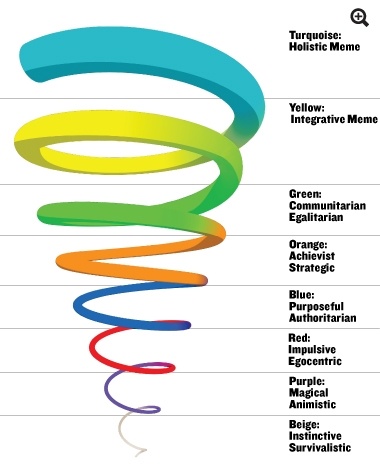
There are two tiers to the spiral: Tier One (Beige through to Green) has the prime motivator as fear, and it is thought that 98% of the human population currently fall within Tier One finding it very difficult to operate beyond fear-based motives, although there is emerging evidence of an increasing shift in consciousness afoot across the globe. The second tier (Yellow and Turquoise) has the prime motivator as love. Here people find it easier to empathise, value and communicate with people on all other levels of the spiral. Let’s take a brief look at each meme (main source for this summary is ‘The Seven Stages of Authenticity’ by Neil Crofts):
Beige – Tribal: An instinctive focus on basic needs such as food, safety and shelter. We are all born into this meme and under extreme stress may call upon this level of consciousness e.g. in the face of natural disaster. Today, Beige represents about 0.1% of the adult population with no influence on the way our global ‘society’ is run.
Purple – Mystic: During our clannish and animist history, our view of the world was essentially superstitious and full of enchantment rooted in an embodied relation with Nature. The conscious and unconscious realm (dream state and shamanic journeying) mix readily here. This may be likened to how a young child engages with life, prior to the formation of a prominent ego-consciousness. Yet, let us not fall into the trap of attempting to simplify or belittle the consciousness of animist cultures, as the inherent wisdom within many indigenous cultures is not limited to a child-like state of consciousness, quite the contrary, as the fluid interplay of ego with ‘shamanic’ consciousness is often a conscious act in itself, unlike a child (as far as ‘Western’ psychology informs us). Today, Purple represents about 10% of the adult population and 1% of the influence.
Red – Ego: While finding our place in the world during adolescence, we may become competitive, impulsive, heroic or rebellious. This stage is essentially hedonistic, self-centred and ego-driven. Immediate pleasure is focused on with scant regard for the wider consequences. A sense of separation between our conscious ‘I’ and unconscious nature de-mystifies the world for us shifting our way of attending from the animate, embodiment of self/nature witnessed in the Purple meme to the more individualistic sense of ‘self’ apart from ‘other’ of the Red meme. Today, red represents about 20% of the adult population and about 5% of the influence.
Blue – Moralistic: The egotistical, dominator approach of Red can transform into a hierarchic way of viewing the world where things are judged as ‘good’ or ‘bad’, ‘right or ‘wrong’, ‘excluded’ or ‘included’ and ranked in order of strict priority, for instance: plants, then animals, then foreigners, then the working class, the middle class and at the pinnacle are the elite ruling class. This accentuates and then acculturates the anthropocentric and individualistic characteristics of the Red meme, formulating them within a hierarchical societal paradigm. Dualistic ways of viewing the world become ingrained as cultural assumptions: self-other; human-nature; rich-poor; male-female, good-evil, etc.. Today, 40% of the world’s population are Blue and they hold 30% of the influence on society.
Orange – Highly competitive: Evolving out of the restrictive, polarised, elitist and essentially oppressive and exploitative nature of the Blue meme is the self-expressive and still largely individualistic nature of Orange. This is the go-getting, materialistic, competitive mentality so prevalent in today’s Western consumerist paradigm. The ego-conscious ‘I’ seeks to make its mark on the world outside itself by rationalising, defining, extracting, commercialising and then exploiting all aspects of life in the pursuit of freedom from perceived constraints. While self-starting, innovating, boundary-pushing, ‘freedom from bureaucracy’ qualities of competitive self-expressive individuals is an important aspect of our own individuation process, it comes at a cost along with an opportunity for us to learn and evolve. Neo-liberal free-market capitalism, neo-Darwinian reductionist science and materialistic consumerism become the dominant norms of this meme. Orange meme people tend towards seeing the world through threat-tinted glasses rooted in ‘dog-eat-dog’ competition which encourages excessive material wealth accumulation. The historic mix of the Blue and Red meme we find prevalent in today’s Western paradigm results in a predominantly elitist, greed-based approach where vast quantities of material wealth accumulate in the few while the many feel impelled to struggle up the lower rungs of the consumerist ladder. It is a worldview that is busily being assimilated throughout humanity. Orange represents around 30% of the adult population across the globe and about 50% of the influence exerted through business, science and politics.
‘From its basis and origin in the differentiated unity of primitive society, subjectivity has undergone a ‘progressive’ atomization and conflictual intensification with the intrusion, first of the state, then of the capitalist market, into the organic relationship between self, others, and nature. This results in the isolated, deeply problematic subject of today.’ Joel Kovel
Green – Anti-hierarchy: With the recognition of the shortfalls and inherent inequality of the Blue meme and the potential for debasement of the ethical and social aspects of human behaviour that come with the Orange meme, the Green meme of consciousness is formed. The motivation for Green meme people is of the co-existence of people at different meme levels and the abolition of hierarchical forms of exploitation. They search for a less dominator-orientated society and a more egalitarian consensus. While this meme is essentially aiming for a peaceful coexistence, it is driven by fear and anger formed by the oppression and control, and subsequent repression, of the Blue and Orange meme. Hence, it manifests by taking an anti-position e.g. anti-capitalist protests. The rise of social and environmental movements largely speaks to the Green meme, and while there are notable exceptions of ‘ecological-social innovation’ approaches which move beyond an ‘anti’ stance into ‘solution’ orientation within such movements, these exceptions are in themselves beyond Green meme consciousness.
The Green meme does a great job of pointing out the atrocities and inequities of the current prevailing paradigm, yet struggles to implement real world practical solutions or move beyond alienating people in the other memes which they are actually trying to assist. In reaction to the ‘anti’ position the Green meme takes against the Blue and Orange memes, often people within the Blue and Orange memes retrench further into their current mind-sets rather than opening up to transformation; a way forward is often blocked due to the ‘anti’ stance taken. What ‘solutions’ the Green meme may grapple with are often viewed as ‘anti’ by the dominant Blue and Orange memes and so resisted.
As we move beyond the Green meme into the second tier of consciousness, fear is replaced by love as the prime motivator which radically alters our way of catalysing scalable transformation.
[ As said at the being of this article, one needs to look beyond viewing these memes as hierarchical, with all traits being an important part of our human consciousness. There are many within social and environmental movements that operate beyond the Green meme. Those that operate within the Green meme provide important impetus for transformation through their ‘anti’ stance, which in-itself is a vital step in helping breaking through the prevailing paradigm of Blue and Red. ]
Enter the second tier consciousness: a shift from fear-based to love-motivated ways of transformation.
Yellow – Solutions: Moving beyond the ‘anti’ position of Green is a more pragmatic Yellow meme where rather than protesting about specific problems and fighting for justice in the face of adversity, our creative energy flows into working on, prototyping and implementing solutions. In being able to deeply collaborate, empathise and engage with the other memes, concerns for status or control are transcended by the opportunity to learn and further expand human consciousness. Here there is the emotional and spiritual potential to comprehend the complexity of issues we face in transforming to a sustainable future. Here we embrace working with (rather than against) business, government, community groups, social entrepreneurs and indigenous peoples.
Yellow meme people recognise the two paths that lie ahead for us as:
1) catastrophic downsizing/revolutionary restart, with the systemic strife and potential for violence that entails, or
2) an evolutionary consensual transformation.
Today 1% of the population are Yellow and they represent 5% of the influence on global society.
Turquoise – co-creative: Complimenting and working alongside the Yellow meme is Turquoise where a deeply intuitive and spiritual (dare I say it, psychic) level of awareness plays out. Improvisational co-creativity and prototyping – rather like a musical dance of resonance – fuels the envisioning and implementing of the path ahead. Here people understand that sustainability is first and foremost a spiritual challenge. For the solutions of the Yellow meme to be lasting and ‘sustainable’ in all senses of the word, the participants become rooted in, attuned with and aligned through love. Here the individual and collective value the fundamental importance of opening up our heart soulscape and allowing our true nature (our Higher Self) to direct our rational minds and sensuous bodies. We begin to recognise the profound sacredness of our being and becoming through each unfolding moment of reality. From this foundation, the individual and collective of humanity embarks on the true journey, the journey home: heaven on earth.
Today Turquoise represents less than 0.1% of the population and 1% of the influence, yet it is an emerging level with increasingly influence expected in the years ahead as the paradigm shift in our midst continues to unfold.
There is also a Coral meme which is emerging as we speak, this Coral meme is referred to as the Integral Holonic and is referenced by Ken Wilber and his Integral Theory (for more on this a deeper read of Ken Wilber’s work is suggested, also see here for further information on spiral dynamics).
Joanna Macy and others have stressed the importance of nurturing our spiritual foundation in facing the realities of our times. Yet any spiritual interiority needs to be balanced with an exteriority – a heartfelt resonance with our natural neighbourhood: human and more-than-human kinship. This is importantly why eco-psychology seeks to attune our inner psyche with our embodied relation with all aspects of life, beyond the self-projected illusion of separation and dichotomist duality. It is important not to embrace any spiritual advancement as an interior prejudice, quite the contrary, any meaningful advancement in consciousness brings interior-exterior attunement. In becoming fully realised, our inner nature flowers through its innate semi-permeability – its dynamic interfacing with its lived-in context. Our true nature becomes attuned with Nature.
‘He who is harmony with Nature hits the mark without effort and apprehends the truth without thinking.’ Confucius
In this way, all meme characteristics are individuated. Repressed aspects of our psyche or unconscious engagement with reality are allowed to flow through our consciousness. From this heartfelt spiritual flowering, we start to understand how aspects of each meme – if embodied in a balanced way – become important contributions to our wisdom. For instance, indigenous wisdom handed down over millennia of shamanic cultures where dreamtime journeying into the depths of our human-Nature consciousness assists in opening up of the semi-permeability of our conscious-unconscious, nature-Nature soulscape. Our animist roots can be accepted as authentic expressions even within the hi-tech, industrialised world we find ourselves in today.
To categorise the ego as corrupting, hierarchies as exploitative, materialist science as debasing, or capitalist economics as evil is to perceive with fear-based blinkers, with an ‘anti’ orientation which may fail to embody the individual and collective learning of our past and present realities.
In shifting from fear to love, we recognise the importance of the ego as assistant, of individuality within individuation and of rationalism as a tool of enquiry, while opening ourselves up to the deeper wisdom of natural inclusion beyond exclusion, where the material and spiritual attune within our authentic co-creativity.
From this place, illusory dichotomies of human-nature, self-other, ego-soul, conscious-unconscious can be transcended into the dynamic spiralling fluidity they really are. As we open our conscious minds to our unconscious oceanic depths, and our human nature with the awesome wildness of Nature, we allow culturally-conditioned shadows of repressed psyche to come out and play.
For a deeper exploration into the second tier of consciousness see this video which explores A Radical Review of Reality
‘And we are put on earth a little space
That we might learn to bear the beams of love’ – William Blake
To explore ‘future business consciousness’ further, join the Face Book community here
Project Wild Thing and The New Paradigm
This is a guest blog by Jon Alexander.
I first met the protagonist of Project Wild Thing, nearly three years ago, and I have a feeling the idea of making his daughter lick a frog was in his mind’s eye even then. The film hits cinemas around the country this weekend; though I am biased, it is funny and moving in equal measure, and I would recommend it from the bottom of my heart.

It also matters. It matters because, as David and I discussed back in 2010, films don’t just tell stories, they can change stories too, and our relationship with nature is a story in dire need of changing. You might call me the philosopher (or the geek) behind the film; if that is the case, and for those who are interested, here is the treatise.
We have a story in British, perhaps Western, perhaps increasingly global society about our relationship with nature. The building blocks are both religious and scientific, involving sources from the Old Testament to Hobbes to Darwin, yet the story is not an essential conclusion of any worldview. It goes something like this.
I am separate from nature, and I have to compete with nature for my survival. If I lose, I am weak, and I deserve to lose. But I can use things from nature to build my strength – to the theme of this blog, I can consume nature to build myself. And if I do that well, I have a chance of winning my competition with nature, and coming to control it, as master of all I survey. That is my destiny.
 This story, so deeply ingrained as to be almost unconscious, manifests itself in different ways in different aspects of our society.
An example of the powerful metaphors arising from this story is the idea of a “race against nature”. This is particularly prevalent in agriculture, where the idea is that we must continually seek new controls – fertilisers, pesticides, and so on – that get us ahead of nature. Each will provide a temporary solution before nature “catches up”, and in the process is also likely to create new problems for which we must then find another new fix. But it is the human condition to run this race, seeking always to break new limits. Or so we believe.
The problem is that this story is constructed on a fundamental flaw. We are not separate from nature. We are part of nature. We are part of a system, a player in the team, not an opposing side. And like any player, we depend on the team for our success.
As James Lovelock, the originator of the Gaia hypothesis, has reflected, this means that by seeking to compete with nature, the more accurate description of our behaviour is “like a pathogenic organism, or like the cells of a tumour.” On this understanding, there are only four possible final outcomes: “destruction of the invading organisms; destruction of the host; or symbiosis – a lasting relationship of mutual benefit to the host and invader.”
Only one of these is particularly desirable. “Destruction of the invading organisms” means us gone and nature continuing. “Destruction of the host” means nature gone – but then we are gone too, nothing without the team. Symbiosis remains as the sole desirable option. And it requires a change in story.
So far, so apocalyptic. But now things get fun. Because the shift of story that we need to make, while it is cognitively very difficult, is actually quite subtle. Its consequences are significant, but actually not a million miles away from what we do now. And we’ve changed a story like this before.
Once upon a time we all believed the sun orbited the Earth. The story of our society depended deeply on this idea. It underpinned our centrality in the universe, our primacy as a species and as a planet. It drove the structures of our society and our use of technology, as we designed and innovated to maximise our benefit from the story we lived in. And for a very very long time, that story fitted all the facts we had available.
One day, someone started to find evidence that the story wasn’t right. This seemed to threaten an awful lot of the structures of society, so we kept it quiet. Over time, though, the evidence built and built until we couldn’t ignore it any more. And then we changed story. And now, nothing could seem more obvious.
What’s most interesting here is that most of the evidence fitted both stories about the universe just as well. One object did orbit another. The Earth in many ways did operate just as we thought. We’d just got it the wrong way round. So we just needed to retell the story slightly differently. And when all the confusion settled down, that’s what we did.
That’s what we need to do again.
We need to and are retelling Darwin, for example. The survival of the fittest isn’t about a tending to one dominant organism or even one individual, the survival of the single fittest being. It is about the survival of as many organisms as possible that fit. Surely that fits the evidence better, focusing attention on random mutation and the exploration of nature’s niches as much as on natural selection and the elimination of failure as the key mechanic of evolution.
We also need to and are rethinking our “race against nature”. A new metaphor is starting to establish itself in agriculture, the idea of a “dance with nature”, where we use her energy to build our own, making the most of nature but in a way that gives energy back and builds it for the future, not seeking to conquer and dominate.
All this is not to say we need to stop using technology. In fact, quite the opposite. But just as technology after Copernicus (and certainly after Galileo) was designed with different intentions, to explore and maximise a different universe to that which came before, so the same sort of shift must now apply again. The technology we need is technology that aids symbiosis, not technology that dominates and conquers.
Perhaps the biggest change we need to make for all this to be possible, though, is the story we tell our children. We are Copernicus’ generation – we are seeing the change that needs to happen. But for many of those who have been brought up with the Sun orbiting the Earth, the change is too hard. That’s fine.
 But we can’t take as long over this shift as the century and more between Copernicus and Galileo. So what is not fine is that we are bringing up our children in a way that stops them from having the opportunity to experience the world differently. Perhaps the greatest negative of the current story is the phenomenon American author Richard Louv has defined as “ecophobia” – a fear of nature among children, born out of the fact that in their education they are taught that nature is other; that it is dangerous; and that it is dying.
 The Nature of Business