Shared Insights To Four Deep Questions
As ‘wise’ Homo sapiens, would it not be sensible to go upstream and identify, understand and then rectify the root sources of our multiple crises – economic, social and environmental?
In these pivotal times for humanity, the questions run deep; tough times demand tough talk and action. It is with this in mind that I posed four succinct yet deep questions to a number of recognised sustainable business thought leaders and change agents. It can be a challenge to catch our breath, pause and reflect on deep questions when we are busy at the coal face, yet many experts took time to formulate and share a considered response as we gather at the threshold of paradigmic transformation.
Here are the full responses I received from a variety of ‘experts’ in sustainability – to read the article that summaries these responses and relates them to ‘radical sustainability’ please go to the original post published here on CSRWire
What is the hidden unity within the diversity of life?
For many years now our Western understanding of ecology (nature’s patterns of relationships) has been founded on the core principles of competition and separation. But now thankfully there is a much broader discussion forum and worldviews are emerging that could be of interest not only to ecologists but also to business.

In 1857 Charles Darwin’s seminal work set the scene for defining the unit of ecological evolution as the organism separate from and in a competitive struggle with its environment.
In 1902, the Russian evolutionary theorist Peter Kropotkin, found that in both animal and human societies cooperation and mutual aid yielded prosperous outcomes far more than competitive behaviour. In 1916, the biologist Frederic Clements extensively explored the role of cooperation, mutualism and community within biotic life at an ecosystem level.
Yet the development of Neo-Darwinism has de-emphasised certain aspects of Darwin’s findings and emphasised others, namely the innate competitive nature of all organisms along with the selfish tendencies of genes that command these organisms. The prevalent ecological mind-set of the West has become essentially competition-based. Nature is all about dog-eat-dog competition, everyone knows that, or have we been misleading ourselves?

The discrete definition of the organism separate from its environment is what Gregory Bateson viewed as the basic flaw which corrupts the thinking that flows from it, as for him the inter-play of the organism with its environment is paramount to its health, viability and evolution. He viewed comparing one species against another in a struggle for survival as insane. He likened our Western worldview of survival through competition as ‘an ecology of bad ideas’ which breeds parasitic humans, purely self-centred and destructive of their host.
All the time new findings bring fresh perspectives to how we view the evolution of life. Far from the genome being a rigid set of building blocks and innately selfish we realise it is a fluid system of dynamic localities that evolve by interplaying with its environment. We recognise that evolution is essentially co-creative, fluid and variably connective. Rather than organisms struggling for survival they thrive through dynamic relationship.
‘Life did not take over the globe by combat, but by networking.’ Lynn Margulis
Biologist Lynn Margulis has extensively studied cell behaviour and contends that symbiosis is a major driving force behind evolution and that cooperation, interaction and mutual dependence among life forms are what allow for the global expression of life we see around us. Far from life being driven by an innate competitive struggle it cooperates to form richer environments for life to further evolve. ‘Facilitation ecology’ is an emerging area of focus where ecologists are studying how facilitation happens between species at an ecosystem level. Traditionally we assumed that species would become more competitive as environmental conditions became tougher, but from recent studies it seems the opposite is closer to the truth, with species becoming more cooperative in stressful times.
It is worth noting that only one out of every ten cells within our bodies is actually human. Our bodies are a good example of the extensiveness of interplay and partnering that goes on throughout the biotic world. Without the help of the ‘friendly’ bacteria within our bodies we would utterly fail at life. It is also worth noting that in times of strife, like the hurricane-induced flooding in New York for instance, we humans transcend perceived boundaries of separation and seek to cooperate and help each other where possible.
Forester Suzanne Simard has been exploring the soils beneath our feet and found extensive mutuality amongst bacteria, fungi and plants. Trees within forests share nutrients with other trees aided by mycelium networks of fungi underground. Young trees trying to grow in areas of the forest that are deficient in certain nutrients and lacking enough sunlight, can be provided the nutrients they need from other trees (of completely different species), ensuring the overall ecosystem benefits. Here is a short video clip about how nutrients between trees are shared and distributed throughout the forest.
The evolution and sustainability of biodiversity depends both on processes of individuation and integration in continual dynamic interplay: there is no binary opposition of one against the other. Life did not originate through enmity like our prevalent Neo-Darwinian paradigm assumes, but through this co-creative interplay that enables life to diversify by forming partnerships in correspondence with differing capabilities and availability of resources. There are a great variety of relationships, patterns and dynamics that inter-play into life’s rich tapestry and continual evolution.

At this point a very clear distinction needs to be made between the abstract concepts of competition and co-operation, which are predicated on an assumption of independence of content from context, and the arguably more natural concept of co-creation, which includes both individuation/dissociation and integration/association processes, and recognises that these arise fundamentally from the needfulness, NOT the ‘selfishness’ or ‘altruism’ of life forms.
Quite simply, any form of life needs to be able to gather in, retain, explore for and redistribute supplies of energy from its neighbourhood. It cannot choose to be independent from its neighbourhood, no matter how much it might desire ( in the case of ‘civilised, rational’ human beings) to be so. Nothing in nature is separate from its environment, everything has a variable boundary which serves to interface inner world with outer. This dynamic interfacing is fundamental to natural sustainability. Likewise nothing is in competition with its environment; everything is in a state of dynamic co-creativity with its environment.
‘The whole philosophy of Hell rests on a recognition of the axiom that one thing is not another thing, and, specifically, that one self is not another self….it means the sucking of will and freedom out of a weaker self into a stronger. ‘To be’ means ‘to be in competition’. C. S. Lewis
Our economic paradigm is founded upon the principles of competition, separation and scarcity. Yet this is not how life truly is. Excessive competition destroys diversity and innovation – a lesson it seems that many politicians, company executives and economists have yet to learn. It’s about time we started to wake up to the inherent grammar running throughout life on Earth – the unity within our diversity is our ability to work with NOT against each other in all aspects of life: business and beyond.
Watch a short video clip on business inspired by nature here . To explore ‘business inspired by nature’ further, join the Face Book community here .
Growth, Transformation & Progress
There is much talk these days about growth, transformation and progress; three key qualities of life yet so often misunderstood.
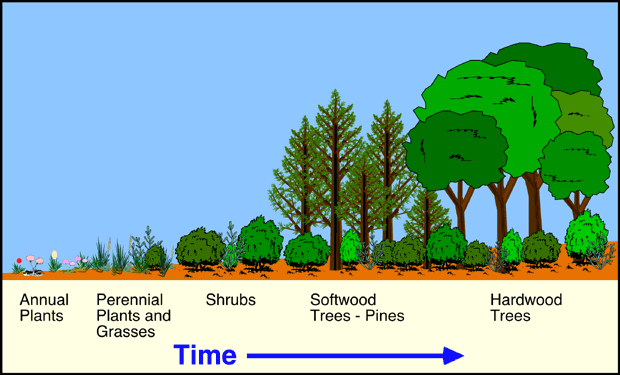
Many of us have been taught – directly or indirectly through cultural assumptions – that transformation follows a progressive, linear trajectory. We many have been taught that transformative growth in the natural world follows four stages: open landscape or bare ground exploited by pioneering species such as ‘weeds’ and grasses, transforming into scrub land with small bushes, then trees start to take over and in time the ecosystem matures into a forest. The mature forest is often viewed as a ‘steady-state’ ecosystem. Ditto for our business systems, we often assume that entrepreneurial pioneers innovate, venture out through prototyping, then experience growth of their products and services, and then the market position is protected and conserved where possible. Ditto for our economic paradigm, new markets are exploited for growth; then tending towards steady-state maturity. In this view of life, success comes with progression through these stages. The goal tends towards an ultimate ‘holding-on’ to conserve the dominant position; the ‘Top Dog’ steady-state.
This view of life is, alas, over-simplistic; life is far more dynamic and spiralling in nature than this. To view life as innovation à growth à conservation is at best half-cut, as it misses out half of the picture. In attending to life in a half-cut way, we run the risk of becoming out-of-kilter with the way life really is and so finding ourselves operating in inherently unsustainable ways.
In reality, to understand life in full colour, depth and flow is to recognise and embrace death and rebirth as fundamental life’s continual transformation. Holding on to any stage of development in order to conserve the status quo unnecessarily saps our creativity, diminishing our learning experiences and holding us back from realising our full potential.
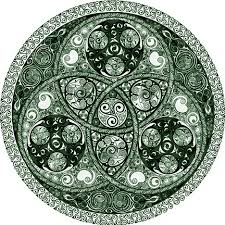
A more balanced way to understand the nature of transformation in Business and Nature is to recognise – as Indigenous Peoples have for millennia – the ever-spiralling transformative process inherent within reality. With the caveat that any rational definition (which our left-brained ego-consciousness craves for) is always bound to be an incomplete explanation of reality, we can delve deeper into the nature of transformational systems by exploring what is called the ‘adaptive cycle’, sometimes referred to as the ‘lazy eight’.
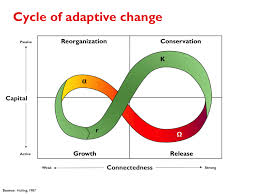 As you can see from the image of the adaptive cycle, there are indeed stages of adaptation that can be represented by innovation, growth and conservation. Yet what we so often do in our current paradigmic way of thinking is overlook or blinker ourselves from seeing the most fundamental. Perhaps because it is deemed socially uncomfortable, we skip over creative destruction and reconfiguration process of death and rebirth so key to any natural ecosystem – whether business, social or ecological. The so called steady state scenario is not what actually occurs in reality, as life is always changing. Rather than trying to shun creative destruction by holding on for fear of the unknown, we would do well to embrace it. Breakdown is what leads to breakthrough. Letting go of old ways is what opens the way for radical innovation. Systemic redesign is what brings long term resilience.
Otto Scharmer, Peter Senge and others from MIT and The Presencing Institute have explored this letting go process at the leadership dimension in business (personal, stakeholder group and organisational). It is this letting go that is vital for real transformation to take place and so for a redesigning for resilience to happen amidst these volatile times.
John O’Donohue in his wonderful book Anam Cara beautifully describes the cyclic nature of the seasonal year and its relation to our stages of transformation, learning, growth and development as we progress through life. This progression relates at many levels: an individual level, organisational level and socio-economic level, for instance.
Spring is a youthful season, full of hope, promise and possibility. It is a time to embark on new adventure as we open up to new possibilities. Innovations abound. It is a busy, yet energising time when new projects are embarked upon.
Summertime is where we find ourselves in full stride. It’s a time for nurturing and growth, and we take risks while adventuring into new horizons.
Autumn is the time when the seeds sown in spring and nurtured during summer are now coming to fruition. The experiences of the past months are now yielding fruit and it is time for us to harvest the learning of our experiences.
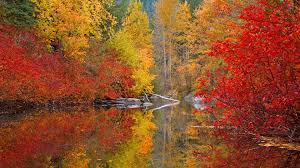
Winter is so often viewed as the end. It is a time of rest, recuperation, winding down and hibernation. Yet it is also a time for reflection and reconfiguration along with inner review of our learnt experiences. Without this inner review and reflection, our preparations for springtime can lack the foundational wisdom needed for transformative change to take root. This time of self-retraction and turning inwards can be viewed as bleak in many ways, yet death is vital for any transformation and rebirth. In this way, aging and inner-contemplation can be seen for what they are: times of great poise and wisdom. It is from this wintertime that new life can take root within our soul and within the soul earth of Nature.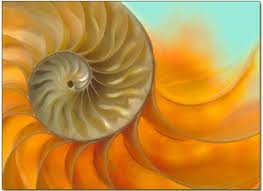
Often in today’s consumerist society of short-lived superficial satisfaction, we wish to skip over the deeper more profound parts of our own self, organisational and societal transformative learning. We wish for a perpetual summer and autumnal harvest festival, cherry picking the perceived ‘highlights’ without recognising that these are part of a spiralling cycle of life, death and rebirth. As any wise person knows there are no short cuts, only false illusory gains which come back to haunt later.
Any truly sustainable transformation at a personal, organisational and socio-economic level requires a conscious embracement of all the seasons and all the spiralling stages of transformation. Half-cuts just won’t do. Propping up our current half-cut way of attending to life by inflating consumption patterns (whether through quantitative easing, easy credit or stimulation of the housing market) largely skips over the inevitable deeper learning and transformation that has to happen if we are to grow up. Our current socio-economic situation is analogous to us busying ourselves by propping up a gigantic hot-air blower trying to keep the cold of winter out. If only we can hang-on for just a bit longer (at least until the next general elections) then perhaps all will be well, we naively hope. We skip the deep learning because we have numbed ourselves to reality through the soul-destroying way of living. In the words of Pink Floyd, ‘We have become comfortably numb’.
This comfortable numbness happens all too often in organisations too. We may embark on efficiency and cost-reduction programs, yet so often shy away from a deep reconfiguration of our business model. The cost cutting is merely a way of holding on to the conservation of our steady state, hoping that consumption will return and so the wheels can keep on turning. No deep learning and inner review of the organisation is properly embraced. Yet in these transformational times, organisations and their leaders need to embrace transformational change: death/rebirth, breakdown/breakthrough. In the words of Dawn Vance, Global Head of Logistics for Nike:
‘Organisations have three options:
1) Hit the wall;
2) Optimise and delay hitting the wall;
3) Redesign for resilience.’
Many organisations today – for profit and non-profit – busy themselves with optimising the existing business model which is only delaying the inevitable car crash.
At a personal level, we so often find it preferable to hold on to our current way of attending to life in challenging times, hoping the tough times will pass, rather than to deeply reflect, let go of old habits and transform to new ways of living and being. In the hectic business of our daily schedules we find it difficult to take time out to reflect on where we are at, let alone take a deep look at how we need to transform our lives. Such deep reflection can stir up deep seated fears of failure and open up old partially healed wounds. Saying goodbye to the autumnal harvests in order to embark on the darker, inward stillness of winter is not for the faint hearted, yet the only real path ahead for real transformation. 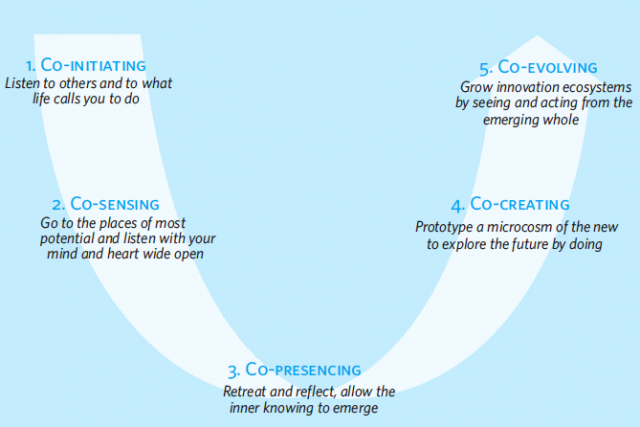
At any time there is a dominant season present in our personal, organisational and socio-economic cycles. Sensing and then responding to where one is in that cycle is the first step to becoming aware of our transformational progression.
To explore ‘business inspired by nature’ further, join the Face Book community here
Encyclement – A Natural Inclusional Cosmology of Life and Love
This is a guest article written by Dr Alan Rayner

Throughout our history, we human beings have sought knowledge not only of our own past and future but also that of the natural world and cosmos we inhabit. What kind of compulsion is it that induces us to make this quest, while other life forms appear to sustain themselves through renewable cycles of living, birthing and dying simply by doing what comes naturally to them?
Whatever it is, it seems to be underlain by a feeling that without it, we feel lost and out of control in an unfathomable and complex labyrinth within which our lives have become inescapably entrapped, with the only way out and back in being through an entrance/exit marked ‘Birth/Death’. This feeling of uncertainty may make us scared silly of some kind of soul-devouring Minotaur that awaits us deep within the labyrinth or a judgmental figure at its entrance/exit who may or may not let us pass. ‘Knowledge is Power’, we may then tell our selves, and with it we can determine our destiny through our own free will, rather than have it decided by some ‘external judge’ or ‘pit-dwelling devourer’ beyond our influence: we can gain dominion over Nature by discovering its hidden rules and turning them to our advantage by knowing the difference between ‘good’ and ‘evil’, ‘right’ and ‘wrong’. We can play-act knowing the ‘Mind of God’. Alternatively, or in addition, we may journey in the humble hope of finding some ultimate source of truth, goodness, love and illumination in the depths or beyond the entrance/exit gate, which will care for us ‘unconditionally’ – but, paradoxically, only if we have ‘faith’ in it and request forgiveness for our departures from its code of practice!
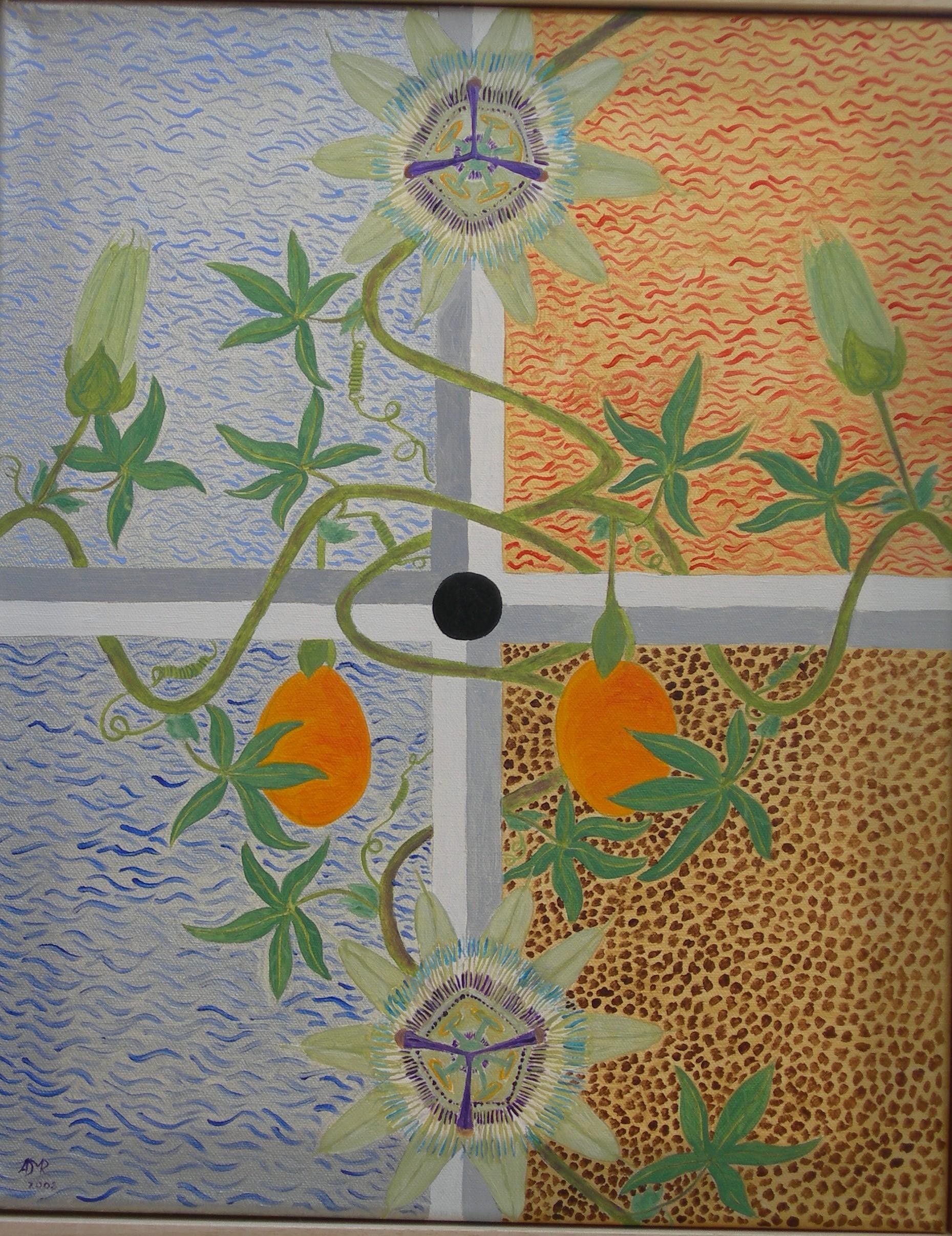
Perhaps inevitably, this quest has brought our interest in knowing ‘the truth’ into tension with our desire to live fulfilling and meaningful lives and our fear of what will become of us and those we love in an uncertain and ultimately unknowable future beyond our immediate sensory perceptions. Given this tension, how can our enquiry into the nature of our being and becoming ever be truly impartial, i.e. comprehensive and unbiased? Is it possible to avoid being influenced by what we would dearly like or not like to know?
The tension between seeking to know ‘truth’ and wishing to know that ‘all will be as we most desire’, not as we most fear, has evolved into the ideological conflicts between different belief systems that have raged for millennia and continue to do so. These conflicts are made all the more destructive through the invention of increasingly potent weaponry. If they are to be resolved peacefully, there is a clear need to develop a view of nature and ourselves that most if not all of us can readily accept is consistent with actual experience and that makes consistent sense, not paradox.
This is a where a truly impartial, natural scientific approach could be of great and lasting benefit to humankind. Unfortunately the objectivist methodology of most modern science is anything but impartial because it deliberately excludes consideration of anything other than physically tangible and hence quantitatively definable (i.e. ‘measurable’) natural presence. This unnatural exclusion is rooted in the abstract, definitive logic, which holds that the only alternative to contradiction (“it is impossible for the same object to belong and not to belong at the same time to the same object and in the same respect”) is unity (“all objects will be one”). By imposing an absolute discontinuity between material and immaterial presence, such logic – which is embedded in the foundations of classical and modern mathematics – is not only paradoxical and inconsistent with actual experience, but also brings the objectivist science built on its foundation into collision with any kind of non-materialistic religious or spiritual belief. Its underpinning belief in and desire for the ultimate definability and predictability of nature – the abstract, hard-lined rules of ‘the labyrinth’ – merely serves to reinforce conflict, not to bring the much needed relief that could be gained from a more comprehensive and widely acceptable approach. In its quest for certainty, one way or the other it impales us on the Minotaur’s horns of dilemma instead of enabling us to leap clean between their opposing menace.
I think that a more natural and comprehensive scientific approach than that espoused by objective abstraction is possible. I have called this approach ‘natural inclusionality’. It arises from impartially addressing the simple question: ‘what, most fundamentally, makes any natural form distinguishable from its surroundings?’ (see video illustration at http://www.youtube.com/watch?v=8CGvQX3eNjI). It becomes apparent that the only way of answering this question is to acknowledge the occurrence of at least two kinds of natural presence: (1) a receptive context or non-resistive medium, which provides freedom for local movement and/or expression; (2) local formative content, which informs or configures that context. The former is necessarily spacious, the latter necessarily cohesive. Moreover, for form to be and become distinguishable, each of these presences must naturally include the other. Spacious presence alone would be formless void, and formative presence alone would have no shape or size. They are necessarily distinct, but mutually inclusive presences. They can neither be abstracted from one another as independent entities, nor be homogenized into ‘Oneness’. The only way in which this necessity can be fulfilled is for one of these presences, natural space, ultimately to be everywhere, continuous, intangible (i.e. frictionless/non-resistive) and immobile, and for the other ultimately to be somewhere, distinctive, tangible and continually in motion. Try whirring your hand around in front of your face until it appears as a blur, and you may get a feel for how all distinguishable form will ultimately appear this way when viewed sufficiently closely (i.e. at sufficient magnification) and for sufficient duration – if the whirring stops even for a moment, so too does ‘time’, and the mutual inclusiveness of each in the other breaks down irretrievably. Natural space and figural boundaries are hence, respectively, continuous and dynamically continuous energetic interfacings and distinctions between the insides and outsides of all natural forms as flow-forms.
What emerges from natural inclusionality is a view of natural geometry as intrinsically dynamic – an ‘Encyclement’ or ‘Becoming Hole’ of vortical/toroidal flow, not a ‘Pre-defined Whole’ of permanently crystalline Form (see http://www.bestthinking.com/article/permalink/2341?tab=article&title=becoming-hole; http://www.bestthinking.com/article/permalink/1798?tab=article&title=place-time-the-flow-geometry-of-space). By its very nature, such flow-geometry is impossible to express adequately in definitive linguistic or mathematical terms. The ‘hole point’ of natural inclusionality is that in a dynamic reality of natural energy flow (‘place-time’), there are no such things as complete ‘wholes’ and ‘parts’ and neither space nor time can be cut into discrete segments. All is in a flux of variable viscosity – continual circulation – and can be seen to be so if examined sufficiently closely and for sufficient duration. Natural ‘Time’ is implicit within this flux, not an abstract, one-size fits all, independent measure set apart from it in order to assess its ‘speed’. In terms of life experience a mouse may live as long as a Galapagos tortoise.
The fundamental physicality of this flow-geometry becomes possible to infer (i.e. ‘imaginatively bring in to awareness’, not rationalistically deduce or induce respectively from general rule to specific instance or vice versa) no sooner than one has acknowledged the mutual inclusion of continuous receptive space and continuously mobile energy in the process of rendering natural bodily form distinguishable from yet not isolated from its surroundings. There is no metaphysics (super-naturalism) here. There is only the inference of how things must be and become if space and energy/form are to be mutually inclusive. For they must be and become this way if the cosmos is not to collapse onto the motionless, timeless, formless condition of nowhere and nothingness of the ‘singularity’ (dimensionless point mass) assumed by abstract ‘big bang cosmology’ and embedded in the abstract foundations of classical and modern mathematics.
So, how can an appreciation of this natural inclusional flow-geometry help us to deal with the potent cocktail of desire and fear, which leads us to seek the certainty of a hard-lined existence and yearn respectively either for the defeat or the love and forgiveness of some fantastic monstrous or adorable Figure beyond our reach? Well, to begin with, it enables us to review afresh some ancient ideas regarding the fundamental nature of life, love and their dynamic relationship. ‘Eros’ corresponds with ‘radiant energy’ (~light/electromagnetic radiation), ‘Agape’ with receptive space in the heart of bodily form and continuous with receptive space everywhere, and ‘Philia’ with ‘bodily energy’, which circulates around local centres of Agape (~gravity) to give rise to bodily flow-form. None of these can express their reciprocal co-creative potential in the absence of the other.
The form of a vortex or spiral galaxy visualizes the erotic radial flow of energy towards and the philial circumferential flow around local centres of agape (eye of the storms, ‘black holes’) rather beautifully. So, there we have it – natural inclusional cosmology in a dynamic nutshell, with
nothing supernatural and everything extra-ordinary about it. With this cosmology in mind, we are free to wander open-heartedly in the ultimately unpredictable wildness of natural flow-geometry, released from hard-lined artifice. We can stop play-acting and start playing, as fully immersed participants in the life and love of our natural neighbourhood. But as we do so, it is important not to look back in longing for the false sense of freedom and security offered by pre-definition – for, if we do so, the Medusa of abstract rationality will be sure to reinforce her stony grip and impale us on one or other of the Minotaur’s horns of dilemma.
Here is a poem that explores such:
The Sea of Receptivity
There is a Sea of Receptivity
That no body can see, or touch, or smell, or taste, or hear
Except implicitly, through its presence of absence –
Its intangibility –
But all can feel calling
From deep within and far without
To come into and out from form
As flowing current
Tidal breathing
Always restless
Eternally at rest
Everywhere inside, outside and throughout
Yet, which escapes attention
Of those whose life and love depends
On this Infinity
So that they leave it out of mind
Set apart from calculating thought
Fixed upon what can be seen, or touched, or smelled, or tasted, or heard
Explicitly in finite units
Weighed and measured in lifeless blocks
According to some independent scale of judgement
Force-fitted to all sizes
Hence, love gets lost
Amidst the screaming rubble of shattered continuity
A multitudinous cacophony
Of independent voices
Each demanding their rights
To be or not to be as they are
For now and all Time
Until called to Order
By a voice Above their Crowd
For All to be One,
Or Else
A War of Words begins
Between One way or an Other
In strident contradiction
Framed in Rhetoric
Abstracted from the Sea
To become a seething Mass
Of Pro- and Anti- Matter
Taking pot shots at One Another
With escalating violence
Dead set on annihilation
Meanwhile,
At the back of those absented minds
The Sea remains Silent
Waiting for their Return
To their Senses.
Acknowledgement
Alan would especially like to thank Rev. Roy Reynolds for his support and insight, which contributed to my preparation of this essay, including his exploration of the meanings of Eros, Agape and Philia in relation to natural inclusional awareness, which Alan then developed further.
Conscious co-creative leadership: Starts with Self
Leadership starts with listening; listening with an open heart and mind. True listening comes within and through stillness.

It has been rightly said before ‘The success of the intervention depends upon the state of the intervener’. If we are to intervene in the world, we ought to ensure we are attuning with our authentic true nature. This enables us to be truthful in our listening, talking, sensing, responding, actions and reactions. So often in today’s hustle and bustle it is easy to get carried along with the noise, struggling to attune with our real inner presence let alone the world around us. By developing a deep space of attention and awareness within ourselves we can help develop an environment of conscious co-creativity where we can really listen to others, and so others become more susceptible to opening up and becoming truthful in themselves. We create the conditions conducive for co-creativity.
This kind of conscious leadership is not about controlling or manipulating outcomes, it is about facilitating an environment where sharing, learning and then transformational change happen. In the words of Lao Tzu:
Giving birth and nourishing
Having without possessing
Acting with no expectation
Leading and not trying to control
This is the supreme virtue
The first step for any authentic leader is personal integrity which comes from centring and attuning with our true Self: ‘Know thy self’. If we are able to recognise and then tame our ego-consciousness then we can begin to untangle our true Self from our ego. Left unchecked, our ego-consciousness (hand-in-hand with our left-brain hemisphere’s rationalistic, grasping, defining, extracting and separating way of perceiving) attempts to usurp control of our way of engaging with reality. Each moment offers us the chance to free ourselves from this self-imprisonment. In the words of Bob Marley:
‘Emancipate yourself from mental slavery
None but ourselves can free our minds’
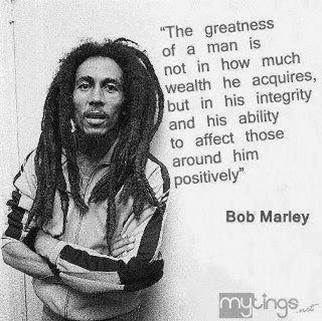 In today’s consumerist culture it is the norm to deaden ourselves from who we really are – deadened we make much better consumers, endlessly seeking outer material gain to stimulate, titillate, perhaps even awaken us, yet it never does in any lasting, sustainable way. How often do we make space and time in our daily lives to ask the most important of questions: ‘What is my purpose? What really makes my heart sing?’ Our culture deeply conditions us, and habitual patterns are hard to break. Yet to become a true leader we must first attend to our own inner relation – our ego-self and true Self – to allow us to attend to other relations in a right way.
‘Our goal is to create a beloved community and this will require a qualitative change in our souls as well as a quantitative change in our lives.’ – Martin Luther King Jr
The transformation in our midst happens within ourselves, within each moment. By attuning with the moment (through contemplative practices, for instance, which essentially allow stillness into each moment) we can allow ourselves to become conscious of the unconscious dynamism within and throughout our lives. We allow ourselves to perceive beyond the confines of our ego-illusion.

A true leader first-and-foremost becomes artful in balancing the rational and the intuitive minds, along with the creative and receptive heart. Deep inside us and all around us are all the answers we need for the moment we are in. The present is a wonderful present as along as we remain fully present.
‘Above all else, to thine own self be true’ – Shakespeare.
Self-mastery through softening the ego and opening the heart allows us to transcend the many paradoxes and false dichotomies that plague our Western paradigm rooted in the illusion of separation: conscious/unconscious, self/other, subject/object, human/Nature, good/evil, space/matter, and so on.
Healing the world begins with healing ourselves. The more attuned we become with our inner human nature and the omnipresent Nature flowing throughout reality, the more our heart and soul flows through all we think and do…then we begin. Here is a short video clip on the future of leadership
‘How you see and what you see determines how you will be.’ John O’Donohue.
The BIG Challenge – True Sustainability – attuning with reality
In the current out-dated paradigm so often we find sustainable initiatives being bolted-on, viewed as distractions from the primary goal of the organisation (short term profit maximisation).
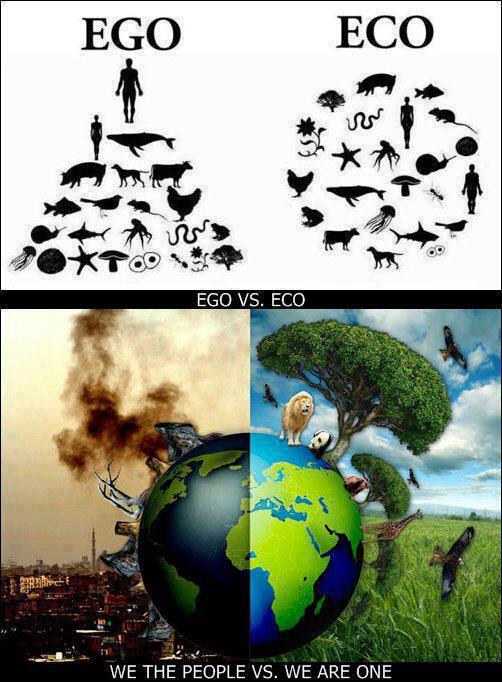
Yet there are good signs of a shift in sustainability becoming core to the ethos of the purpose and people of the business and their ecosystem of stakeholders – creating real value for life. This is good business sense and a transformation from greed-based, ego-conscious short term profit maximisation for the few at the expense of life.
Attuning – individually and collectively – as leaders and co-creators with the deep wisdom of Nature helps align our sense of purpose in line with becoming in harmony with life. This Nature-attunement helps ensure we co-create the conditions conducive to life, shifting our business activities from hurting to helping. Is now not a good time to move on from carcinogenic, life-destructive ways of operating?
The BIG challenge (and perhaps why many struggle in this area) is that real nature-inspired transformation goes hand-in-hand with paradigmic transformation – whole system change. Fundamentally, it requires a transformation of our relationship with Nature – from one of a scientific explorer objectifying and extracting things from their lived-in context for materialist content, to a deep awakening of our being part of Nature and opening ourselves up to the deeper wisdom that lies within and all around.
 Such a shift is radical by its nature, as it goes to the root of our pressing challenges. It is scary because it threatens to dislodge much of what our current illusion of reality is based on – materialist consumerism. And yet, quite frankly, anything else is secondary – only of use if the paradigmic transformation is happening. The great news is that there is great potential for synergy in ‘nature-inspired’ transformers working across the disciplines of: biomimicry, eco-psychology, eco-literacy, permaculture, indigenous wisdom, nature-based education, biophilic cities, social innovation, regenerative economy, etc. as well as the great work already being done in the biomimetic and cradle-to-cradle design space. The time is right, the landscape is ripe, it is only our fear, ego and rational minds that hold us back – our imaginations are just itching to let-go of the old, exploitative, reductionist way and embrace true sustainability for our bright future.
To explore ‘business inspired by nature’ further, join the Face Book community here
View a short video clip on business inspired by nature here
The Nature of Emergence for the Firm of The Future
The concept of emergence and emergent processes and behaviour is fundamental to how nature operates.
‘Throughout the living world, the creativity of life expresses itself through the process of emergence’ Fritjof Capra

We all know the feeling when one plus one is greater than two; when the whole is greater than the sum of the parts; when a single conversation can be life-changing. As children, we were delighted to see a recognisable image appear when we simply drew an ordered sequence of lines in a dot-to-dot drawing. And no matter how much gardening we do, it is always magical to watch sprouts pop up out of the soil a few days after we plant them.
All biological systems have an emergent quality as all living structures (including social and organisational) are emergent structures. Emergence has a self-generating quality, where individual parts of an ecosystem interact to provide an emergent order (an unfolding of events that are self-fuelled by the actions and interactions of the parts). Emergence is when an organised, complex, and/or cohesive pattern or result arises — often unpredictably — from a series of individually simple component interactions – this is the nature of nature. Emergent systems exhibit synergistic effects, where the individual parts (aware or not) inter-relate and in so doing provide synergies, where the interaction of the whole is greater than the sum of its parts involved in the interaction. This synergy is what feeds the growth of the ecosystem and provides for its emergent behaviour. Humans are part of biotic life and we too exhibit emergent behaviour (from stock market trends to world-wide web interactivity). It is as if the collective whole, through the interaction of the parts, self-organises as a whole. Hence the notions of relationships, communities, ecosystems and Gaia itself all being part of an emergent inter-related community of parts. 
Emergence in human behaviour is linked to decentralised, distributed decision-making and self-learning which requires a degree of openness and self-criticism. Critical self-reflection requires stepping out of one’s comfort zone, which is not easy at the organisational or personal level. Emergence in business therefore requires a higher level of intellectual and emotional maturity, moral integrity and courage than currently found in the prevailing business ethos of today. It is also important to point out that the level of emergence may vary depending on the organisation’s challenges, and may also vary by area (team, department, focus group) within the organisation.
Conventional thinking suggests that if you want to accomplish something, particularly something complex, you need to fully articulate the desired result, analyse the situation, create a step-by-step plan, gather needed resources, and then execute the plan to completion. If all works well, you will end up with the desired or predicted result. Whilst operating in volatile, dynamically changing environments, there is also a need for innovative and radical redesign, to drive towards as-yet-unimagined results, to accomplish things that have never been done before. How do you accomplish results you cannot even describe? How do you tick boxes that don’t yet exist? Like nurturing seedlings in fertile soil, if you put the right resources together under the right conditions, emergence just happens. It is what happens naturally when all players understand their context and the speed, scale, and scope of what is needed; being empowered to execute the collective vision through individual interactions and emergent behaviour. 
The concept of emergence, emergent behaviour, and emergent processes is core to Chaos Theory and Systems Thinking. Emergence is how complexity and diversity are created from simplicity; how the apparently chaotic behaviour of swarms can result in self-organising super-organisms. The collection of the parts — interconnected within a network of synergistic relationships, all contributing to the system while functioning independently — form a dynamic resilient whole whose properties cannot be predicted by analysing the parts.
Collective adaptation emerges from the collective whole as individual members strive to adapt and enhance themselves and their relationships to generate more benefits for themselves and the whole. Order in the chaos of emergence comes through shared values, the core behavioural patterns that provide cohesion and common goal.
Example of Emergence: We are participating in the largest value-generating emergent process in human history, made possible by the internet and mobile communication technologies. Individually and collectively, we have all gained incredible value from our use of and participation in the “the cloud”, which in turn has led to the emergence of new value. No one over-arching governor owns, controls, manages or directs – it is entirely emergent.

In summary, successful emergence at an organisational level requires deeply understanding what ‘good’ looks like, ‘letting go’ of predictability and stepping out of comfort zones, being okay with ambiguity, working with dynamic tension, being flexible and patient, and operating at a higher level of trust and intellectual and moral maturity than is typically found in today’s organisations.
This is an extract from ‘The Nature of Business’, which you can find here for North American version
To explore ‘business inspired by nature’ further, join the Face Book community here
View a short video clip on business inspired by nature here
The Receptive Presence of Reality – we are One yet Many
Recent discovers in Quantum physics point to matter being vibrating energy and energy being a projection within an all-pervasive field (or quantum vacuum – QV – as some refer to it as). The renowned quantum scientist David Bohm explored reality as light flowing into matter and back into light again and where any part of the universe is a partial realisation of the relationships within the whole universe. In this regard, the universe can be viewed as a rich sea of consciousness, a holographic web of information.

Far from space being empty, according to this quantum view, it is what brings matter into being and enables it to interact and take part in evolution. This makes for a universe that is more than ‘interconnected’. It leads us to realise the universe is a receptive medium that births and sustains form. It points to that receptive medium containing and permeating all forms. Thus we can no longer view matter as primary and space as secondary, as it is space and the field (or cosmic ocean) that pervades it which allows reality to come into existence.
‘The all nourishing abyss’ Brian Swimme
The concept of an all-pervading field (or receptive ocean) may be gaining ground in Western science through the discoveries of quantum theory, yet it is not new to humanity. Ancient cultures have long recognised the existence of an all-pervading life force. For instance, the Indian Upanishads, the Source of life is known as Akasha, with Prana the all-pervading life-force that emanates from the Akasha. The Akasha underlies all of creation and contains memory of the self-creating universe through the ‘Akashic record’, much like an ocean retains memory of what happens upon its surface through the ripples and waves formed. The quest for the Holy Grail is viewed as the alchemic attunement of the sacred masculine with the sacred feminine, much like the attunement of polarized energy (form) with the non-polar QV (receptive ocean). Rather than separating, as reductionism tends to do, perhaps attuning is wiser.

Perhaps we can find our own attunement with this receptive QV space. Perhaps shamans and mystics enter this all-pervasive presence by tuning into levels of consciousness beyond our normal realm.
Natural Inclusion beyond Separation
A relatively new, yet to be well-publicised, way of perceiving reality developed by scientist Alan Rayner is ‘natural inclusionality’. At its core is the understanding that everything is pooled together inescapably within the natural influence, or ‘natural communion’ of everything else. Everything is dynamically distinct as local identities, NOT definitively discrete, autonomous entities. Space is not empty distance between things, but a limitless (hence truly continuous and infinite) intangible (frictionless or ‘slippery’) receptive pool, which permeates within, throughout and beyond all tangible form as ‘flow-form’. Space is that presence literally ‘everywhere’ within which these natural forms interplay in a co-creative evolutionary dynamic. Natural inclusionality offers a view of reality that appreciates the mutual inclusion of energy-matter and space-time in the continuum of natural energy flow.
‘We inhabit nature as flow-forms in a limitless pool of space, each in the others’ influence, not as objects and subjects isolated by and cut apart from space.’ Alan Rayner.
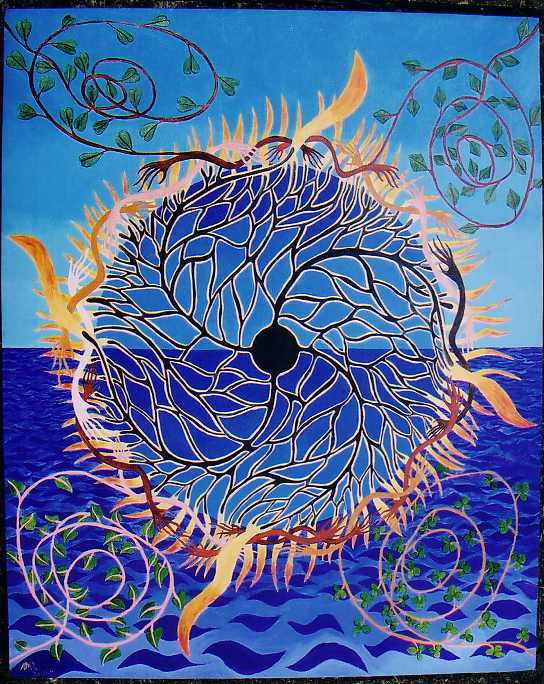
Our overly rationalistic mind desires to turn the intangible into the tangible so it can define, abstract, name and categorise ‘it’. Yet space is inescapably an intangible, immaterial, receptive presence. As an intuitive, perceptive feeling we can perhaps get closer to an understanding of space by saying that ‘being’ is spatial and ‘becoming’ is energetic; that way we sense and feel the divergent yet convergent difference of space and energy as receptive presence and responsive presence. It is this co-creativity of receptivity and responsiveness which manifests flow-forms as yin-yang configurations of space-energy.
Rationalistic science and mathematics compels us to draw an imaginary hard line or ‘discontinuity’ between ‘self’ and ‘other’. Our prevalent view is of the individual ‘self’ or organism as an exception from its spatial neighbourhood, separated by a discrete boundary. In reality, it is the variable semi-permeability of an organism’s, and indeed any natural form’s, distinguishing boundary – its free permeability to space but variable permeability to energy – which enables it both to be present and evolve ( to ‘become’) as a changeable identity locally included within and influencing its natural neighbourhood.
There is nothing entirely discrete and detached in nature, rather there is a natural communion of each within other – space in energetic form and energetic form in space.
‘In nature, everything is distinct, yet nothing defined into absolute, independent singleness’ William Wordsworth.
This insight from William Wordsworth goes to the heart of the paradox of our prevalent paradigm. Rather than space providing a gap between discrete objects, it is the presence of openness as a receptive quality that induces ‘flow’. This presence is what enables a flow-form relationship to come about. Infinite space and local energy combine in the reciprocal fluid arrangements of ‘yin’ and ‘yang’ to co-create natural diversity; distinctness without singleness; attunement of each within other’s reach; co-creative participation rather than separation. As living creatures we are neither entirely independent nor interdependent. But we are, inescapably, intradependent – inclusions of space within energetic interfacings and energetic interfacings within space.
We are One yet Many.
To explore nature’s inspiration further, join the Face Book community here
Living With Opposite-Mindedness
The Emergence of a Natural Inclusional Guide to Self-Sustenance
By Alan Rayner
Alan Rayner is a British scientist and originator of a scientific-philosophy called ‘Natural Inclusionality’ . Here he wears his heart on his sleeve and in-so-doing shares with us his trials, tribulations and profound insights.
Since childhood, I have been one of those people who is quick to recognise and appreciate the truths and falsehoods on both sides of an argument, rather than feel obliged to favour one over the other. Possibly I developed this ability through being the offspring of an acutely analytical yet nature-loving father and a broadly intuitive yet socially and politically active mother. Despite their deep and lasting love for each other and for me, their sometimes violent arguments and actions often left me feeling stranded in the middle and sometimes a target of their opposing attitudes of mind. This led me to ‘see’, through my child’s eye view and peace-making efforts, the need both for a way of distinguishing between individual identities and a way of including them within each other’s influence as co-creative partners, not opponents. Nothing could be more natural and obvious, I have always thought and felt.
Beyond Hierarchies – Inspired By Nature
The network has been recognised as the basic pattern of organisation in all living systems.

Ecosystems in nature are essentially networks of organisms. As Fritjof Capra points out, organisms themselves are networks of cells, and cells networks of molecules. An ecosystem is a flexible, responsive, ever-fluctuating network. Its flexibility is a consequence of multiple dynamic sense-and-respond feedback loops that keep the system in a state of dynamic balance. No single variable is maximised; all variables fluctuate in concert around a collective optimum.
Ecosystems in human nature are essentially networks of communication, social networks of relationships and business ecosystems of partnerships.
People are empowered by being connected to the network, where the success of the whole community depends on the success of each member and vice versa. Empowerment of individuals empowers the network; likewise empowerment of the community empowers the individuals.
So often in today’s business and social paradigm, we perceive the world as parts, as mechanical, as inputs and outputs, linear chains and hierarchies; whereas life is actually about networks and interconnecting relationships. Manuel Lima talks of a mental shift to network thinking where hierarchical thinking is no longer adequate for the inter-connected complexity of today’s world. Alan Moore points to adapting in a non-linear world, where ‘companies become clubs or user groups of co-evolved customers’. In his book, No Straight Lines, Alan Moore explores the ‘law of the ecosystem’ where mutuality is what encourages a healthy, resilient ecosystem. He points to the Japanese mobile industry and its iMode ecosystem, Apple’s iTunes/iOS and Google’s Android platform as ecosystems that thrive based on principles of mutuality within content and service provision. He also explores how playfulness/experimentation and participatory/sharing cultures greatly help the emergence of healthy, thriving ecosystems; re-balancing our focus on metrics and output with more focus on experimenting and learning together.
Part of the transformation afoot is a paradigm shift in our thinking and perceiving:
Linear –> network
Dictate –> empower
Bureaucracy –> community
Predictability –> emergence
Mechanistic thinking –> ecological thinking

Neuroscientist Iain McGilchrist explores left-brain dominance in our Western culture. The left brain, according to McGilchrist’s findings, focuses on parts of the problem, decontextualising and abstracting the problem in a closed system. This, of course, helps us to analyse and find a solution to that problem. But this is a solution in its isolated closed system, not in a living, emergent, volatile business environment. The right brain is what interconnects, provides living world context, views things in an open system and develops a broad understanding. It is both the knowledge of the parts (left brain) and wisdom of the whole (right brain) that we need for complete and proper problem understanding and correct solution creation. To quote Einstein, “The intuitive mind is a sacred gift and the rational mind is a faithful servant”. For McGilchrist, “we have created a society that honours the servant but has forgotten the gift”
Core to the power of networks is an understanding of the world we live in as emergent and ever-changing nested networks of systems within systems working through interconnected relationships. The relationships are just as (if not more) important than the inputs and outputs.
The rational mind struggles to cope with complexity, but the intuition can do this quite effortlessly. Re-connecting with our intuition by creating silence and space for our minds to re-balance both left and right hemispheres is fundamental to realising transformational change (in business and beyond).

Patrick Andrews points out, in a blog for the Ellen MacArthur Foundation, that the governance processes in our businesses are not designed for systems-thinking and emergence, they have been designed for the Industrial Era, hence left-brain dominance prevails where the rational reductionist mind master’s over the intuitive, relational mind. To Patrick ‘It is time, to start experimenting with the corporate structure.’ As Margaret Wheatley put it, ‘Organisations of all kinds are cluttered with control mechanisms that paralyze employees and leaders alike… We never effectively control people with these systems, but we certainly stop a lot of good work from getting done.’
Part of the challenge we face is perceiving relationships in life in looking beyond the more obvious and tangible material component parts; this was examined in depth by Gregory Bateson, amongst others. Bateson, upon exploring nature and human nature, begun to realise that nature can provide immense depth of inspiration for humanity in understanding itself as well as understanding how best to live on Earth. A quote from one of his book’s Mind and Nature by way of example:
On the whole, it was not the most crudest, the simplest, the most animalistic and primitive aspects of the human species that were reflected in the natural phenomena. It was, rather, the more complex, the aesthetic, the intricate, and the elegant aspects of people that reflected nature. It was not my greed, my purposiveness, my so-called “animal,” so-called “instincts,” and so forth that I was recognizing on the other side of that mirror, over there in “nature.” Rather, I was seeing there the roots of human symmetry, beauty and ugliness, aesthetics, the human being’s very aliveness and little bit of wisdom. His wisdom, his bodily grace, and even his habit of making beautiful objects are just as “animal” as his cruelty. After all, the very word “animal” means “endowed with mind or spirit (animus).”
As our linear, competitive, reductionist thinking (which, alas, schools and colleges still in the main teach as being the best way to approach life) shifts to more networked, emergent ways of engaging and empowering ourselves, we start to see that everyone participates and contributes to the network, and we start to see inspiration all around us in ourselves and nature. Rather than a ‘dog-eat-dog’ approach to business and life, we start to realise that the spark of life is self-integrating divergent parts networking for a shared goal, this is the power of emergent networks; as Michelle Holliday says ‘divergence within convergence’ is what ensures life thrives.
Whether it be facebook and pinterest or crowd-funding and co-innovation, new frameworks thrive by encouraging connectivity and community; hence transforming the old paradigm and out-dated ways of viewing life (power, competition and control) to new ways (empowering, collaborating and connecting).
Re-connecting with our authentic human nature and the natural world around us is one of the most joyous and yet pivotal actions we can undertake on our individual and collective journey towards sustainable living, working, doing and being.
To explore ‘business inspired by nature’ further, join the Face Book community here
View a short video clip on business inspired by nature here
See here for the recently released North American version of The Nature of Business.
 The Nature of Business